Recent POST






Traveling internationally while on blood thinners doesn’t have to be scary-but it does need planning. If you’re taking warfarin, rivaroxaban, apixaban, or any other anticoagulant, your biggest worry isn’t the flight itself. It’s what happens when you sit still for hours, your blood thickens, and a clot forms. Deep vein thrombosis (DVT) isn’t rare during long trips. For people on anticoagulants, the risk is lower than for others, but skipping doses or ignoring simple precautions can turn a safe trip into a medical emergency.
Why Travel Increases Your Risk of Blood Clots
Sitting for more than four hours-whether on a plane, train, or car-slows blood flow in your legs. That’s when clots can start forming. It’s not about economy class. It’s about immobility. The CDC found that the risk of a travel-related blood clot doubles after four hours of sitting. For someone with no other risk factors, the odds are still low: about 1 in 4,656 flights. But if you’re over 40, have a BMI over 30, had surgery in the last three months, or have a history of clots, your risk jumps to 1 in 1,000. And if you’re on anticoagulants but skip doses? That risk spikes even higher.Are You High Risk? Know Your Factors
Not everyone needs the same level of caution. The CDC and American College of Chest Physicians list clear risk factors that change your plan:- Age over 40 (risk goes up 10% every decade after 40)
- BMI of 30 or higher
- Recent surgery or injury (within the last 3 months)
- Active cancer or cancer treatment
- Previous blood clot (DVT or pulmonary embolism)
- Family history of clotting disorders like Factor V Leiden
- Pregnancy or within 3 months after giving birth
- Using estrogen-based birth control or hormone therapy
- Heart failure (NYHA Class III or IV)
- Chronic lung disease like COPD
- Leg cast or central venous catheter
If you have one or more of these, you’re in the high-risk group. That means you need more than just taking your pills. You need a full strategy.
Medication Matters: Warfarin vs. DOACs
If you’re on warfarin, your life is more complicated. You need regular INR tests to make sure your blood is thin enough-not too thin, not too thick. The target range is usually 2.0-3.0 for atrial fibrillation, and 2.5-3.5 for mechanical heart valves. Before you travel, get an INR check within two weeks. If your trip is longer than two weeks, or your INR swings a lot, consider buying a portable monitor like the Roche CoaguChek® Mobile. It costs about $299, and each test strip is $7.49. For frequent travelers, that’s cheaper than flying home for a blood test.If you’re on a DOAC-like rivaroxaban, apixaban, or dabigatran-you’re luckier. These don’t need blood tests. They work fast (within 2 hours), have fewer food interactions, and are easier to manage across time zones. But they’re expensive. Rivaroxaban runs around $575 for a 30-day supply. Warfarin? About $4. That’s a big difference. Still, DOACs are the better choice for travel if you can afford them.
Don’t take extra blood thinners just because you’re flying. Aspirin won’t help, and adding another anticoagulant increases bleeding risk without lowering clot risk. The ACCP says this clearly: if you’re already on therapeutic anticoagulation, don’t add more.
Compression Stockings: Simple, Effective, Underused
Wearing compression stockings isn’t optional if you’re high risk. They squeeze your legs just enough to keep blood moving. The CDC and ACCP both recommend below-knee stockings that give 15-30 mmHg of pressure at the ankle. Make sure they fit right-too tight or too loose won’t help. Wear them for the entire trip, even if you’re only flying for six hours. Don’t wait until your leg swells to put them on. Put them on before you leave the house.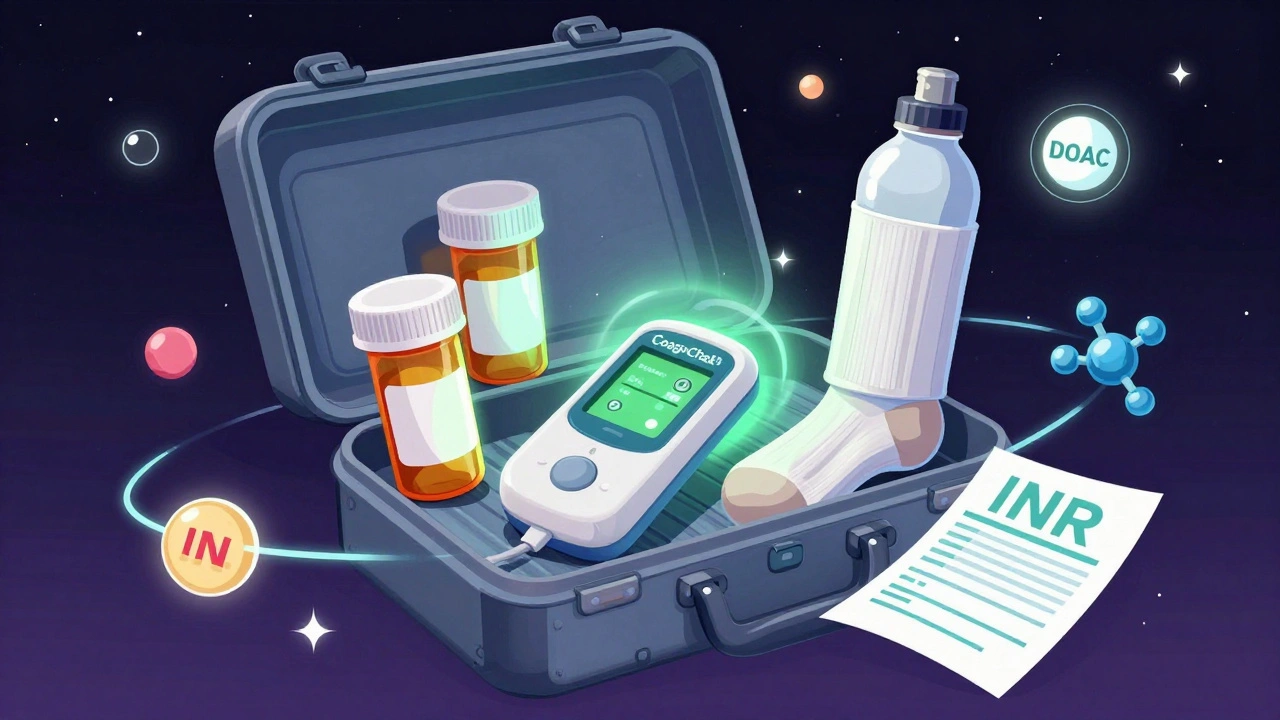
Move. Even When You Don’t Want To.
You’ve heard it before: get up and walk. But here’s the truth: most people don’t do it. You don’t need to sprint down the aisle. Just stand up every 2-3 hours. Walk to the bathroom. Stretch your legs. If you’re in a window seat, do seated calf raises every 30 minutes. Flex your feet. Point your toes up, then down. Do 10 reps. It sounds silly, but it keeps blood flowing. A 2023 study from UT Physicians found that travelers who moved regularly had 60% fewer clot symptoms than those who didn’t.Hydration: Water Over Wine
Alcohol and sugary drinks dehydrate you. Dehydration makes your blood thicker. That’s a recipe for clots. Drink water. Aim for at least one glass per hour during your flight. Bring a refillable bottle. Skip the soda, the juice, and the free wine. Even if you’re tired, water is your best friend.What If You’ve Had a Clot Recently?
This is where things get tricky. Cambridge University Hospitals says don’t fly within four weeks of a DVT or PE. The IATA Medical Manual says you can fly as soon as you’re asymptomatic and stable on anticoagulants. No time frame given. So what do you do?Listen to your doctor. If you had a recent clot, your doctor knows your clotting risk better than any guideline. But here’s a general rule: if you’re still on pain meds, still swollen, or still feeling short of breath, wait. If you’re back to normal, taking your meds on time, and your doctor says it’s okay, then go. But don’t skip the compression stockings or the movement. Even if you’re cleared, your body is still healing.

What to Pack: Beyond Your Pills
Don’t just throw your meds in your suitcase. Pack a travel kit:- Original prescription bottles with your name and the doctor’s contact info
- A printed copy of your most recent INR result (if on warfarin)
- A list of all your medications: generic names, doses, and why you take them
- Compression stockings
- Water bottle
- Small bottle of hand sanitizer (to clean your hands before any self-injection)
If you’re flying to a low-income country, check if your DOAC is even available there. Apixaban isn’t sold in 32% of them, according to WHO data. If you’re on apixaban and your destination doesn’t carry it, bring enough for the whole trip-and then some. Extra days in case of delays.
Know the Warning Signs
Clots don’t always show up during the flight. They can appear days or even weeks later. Watch for:- Swelling in one leg (72% of DVT cases show this)
- Pain or warmth in your calf
- Sudden shortness of breath
- Chest pain that gets worse when you breathe
- Unexplained cough, sometimes with blood
These are signs of a pulmonary embolism-a clot that traveled to your lungs. It’s life-threatening. If you feel any of these, get to a hospital immediately. Don’t wait. Don’t assume it’s just muscle soreness.
Also watch for bleeding: unusual bruising, nosebleeds that won’t stop, pink or red urine, dark or bloody stools. Too much blood thinning can be just as dangerous as too little.
Time Zones and Dosing: Don’t Get Confused
If you’re on warfarin, take your pill at the same clock time every day-not the same circadian time. If you fly from Perth to London and lose 8 hours, don’t take your pill at 8 p.m. your old time. Take it at 8 p.m. local time. Your body doesn’t care about your internal clock. It cares about the schedule you keep. If you’re unsure, set a phone alarm. Write it down. Ask your pharmacist for a dosing plan before you leave.What’s Next? Research Is Still Evolving
The MARVEL trial, which started in 2022, is testing whether a single dose of rivaroxaban before a long flight can safely prevent clots in high-risk travelers. Results are expected in late 2024. If proven effective, this could change guidelines. But until then, stick to what works: take your meds, move often, wear stockings, drink water.Four million Americans are on long-term anticoagulants. About 65% of them travel every year. Most do it safely. You can too. It’s not about avoiding travel. It’s about preparing for it.
Can I fly after having a deep vein thrombosis?
Yes, if you’re asymptomatic and stable on anticoagulant therapy. The IATA Medical Manual allows flying once symptoms are gone and your treatment is steady. But many doctors recommend waiting at least four weeks after diagnosis to reduce the chance of a new clot forming during travel. Always check with your doctor before booking a trip.
Should I take aspirin before flying if I’m on blood thinners?
No. Taking aspirin in addition to your prescribed anticoagulant increases your risk of bleeding without reducing your risk of clots. The American College of Chest Physicians advises against it. Your current medication is already doing the job. Adding more doesn’t help-it just makes bleeding more likely.
Do compression stockings really work for preventing DVT?
Yes, if they’re the right kind. Below-knee graduated compression stockings with 15-30 mmHg pressure at the ankle are proven to reduce swelling and improve blood flow. They’re especially helpful for high-risk travelers. But they must fit properly. Loose or too-tight stockings won’t help. Wear them from the moment you leave home until you reach your destination.
Can I drink alcohol while on anticoagulants during travel?
Moderation is key. Heavy drinking can interfere with how warfarin works and increases bleeding risk. It also dehydrates you, which makes your blood thicker and raises clot risk. One glass of wine occasionally is usually fine, but don’t binge. Stick to water as your main drink during flights and long trips.
What if I forget to take my blood thinner on a flight?
If you miss a dose, take it as soon as you remember-unless it’s almost time for your next one. Don’t double up. For DOACs like rivaroxaban, missing one dose slightly increases clot risk, but it’s not an emergency. For warfarin, missing a dose can cause your INR to drop quickly. If you’re unsure, call your doctor or anticoagulation clinic. Always carry your medication list and doctor’s contact info with you.
Are DOACs safe to use in all countries?
No. While DOACs are widely available in high-income countries, they’re not always accessible in low- and middle-income countries. Apixaban, for example, isn’t sold in 32% of countries according to WHO data. Before you travel, check if your medication is available at your destination. Bring enough for the entire trip plus extra in case of delays. Never rely on being able to refill abroad.
How long after travel can a blood clot still develop?
Up to eight weeks. Many people assume the risk ends when the flight lands. But clots can form days or even weeks later, especially if you were inactive after arriving. Stay alert for swelling, pain, or breathing trouble for at least two months after your trip. Don’t ignore symptoms just because you’re home.

Charles Moore
Just got back from a 14-hour flight to Dublin while on apixaban-wore my compression socks the whole time, drank water like it was my job, and set three phone alarms for doses. No clots, no drama. Seriously, it’s not rocket science. Just don’t be lazy. Your legs will thank you.
Also, skip the free wine. I know it’s tempting, but your blood doesn’t care how fancy the airline thinks it is.

Rashi Taliyan
OMG I just had a DVT last year and flew 3 weeks later-my doctor nearly had a heart attack. But I did everything right: socks, water, walks every hour, no alcohol, and I brought my INR report printed in triplicate. I cried when I landed. Not from sadness-from relief.
Y’all need to take this seriously. It’s not ‘maybe’-it’s ‘I might die if I don’t.’

sagar bhute
Wow. So we’re supposed to believe that a $300 monitor is better than just not flying? People on warfarin are already walking time bombs. Why not just stay home? Or better yet-why are we even letting people on anticoagulants travel at all? This is just corporate fear-mongering wrapped in a CDC pamphlet.

Albert Essel
One thing no one mentions: the real danger isn’t the flight-it’s the taxi ride from the airport to your hotel when you’re exhausted, your legs are stiff, and you haven’t moved in 8 hours. I’ve seen it. People sit in a cab for 45 minutes, then collapse in their room. Move before you even sit down. Stretch in the airport terminal. Do calf raises while waiting for your bag. It’s not about the plane-it’s about the whole damn journey.
And yes, DOACs are worth the cost. I switched from warfarin after three INR freakouts abroad. Worth every penny.

Gavin Boyne
Let me get this straight: we’ve got a 65% travel rate among 4 million Americans on blood thinners, and the only advice is ‘drink water and flex your toes’? No wonder people think medicine is a cult.
Meanwhile, in India, someone’s taking warfarin with chai and a side of street food, and somehow they’re fine. In Germany, they prescribe compression socks like they’re sunglasses. In the U.S., we turn anticoagulants into a Netflix documentary with a checklist.
Maybe the real problem isn’t the clot-it’s that we’ve turned survival into a productivity hack.

Rashmin Patel
Y’all are overcomplicating this. I’m from Mumbai, on rivaroxaban, and I fly to Dubai every 6 weeks. I don’t have a portable monitor. I don’t even own compression socks. I just drink water, walk the terminal, and never skip a pill. I’ve never had a clot. My uncle flew from Chennai to Toronto on warfarin with no INR check and lived to tell it. The real issue? We’re scared of our own shadows.
But if you want to buy a $300 gadget and wear socks like you’re modeling for Lululemon-go ahead. I’m not judging. Just don’t act like you’re the only one who’s ‘doing it right.’ 😌
Also, if you miss a dose? Chill. Take it when you remember. Don’t panic. Your body isn’t a spreadsheet.

Kara Bysterbusch
As someone who manages anticoagulant therapy for elderly patients across three continents, I can attest that the most dangerous variable is not the medication, the flight, or even the time zone-it is the assumption that ‘it won’t happen to me.’
The data is unequivocal: immobility, dehydration, and inconsistent dosing are the trifecta of thrombotic catastrophe. Compression stockings are not a suggestion; they are a biomechanical imperative. Hydration is not a lifestyle trend; it is a physiological necessity. And the notion that aspirin offers additive protection? A dangerous myth with lethal consequences.
Let us not confuse accessibility with advisability. Just because a DOAC is unavailable in a country does not mean it is safe to substitute it with unregulated alternatives or to discontinue therapy. The ethical imperative is to plan, prepare, and prioritize-not to gamble with physiology.
Travel is not a privilege reserved for the perfectly healthy. It is a right that must be earned through diligence. And those who dismiss these measures as ‘overcautious’ misunderstand the very nature of chronic disease management: it is not about avoiding risk-it is about managing it with precision, humility, and unwavering consistency.

Cindy Lopez
Wow. So you’re telling me I need to buy socks, a $300 machine, and stop drinking wine to fly? And this is the advice for millions of people? I’m just glad I’m not on blood thinners. This is like being told you can’t breathe without a permit.
Write a comment