Recent POST


For someone with end-stage renal disease (ESRD), dialysis isn’t just a medical procedure-it’s a lifestyle. And for many, doing it at home changes everything. Home hemodialysis lets you take control of your treatment, not the other way around. But it’s not as simple as plugging in a machine. It requires training, planning, and support. If you’re considering home hemodialysis, you need to know what it really means-how often you’ll dialyze, how long training takes, and what kind of results you can expect.
What Home Hemodialysis Actually Involves
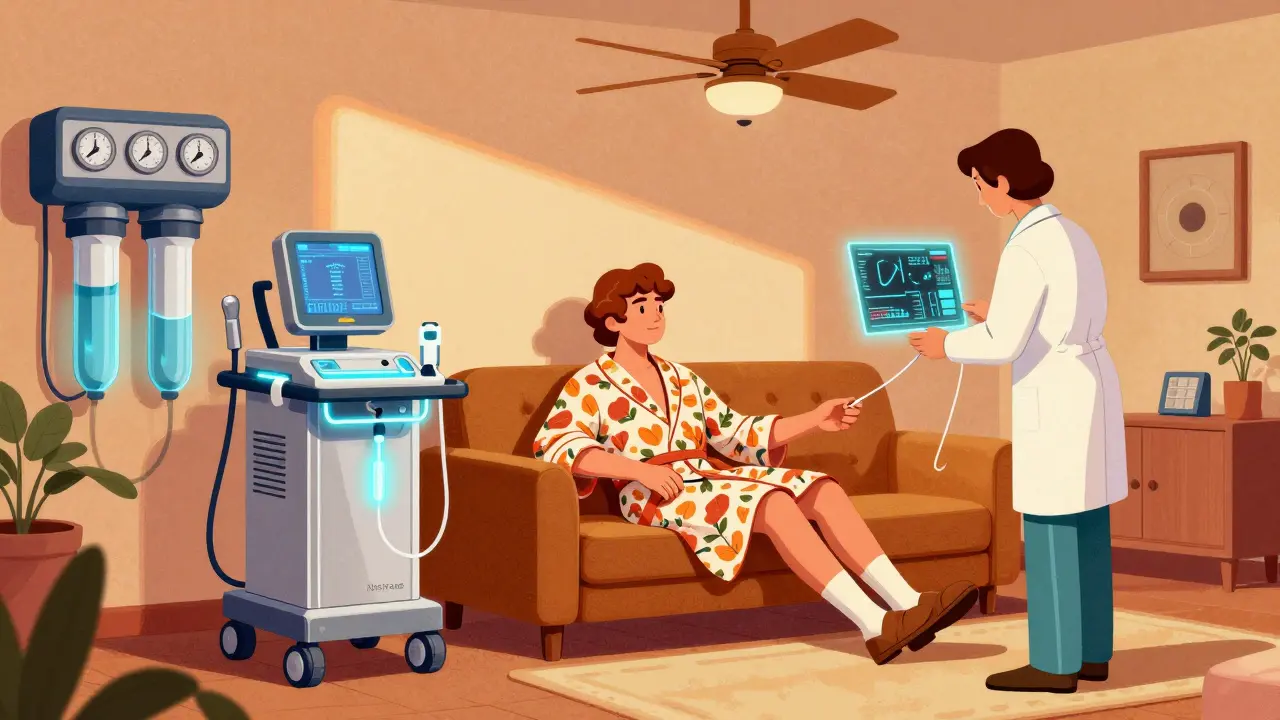
Home hemodialysis means you do your dialysis treatments in your own house, using a machine that filters your blood the same way a center does. But instead of going to a clinic three times a week, you choose when and how often you do it. This isn’t a new idea-it’s been around since the 1960s-but it’s only in the last decade that it’s become practical for most people. Machines like the NxStage System One and newer models from Fresenius are smaller, quieter, and easier to use. They connect to a standard electrical outlet and require a dedicated water line and drain. You don’t need a basement or a special room-just about 6 feet by 6 feet of clear space.
The biggest shift isn’t the machine. It’s the mindset. You’re no longer a patient waiting for an appointment. You’re the one managing your care. That means learning how to set up the machine, handle the tubing, insert needles into your vascular access, and respond to alarms. It sounds intimidating, but thousands of people do it every day. The key is training-and not just any training. It has to be thorough.
Training Takes Time-And It’s Not One-Size-Fits-All
Some programs promise you’ll be ready in three weeks. Others say it’ll take up to three months. The truth? It depends on you. Most people need between four and six weeks of training, with sessions lasting three to five hours each. That’s around 20 to 30 supervised treatments before you’re cleared to go solo. But here’s the catch: you’re not doing this alone. Medicare covers up to 25 training sessions, and your care partner must go through the same training.
Training isn’t just about pushing buttons. You’ll learn how to:
- Set up your treatment area and keep it clean
- Check water quality and maintain the reverse osmosis system
- Insert needles into your fistula or graft (self-needling is a major milestone)
- Calculate fluid removal goals based on weight and diet
- Monitor blood pressure before, during, and after treatment
- Recognize signs of trouble-like low blood pressure, air in the line, or bleeding
- Order and store supplies without running out
- Document every session in a logbook or digital app
One of the hardest parts? Learning to needle yourself. About 45% of patients struggle with this at first. Some find it easier to start with a care partner doing the needling, then gradually take over. Programs like the one at the University of Washington use virtual reality simulators to practice needle insertion before touching real skin. That approach has boosted competency rates from 78% to 92%.
And yes, your care partner needs to know all of this too. In fact, most programs require that you always have someone trained with you during treatment. That’s not optional. The Maryland Department of Health and other state agencies make this clear: “The patient cannot dialyze alone.” That rule exists because complications can happen fast. A sudden drop in blood pressure, a disconnected line, or an alarm you don’t recognize-these aren’t theoretical risks. They’re real. And they need a second set of hands.
Three Main Schedules-Each with Different Benefits
Not all home hemodialysis is the same. You get to pick your schedule, and that choice affects how you feel, what you can eat, and even how long you live.
Conventional Home HD: Three times a week, three to four hours per session. This looks like the center schedule, but you can do it at 8 p.m. instead of 10 a.m. It’s a good starting point if you’re new to home dialysis. But it doesn’t offer the same benefits as more frequent treatments.
Short Daily HD: Five to seven times a week, two to three hours per session. This is where things get powerful. Studies show this schedule lowers mortality risk by 28% compared to in-center dialysis. Why? Because your body isn’t overwhelmed with toxins and fluid all at once. Blood pressure improves. Heart strain drops. Left ventricular mass decreases. You wake up feeling less tired. A 2021 study in the Clinical Journal of the American Society of Nephrology confirmed this pattern across thousands of patients.
Nocturnal HD: While you sleep. Three to seven nights a week, six to ten hours per session. This is the most effective version for clearing waste. Phosphorus levels drop by 42% compared to conventional dialysis. That means fewer phosphate binders-on average, 3.2 fewer tablets a day. Sleep quality often improves because you’re not feeling bloated or itchy. But it’s not for everyone. You need a quiet space, a partner who can handle alarms in the middle of the night, and a machine designed for long sessions.
The data doesn’t lie: more frequent dialysis equals better outcomes. But it also demands more from your life. You’ll need to plan meals, sleep, and social time around your schedule. And you’ll need to be disciplined about logging treatments and tracking weight.
Outcomes: Better Survival, Better Quality of Life
People who do home hemodialysis live longer. The U.S. Renal Data System found home patients had 15-20% lower mortality rates than those staying in centers. That gap shrinks if you compare only frequent home dialysis users-but even then, the advantage holds.
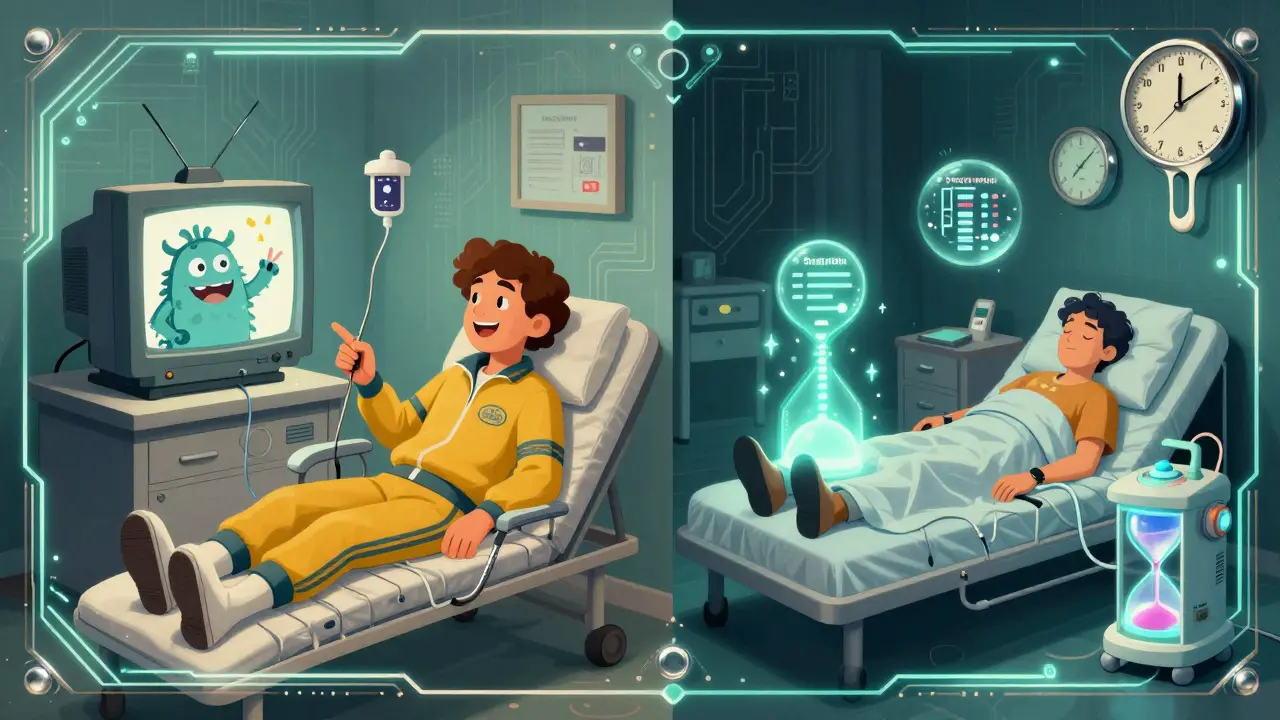
Quality of life is even clearer. A 2019 review in the American Journal of Kidney Diseases showed home dialysis patients scored 37% higher on quality-of-life surveys. Why? They’re not spending 12 hours a week commuting to a clinic. They’re not stuck in a chair watching TV while machines hum around them. They’re cooking dinner after dialysis. They’re taking their grandkids to the park. They’re sleeping through the night.
But it’s not all smooth sailing. On forums like Reddit and the American Association of Kidney Patients, common complaints include:
- Machine alarms going off at 3 a.m.
- Running out of supplies and having to call for replacements
- Strain on relationships because the care partner feels like a nurse, not a spouse
- Anxiety about handling emergencies alone
Still, 92% of users on DaVita’s patient portal say flexibility is the biggest win. And 85% report more energy. That’s not just anecdotal-it’s measurable.
What You Need at Home
You don’t need a hospital. But you do need a few things:
- Space: A 6x6 foot area for the machine, supplies, and water system.
- Water: A dedicated line with 40-80 psi pressure and a reverse osmosis (RO) system. Monthly water cultures and annual chemical tests are required by law.
- Electricity: A dedicated 120-volt, 20-amp circuit. No extension cords.
- Drain: A floor drain or special sink setup to handle waste fluid.
- Storage: A locked cabinet for supplies-sterile tubing, needles, disinfectant, and dialysate.
If you travel? Standard machines aren’t portable. But the NxStage System One is small enough to fit in a suitcase. With planning, you can dialyze in hotels or even while visiting family. Just make sure the destination has a working water line and power outlet.
Barriers Still Exist-And They’re Not Just Technical
Despite the benefits, only 12% of U.S. dialysis patients use home hemodialysis. Why? Three big reasons:
First, access. Only 12% of dialysis centers offer home training. If you live in a rural area, you might have to drive 100 miles for your first session.
Second, training capacity. Nephrologists say 71% of clinics don’t have enough staff to train patients properly. Training takes time-and Medicare doesn’t pay enough for it. That’s why some centers push patients toward peritoneal dialysis, which requires less staff time.
Third, the care partner requirement. About 30% of potential candidates don’t have someone reliable to help them. Spouses get sick. Children move away. Friends can’t commit. That’s not a failure-it’s a systemic gap. Solo home dialysis is possible with newer machines and safety features, but it’s still rare and heavily regulated.
Experts agree: the biggest predictor of success isn’t technical skill. It’s psychological readiness. Dr. Steven Weisbord from the University of Pittsburgh says, “The most critical factor for successful home hemodialysis isn’t technical skill but psychological readiness and social support structure.”
What’s Changing in 2026
The future is getting brighter. The 2021 Advancing American Kidney Health initiative aimed for 80% of new ESRD patients to start on home dialysis or transplant by 2025. That goal won’t be met-but progress is happening.
New FDA-approved devices like the WavelinQ endoAVF system make vascular access easier. Medicare’s 2025 reimbursement changes will tie payments to patient outcomes, not just treatment location. That means centers will be incentivized to train more people for home dialysis.
And the data keeps piling up. More frequent dialysis means better survival. Better nutrition. Fewer hospital visits. Less medication. A real chance to live-not just survive.
Is Home Hemodialysis Right for You?
Ask yourself:
- Do you have someone who can be with you during every treatment?
- Are you comfortable learning new skills and managing your own care?
- Can you handle the responsibility of setting up, monitoring, and cleaning the machine?
- Do you want more control over your schedule-and are you willing to plan around it?
If you answered yes to most of these, home hemodialysis could be the best thing you’ve ever done for your health. It’s not easy. But it’s worth it.
How long does home hemodialysis training usually take?
Most people need between four and six weeks of training, with sessions lasting three to five hours each. That adds up to about 20 to 30 supervised treatments. Some programs can finish in as little as three weeks if the patient already knows how to needle themselves. Others take up to 12 weeks, especially if there are learning delays or complex health needs. Medicare covers up to 25 training sessions, and both the patient and care partner must pass written and practical exams before going home.
Do you need a care partner for home hemodialysis?
Yes, in nearly all cases. Most state health departments and dialysis programs require that a trained care partner be present during every treatment. This isn’t just a recommendation-it’s a safety rule. Complications like low blood pressure, bleeding, or machine alarms can happen quickly. A second person can respond, call for help, or stabilize the situation. Solo home dialysis is possible with newer machines and safety features, but it’s rare, heavily regulated, and not offered by most centers.
What’s the difference between short daily and nocturnal home hemodialysis?
Short daily home hemodialysis means five to seven treatments per week, each lasting two to three hours, done during the day. Nocturnal home hemodialysis means three to seven treatments per week, each lasting six to ten hours, done while you sleep. Short daily improves energy and blood pressure control. Nocturnal is better at removing phosphorus and middle molecules, which reduces the need for phosphate binders. Both are more effective than conventional three-times-a-week dialysis, but nocturnal requires more commitment and a quiet, safe sleeping environment.
Can you travel with a home hemodialysis machine?
It depends on the machine. Standard home hemodialysis machines are large and not designed for travel. But portable systems like the NxStage System One are small enough to fit in a suitcase. With advance planning, you can dialyze in hotels, RVs, or even while visiting family. You’ll need to arrange for water access and power at your destination. Some patients coordinate with local dialysis centers for backup. Always notify your care team before traveling.
Does home hemodialysis really improve survival rates?
Yes. Data from the U.S. Renal Data System shows home hemodialysis patients have a 15-20% lower mortality rate than those on in-center dialysis. The biggest survival benefit comes with more frequent treatments-short daily or nocturnal schedules. These reduce fluid overload, improve heart function, and clear toxins more completely. A 2021 study in the Clinical Journal of the American Society of Nephrology found a 28% lower risk of death for patients on short daily home dialysis compared to conventional in-center treatment, even after adjusting for age and other health conditions.
Next Steps: What to Do If You’re Considering Home Hemodialysis
Start by talking to your nephrologist. Ask if your center offers home training. If not, ask for a referral to a program that does. Don’t wait until you’re on dialysis to start the conversation-begin exploring options early.
Visit Home Dialysis Central or the National Kidney Foundation’s website to read patient stories and watch training videos. Talk to people who’ve done it. Join a support group. Ask about simulator training if your center offers it.
And don’t let the fear of needles or the thought of responsibility stop you. Most people who start home hemodialysis say they wish they’d done it sooner. The learning curve is steep, but the payoff-more energy, more control, more life-is real.

Alvin Bregman
ive been on dialysis for 5 years and i still cant believe people think home hd is easy

Sarah -Jane Vincent
they dont tell you the truth about home hemodialysis. the machines are rigged to fail after 18 months so you have to buy new ones. the water filters are laced with tracking chips. and dont get me started on the care partner requirement-its just a way to get your spouse hooked on the system so they become a full-time nurse for free. the government and big dialysis corps are in cahoots. you think this is healthcare? its a surveillance program with a side of kidney cleanup.

Henry Sy
you people act like home dialysis is some kind of miracle cure. i did it for 11 months. woke up at 3am to alarms, spilled dialysate on my cat, and my wife started calling me "the patient" instead of "husband." i lost 20 pounds and 3 friendships. the only thing better than in-center? not having to see your own face in the mirror every morning knowing you’re a walking machine. and yes i needle myself now. but i dont feel like a hero. i feel like a glitch in the system.

Anna Hunger
While the article presents a comprehensive and evidence-based overview of home hemodialysis, it is imperative to emphasize that patient autonomy must be balanced with rigorous adherence to clinical protocols. The requirement for a trained care partner is not merely procedural-it is a non-negotiable safety standard grounded in peer-reviewed outcomes data. Furthermore, the psychological readiness component, as cited by Dr. Weisbord, must be formally assessed via validated instruments such as the HHD Readiness Scale prior to initiation. Failure to do so increases the risk of non-adherence, which correlates directly with increased hospitalization rates.

shiv singh
why do americans think they can just plug in a machine and fix their body like a car? in india we dont have fancy dialysis machines we just sit under a tree and pray. your kidneys arent broken because of bad water or bad food theyre broken because you lost your soul. you think training for 6 weeks makes you strong? you just trained yourself to be dependent on a machine. real strength is accepting your fate without a reverse osmosis system

Robert Way
just got my nxstage delivered and the box was missing the needle kit and the manual was in spanish. called customer service and they said oh we sent it to your care partner. but i dont have one. so now im stuck with a $15k paperweight. the whole system is a scam. they want you to fail so they can sell you more stuff. also the drain hose is too short and my bathroom is tiny. why dont they make these for normal houses?

Sarah Triphahn
everyone talks about flexibility like its a gift. but flexibility is just another word for isolation. you think you’re in control? you’re just trapped in a 6x6 foot prison with a machine that beeps at you like a prison guard. and don’t get me started on the care partner. you’re not a couple anymore-you’re a medical team. your love life? gone. your sleep? gone. your identity? now it’s "hd patient." you’re not living. you’re just surviving in a very expensive way.

Vicky Zhang
oh my god i just cried reading this. i started home hd 3 years ago and i thought i was going to die. i was scared to needle myself. my husband held my hand through every single session for the first month. now we dance in the kitchen after i finish. i make pancakes. i take my grandkids to the zoo. i sleep through the night. i dont miss a single treatment. yes the alarms scare me. yes the supplies run out. but this? this is living. i wish i had done this 10 years ago. you can do this. you really can. just start with one step. one needle. one day. one breath. you are stronger than you think.

Allison Deming
The assertion that home hemodialysis confers a 15–20% mortality reduction is statistically significant but contextually misleading. This benefit is primarily observed in patients with high socioeconomic status, robust social support networks, and access to consistent supply chains-all of which are not universally available. The article omits critical disparities in rural access and the disproportionate burden placed on female caregivers, who are statistically more likely to be the designated care partner and subsequently experience burnout, depression, and reduced labor force participation. To frame home hemodialysis as a universally beneficial option without addressing structural inequities is not merely incomplete-it is ethically negligent.

Susie Deer
usa has the best machines the best training the best outcomes why arent more people doing this its not rocket science get your act together

TooAfraid ToSay
you americans think you invented dialysis. in nigeria we use solar-powered machines made by our own engineers. you pay $100k for a machine that breaks. we fix ours with duct tape and prayer. your care partner? we have 12 family members who take turns. you call it training. we call it survival. you talk about flexibility. we talk about dignity. you have a system. we have a community. you think you’re ahead? you’re just louder.

Dylan Livingston
how quaint. you all treat home hemodialysis like it’s a lifestyle upgrade. it’s not. it’s a corporate-designed performance metric disguised as empowerment. you’re not choosing freedom-you’re choosing to become a data point for the dialysis conglomerate’s quarterly report. the "better outcomes"? measured by how many patients don’t die before their insurance lapses. the "energy boost"? a placebo effect from being too exhausted to complain. and don’t get me started on the VR needle simulators-how many people actually get to use those? 2%? the rest of us are just learning on real skin while the insurance company counts the pennies saved by not sending us to a clinic.

Andrew Freeman
my wife does the needling and i do the logbook and we still mess up like 3 times a week. the machine beeps like a broken alarm clock. the water filter smells like wet socks. but i can eat a burger on a saturday and not feel like i’m gonna die. i can sleep in. i can watch my kid play soccer. so yeah its a mess. but its our mess. and i’d rather have this mess than the clinic chair with the tv that never works
Write a comment