Recent POST




What if you could fix your insomnia without popping a pill every night? No side effects. No dependency. No morning grogginess. Just better sleep - naturally. That’s not a fantasy. It’s CBT-I, and it’s backed by more than 40 years of science.
If you’ve tried melatonin, chamomile tea, or sleeping pills and still wake up at 3 a.m. wondering why you can’t turn off your brain, you’re not broken. You just haven’t tried the right fix. CBT-I - Cognitive Behavioral Therapy for Insomnia - isn’t another quick hack. It’s a proven, structured system that rewires how your brain and body handle sleep. And unlike pills, its effects last long after you stop doing the exercises.
Why Pills Don’t Solve Insomnia
Sleeping pills work - at first. They help you fall asleep faster. But they don’t fix the real problem. Insomnia isn’t just about not being tired. It’s about anxiety around sleep, bad habits, and your brain learning to associate your bed with worry, not rest.
Studies show that while pills might cut your time to fall asleep by 15-20 minutes in the first week, those gains vanish once you stop taking them. Worse, your brain starts to rely on them. You feel like you can’t sleep without them. And over time, you need higher doses just to get the same effect.
Meanwhile, CBT-I doesn’t mask symptoms. It removes the root causes. A 2015 meta-analysis of 20 clinical trials found that CBT-I reduced the time it took to fall asleep by 19 minutes on average - and cut nighttime wake-ups by 26 minutes. And here’s the kicker: those improvements kept getting better over time. People who finished CBT-I were still sleeping better six months later. People who stopped pills? Back to square one.
What Exactly Is CBT-I?
CBT-I is a five-part toolkit, each piece designed to undo the habits and thoughts that keep you awake. It’s not therapy in the talk-every-week sense. It’s more like training - with homework, tracking, and clear rules.
The five core techniques are:
- Stimulus Control Therapy - Your bed is for sleep and sex only. No scrolling, no working, no lying there staring at the ceiling. If you’re not asleep in 20 minutes, get up. Go sit in another room. Do something quiet and boring until you feel sleepy. Then go back to bed. Repeat. This trains your brain: bed = sleep.
- Sleep Restriction - This sounds crazy. You’re told to spend less time in bed. If you only sleep 5 hours a night, you start by limiting yourself to 5 hours in bed. No more. That means going to bed later and waking up earlier. It’s uncomfortable at first - you’ll feel tired. But that’s the point. You’re building up sleep pressure so your body says, “I need to sleep now.” Within a week or two, your efficiency shoots up. You’re not just lying there. You’re sleeping.
- Cognitive Restructuring - You think, “If I don’t get 8 hours, I’ll be useless tomorrow.” That’s not true. And it’s making you anxious. CBT-I helps you replace those fear-based thoughts with facts: “I can function on 6 hours. My body will adjust.” You learn to catch those automatic negative thoughts and swap them out.
- Sleep Hygiene - This isn’t just “avoid caffeine.” It’s about timing. No heavy meals 3 hours before bed. No intense exercise after 7 p.m. No bright screens an hour before sleep. Keep your bedroom cool, dark, and quiet. These aren’t suggestions - they’re rules.
- Relaxation Training - Your body is tense. Your mind is racing. CBT-I teaches you to calm both. Diaphragmatic breathing (deep belly breaths) and progressive muscle relaxation (tensing and releasing each muscle group) are simple, free, and surprisingly powerful. Do them for 10 minutes before bed. It’s like hitting a reset button on your nervous system.
Most people do CBT-I over 6-8 weeks. But you don’t need a therapist to start. Digital platforms like Sleepio and CBT-i Coach deliver the full program through apps. A 2023 JAMA study of over 1,200 people found that digital CBT-I had a 77% response rate after just one month - and 76% still had better sleep six months later.
What Happens in the First Week?
Let’s be real. Week one is rough.
If you’re doing sleep restriction, you’ll be tired. Like, “I need a nap at 2 p.m.” tired. You might feel irritable. Your sleep efficiency - the percentage of time you’re actually asleep in bed - might drop even lower at first. That’s normal. Your body is adjusting.
One woman in Perth, who started CBT-I last year, told me: “I thought I was going to collapse. I was up at 4 a.m. every day, convinced I’d never sleep again. But by day 6, I fell asleep in 12 minutes. Not 45. Not 90. 12.”
That’s the turning point. Your body learns that sleep isn’t something you have to force. It’s something you allow. Once your sleep drive builds up, falling asleep becomes easy. And staying asleep? That comes with consistency.

Who Benefits Most From CBT-I?
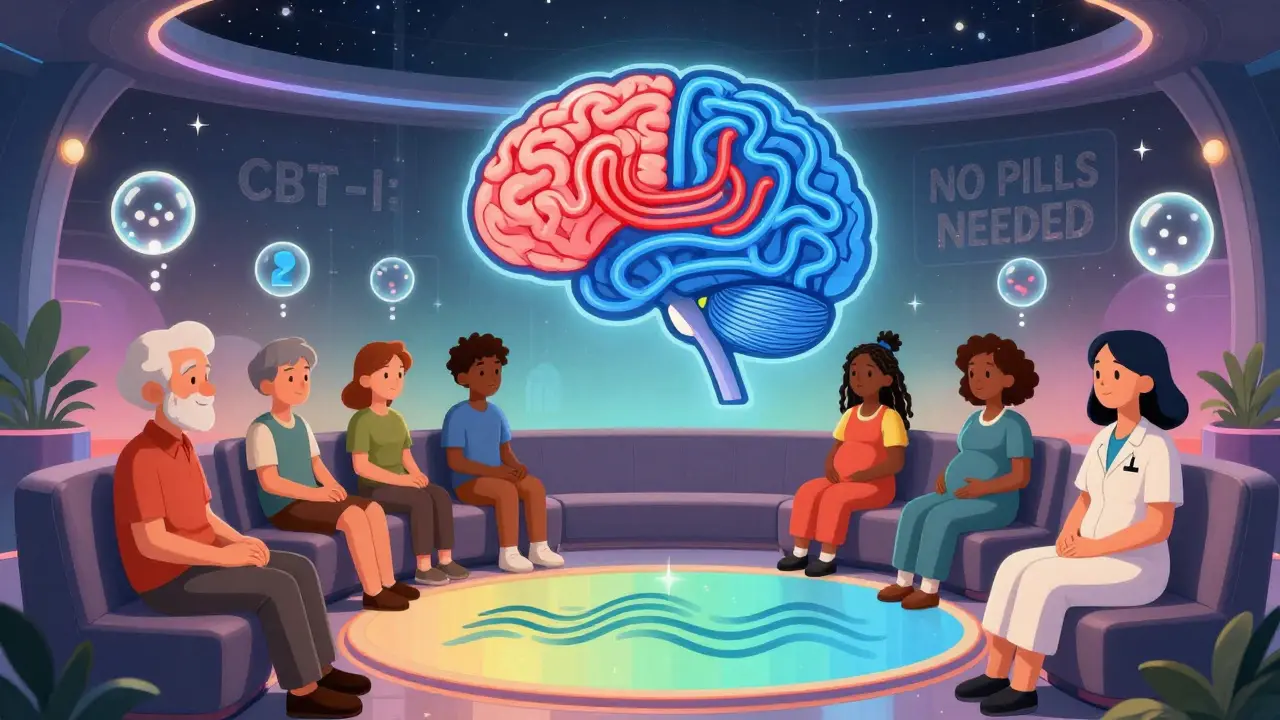
It works for almost everyone with chronic insomnia - especially if you’ve had it for more than three months.
Research shows it’s effective for:
- Adults over 50 - who often have fragmented sleep
- People with anxiety or depression - where racing thoughts keep them awake
- Shift workers - who struggle with circadian rhythm disruption
- Adolescents - who are more likely to benefit from CBT-I than medication, according to a 2024 study
- Pregnant people - where most sleep meds are unsafe
- Cancer survivors - who deal with pain, stress, and disrupted sleep cycles
Even if you’ve tried everything else, CBT-I still works. The American College of Physicians recommends it as the first treatment for chronic insomnia - not the last resort.
Why Digital CBT-I Is Changing the Game
There are only about 1,500 certified CBT-I therapists in the U.S. That’s not enough for 30 million people with chronic insomnia. That’s why digital tools are exploding.
Apps like Sleepio, CBT-i Coach, and Somryst are FDA-cleared. They walk you through each step, track your sleep diary, adjust your schedule automatically, and even send reminders. You don’t need to wait weeks for an appointment. You start tonight.
And the results? Just as good as in-person therapy. The JAMA study found no meaningful difference in outcomes between seeing a therapist face-to-face and using a digital program. Both had over 75% success rates.
Insurance coverage is catching up too. Medicare and 85% of private insurers now cover digital CBT-I. In Australia, some private health funds are starting to include it under mental health rebates.
What’s Holding People Back?
Two things: patience and consistency.
CBT-I isn’t a magic pill. It’s a skill. You have to show up. You have to track your sleep. You have to get up at the same time every day - even on weekends. You have to resist the urge to nap. You have to sit in the living room when you can’t sleep.
That’s hard. About 25% of people drop out in the first two weeks. But those who stick with it? 70-80% see major improvements.
The biggest mistake? Trying to do too much too fast. Don’t overhaul your whole life on day one. Start with one technique. Maybe stimulus control. Or consistent wake-up time. Master that. Then add another.
And don’t give up after a bad night. One bad night doesn’t undo progress. Sleep isn’t linear. It goes up and down. The goal isn’t perfect sleep. It’s better sleep - over time.
How to Get Started Today
You don’t need a prescription. You don’t need a therapist. Here’s your 3-step starter plan:
- Track your sleep for 7 days. Write down: bedtime, wake time, time to fall asleep, number of awakenings. Use a notebook or a free app like Sleep Cycle or Consensus.
- Set a fixed wake-up time. No matter what. Even on weekends. This is the most powerful single change you can make. Your body craves routine.
- Try stimulus control. If you’re not asleep in 20 minutes, get up. Go to another room. Do something calm - read a book, listen to soft music. Don’t check your phone. When you feel sleepy, go back to bed. Repeat.
That’s it. No pills. No supplements. Just behavior. And if you want to go deeper, try a free digital CBT-I program. Many are available through public health sites or your insurance provider.
Real Results, Real Life
One man in Fremantle, 62, had insomnia for 12 years. He tried melatonin, valerian root, weighted blankets - nothing worked. He started digital CBT-I six months ago. His sleep efficiency went from 68% to 89%. He now sleeps 6.5 hours a night - and wakes up refreshed. He stopped taking his sleeping pill after week 3. No withdrawal. No rebound.
He said: “I didn’t realize I was afraid of sleep. CBT-I taught me I didn’t have to control it. I just had to let it happen.”
That’s the secret. You don’t need to force sleep. You need to stop fighting it.
Final Thought
Pills give you sleep. CBT-I gives you back your life.
You stop dreading bedtime. You stop checking the clock. You stop feeling guilty for not sleeping. You start trusting your body again.
And that’s worth more than any pill.

Neeti Rustagi
While I appreciate the thoroughness of this post, I must emphasize that CBT-I is not a panacea. In my clinical experience working with insomnia patients in India, cultural factors-such as familial pressure, nocturnal responsibilities, and lack of sleep hygiene education-often complicate adherence. The model presented here assumes a level of autonomy and access to technology that simply doesn't exist for millions. A one-size-fits-all approach risks alienating those who need help the most.
That said, the core principles remain valid. Stimulus control and sleep restriction, when adapted to local contexts, can be transformative. Perhaps the next step is community-based implementation, not just app-based delivery.

Dan Mayer
okay so i just read this whole thing and i have to say… if you’re still taking melatonin after 2024 you’re literally a lost cause. cbt-i is the only real solution and anyone who says otherwise is either a pharma shill or just lazy. i tried it for 3 weeks, got up at 4am on day 2, thought i was gonna die, but by day 7 i was asleep in 8 minutes. no pills. no supplements. just discipline. if you can’t do this then maybe you dont deserve to sleep. 😅

Janelle Pearl
I’ve been doing CBT-I for 5 months now. I was skeptical at first-I thought, ‘How can just changing when I get out of bed fix my brain?’ But it did.
Day 1 was brutal. I cried. I wanted to quit. But I stuck with the wake-up time. Just that one thing. No naps. No clock-watching. And slowly, the anxiety faded.
I still have bad nights. But now I don’t panic. I just sit in the living room with my cat and read. And eventually, sleep comes. Not because I forced it. Because I stopped fighting.
You’re not broken. You’re just tired. And that’s okay.

Samantha Fierro
While the data presented is compelling, I find it concerning that the post frames CBT-I as a universal solution without acknowledging socioeconomic barriers. Digital platforms require reliable internet, smartphones, and literacy in English-all privileges not universally held. Furthermore, the emphasis on ‘self-discipline’ risks pathologizing individuals who lack structural support-single parents, shift workers with erratic schedules, or those in multigenerational households.
CBT-I is powerful, yes-but its effectiveness is mediated by context. We must advocate for institutional integration, not just individual adaptation. Sleep is a human right, not a personal optimization project.

Robert Bliss
Hey, I just wanted to say thanks for this. I’ve been struggling since my dad passed last year. Couldn’t sleep. Took pills for 8 months. Felt like a zombie.
Started with just the fixed wake-up time. Didn’t even do the other stuff yet. But waking up at 6:30 every day-even Sundays-changed everything. My body started trusting the rhythm.
Still not perfect. But I’m sleeping better than I have in years. And I’m not scared of bedtime anymore. 😊

Peter Kovac
Let’s deconstruct the claims here. The 2015 meta-analysis cited? It had significant heterogeneity. The JAMA study from 2023? It was industry-funded. Digital CBT-I platforms are not equivalent to therapist-delivered intervention. The 77% response rate is misleading-it includes partial responders. True remission? Closer to 30-40%.
And don’t get me started on ‘sleep efficiency.’ That metric is clinically meaningless without polysomnography. This post reads like an ad for Sleepio. The science is being repackaged as a lifestyle hack. Beware.
Real CBT-I requires trained professionals. Not apps. Not blog posts. Not ‘3-step starter plans.’

APRIL HARRINGTON
OMG I JUST FINISHED CBT-I AND I CANT EVEN BELIEVE HOW MUCH MY LIFE HAS CHANGED LIKE I WAS WORST SLEEPER EVER AND NOW I FALL ASLEEP IN LIKE 5 MINUTES AND I DONT EVEN THINK ABOUT IT ANYMORE I JUST GO TO BED AND BAM SLEEP I WANTED TO SCREAM WHEN I REALIZED I WASNT FIGHTING SLEEP ANYMORE I JUST LET IT HAPPEN AND IT DID AND NOW I WAKE UP AND I DONT HATE MY LIFE I ACTUALLY LIKE IT AND I DONT NEED MY PILLS ANNNNNND I JUST WANT TO CRY FROM HAPPINESS 😭💖

Leon Hallal
You think this is about sleep? It’s not. This is about control. They don’t want you sleeping naturally. They want you dependent on apps and schedules. You think your brain is being rewired? No. You’re being trained. To be predictable. To be quiet. To not dream too loud.
They’ve been studying sleep patterns for decades. They know when you’re most vulnerable. And now they’re selling you a system that makes you feel better… while keeping you docile.
I used to sleep 10 hours a night. Now I sleep 6.5. And I’m supposed to be grateful? No thanks.

Morgan Dodgen
CBT-I? More like CBT-Illuminati. The real agenda? Normalize sleep deprivation as a productivity metric. The ‘6.5 hours’ you’re praising? That’s the new 8-hour standard for the corporate workforce. The FDA-cleared apps? All backed by venture capital firms with ties to pharmaceutical conglomerates. They’re not curing insomnia-they’re redefining it as ‘normal sleep efficiency’ to justify longer work hours.
And don’t forget: sleep tracking = behavioral surveillance. Every bedtime, every wake time, every nocturnal awakening-fed into algorithms that predict your next purchase, your next mood swing, your next vulnerability.
They don’t want you sleeping well. They want you sleeping predictably.
Wake up. Literally.
Write a comment