Recent POST





When your blood pressure stays too high for too long, it doesn’t just make you feel off - it quietly damages your heart, kidneys, and brain. That’s why doctors reach for antihypertensives. Among the most common are beta-blockers, ACE inhibitors, and ARBs. But these aren’t interchangeable. Each works differently, carries different risks, and suits different people. Choosing the right one isn’t about what’s newest or most prescribed - it’s about matching the drug to your body and your health history.
How ACE Inhibitors Work - and Why They Cause Cough
ACE inhibitors like lisinopril, enalapril, and ramipril were among the first drugs to prove they could do more than lower blood pressure - they could save lives. Developed in the 1970s and approved in the early 1980s, they block an enzyme called angiotensin-converting enzyme. That enzyme normally turns angiotensin I into angiotensin II, a powerful vasoconstrictor. No angiotensin II? Blood vessels relax. Blood pressure drops. Kidneys also produce less aldosterone, which means less salt and water retention.
But here’s the catch: blocking that enzyme also causes bradykinin to build up. Bradykinin is a natural chemical that helps blood vessels dilate - great for lowering pressure. But it also irritates the throat. That’s why 10-20% of people on ACE inhibitors develop a dry, hacking cough. It’s not an allergy. It’s a side effect built into the drug’s mechanism. For some, it’s mild. For others, it’s constant, sleepless, and unbearable. Studies show 42% of patients on lisinopril report coughing, and 8% stop taking it because of it.
The HOPE trial in 2000 showed ACE inhibitors cut major cardiovascular events by 20-25% in high-risk patients. That’s why they’re still first-line for people with diabetes, kidney disease, or a history of heart attack. But if you’re starting from scratch with high blood pressure and no other conditions? That cough risk might not be worth it.
ARBs: The Quiet Alternative
ARBs - angiotensin receptor blockers - came along in the mid-1990s with losartan as the first. Instead of blocking the enzyme like ACE inhibitors, they block the receptor that angiotensin II binds to. Same result: relaxed blood vessels. Lower pressure. But no bradykinin buildup. No cough.
That’s why ARBs like valsartan, candesartan, and losartan became the go-to for people who couldn’t tolerate ACE inhibitors. Real-world data from over 300,000 patients in 2021 showed ARBs cut cough risk by nearly half compared to ACE inhibitors. Only 15% of ARB users report side effects, compared to 42% on ACE inhibitors. Patient reviews on Drugs.com give ARBs a 7.1/10 average rating versus 5.8/10 for lisinopril.
Are they as good? Yes. The Cochrane review from 2015 found no difference in death rates, heart attacks, or strokes between ACE inhibitors and ARBs. In fact, some studies suggest ARBs might be better for brain health. A 2021 study linked ARB use to slower cognitive decline in older adults, possibly because they don’t trigger inflammation the way bradykinin buildup can.
Still, ARBs aren’t magic. They can raise potassium levels, especially in people with kidney disease. And they’re not safe in pregnancy. But for most people with high blood pressure and no heart failure, ARBs offer the same protection as ACE inhibitors - without the cough.
Beta-Blockers: Slowing Down the Heart
Beta-blockers are older than the other two. Propranolol hit the market in 1964. They work by blocking adrenaline’s effect on the heart. That means slower heart rate, less forceful beats, and lower cardiac output. The result? Lower blood pressure.
But here’s the problem: they’re not great for everyone. In uncomplicated high blood pressure - meaning no heart disease, no diabetes - beta-blockers like atenolol and metoprolol don’t prevent strokes as well as other drugs. The INVEST trial in 2007 showed people on atenolol had a 16% higher stroke risk than those on calcium channel blockers. That’s why most guidelines now say: don’t start here unless you have another reason.
So when do you use them? Three clear cases:
- After a heart attack - beta-blockers cut death risk by 23% in the first year. The COMMIT trial proved this.
- Heart failure with reduced ejection fraction (HFrEF) - carvedilol and bisoprolol cut death risk by 30-35%. But atenolol? Not so much.
- Fast heart rate or arrhythmias - if your heart races without reason, beta-blockers can help.
Side effects? Fatigue is common. Up to 28% of people say they feel drained. Weight gain, cold hands, and worsened asthma are also risks. Newer beta-blockers like nebivolol cause less fatigue - only 14% report it. But even then, they can raise triglycerides and lower HDL (good cholesterol) by 5-10%. If you’re diabetic, that’s a red flag.

When to Switch - And When Not To
Let’s say you’re on lisinopril. You’ve had a persistent cough for six months. You’re tired of it. You switch to valsartan. Within two weeks, the cough is gone. That’s a win.
But what if you had a heart attack last year? Then switching from an ACE inhibitor to an ARB might not be smart. The evidence for ACE inhibitors in post-MI care is stronger. The SAVE trial showed a 19% drop in death risk. That’s not something you give up lightly.
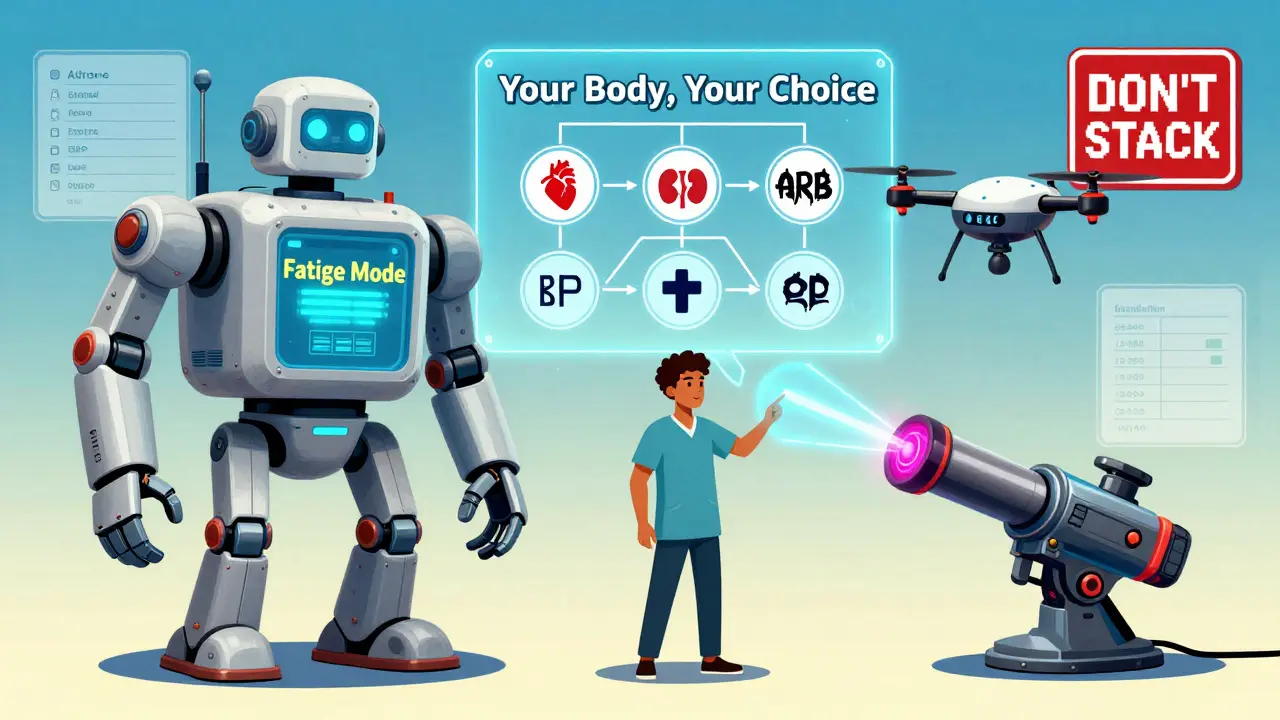
And what about combining them? Don’t. ACE inhibitor + ARB? That combo was tried in the ONTARGET trial in 2008. It didn’t help. It hurt. Kidney failure risk went up 38%. Blood pressure didn’t drop any further. So if you’re on one, stay on one. No stacking.
For people with diabetic kidney disease, ACE inhibitors still win. The RENAAL trial showed they reduce protein in urine 21% better than ARBs. That’s crucial - less protein means slower kidney damage.
What Doctors Are Really Doing
Guidelines say one thing. Real life says another.
A 2022 Medscape survey of 1,500 cardiologists found 68% prefer starting new patients on ARBs instead of ACE inhibitors - not because they’re more effective, but because they’re better tolerated. Fewer side effects mean fewer people quit taking their meds. CVS Health data shows 63% of ARB users stick with their drug after 12 months. Only 57% of ACE inhibitor users do.
But when it comes to heart failure? 82% of cardiologists still start with ACE inhibitors - or better yet, sacubitril-valsartan. That’s the new combo drug (brand name Entresto) that combines an ARB with a neprilysin inhibitor. The PARADIGM-HF trial showed it cut heart failure deaths 20% more than enalapril. It’s not first-line for all high blood pressure - but for HFrEF? It’s now the gold standard.
And beta-blockers? They’re still essential for heart attack survivors and heart failure patients. But for a 55-year-old with no history of heart disease and just high blood pressure? Most doctors now avoid them. They’re not the best for preventing stroke. And the fatigue? It’s real.
Dosing and Real-World Tips
Starting doses matter. Too high too fast? Side effects spike.
- ACE inhibitor: Start with lisinopril 10 mg daily. Max is 40 mg.
- ARB: Losartan 50 mg daily. Max is 100 mg.
- Beta-blocker: Metoprolol succinate 25 mg daily. Max is 200 mg.
For heart failure, go slow. Carvedilol starts at 3.125 mg twice daily. Double every two weeks. It takes months to reach the full dose. Rushing it? You risk low blood pressure, dizziness, and worse symptoms.
Also - don’t forget the combo. Adding a thiazide diuretic like hydrochlorothiazide to any of these three drugs can drop systolic pressure another 20-25 mmHg. That’s often what’s needed to reach target. But avoid combining ACE inhibitors and ARBs. Ever.
The Bottom Line
There’s no single best drug. The best one is the one that works for you.
If you have diabetes, kidney disease, or a history of heart attack - ACE inhibitors are still your best bet. But if you get a dry cough? Switch to an ARB. It’s safe, effective, and you’ll feel better.
If you’ve had a heart attack or have heart failure - beta-blockers are non-negotiable. But if you’re just starting out with high blood pressure and no other issues? Skip them. Go with an ARB or a calcium channel blocker instead.
And if you’re on one of these drugs and feel off - don’t just suffer. Talk to your doctor. Maybe it’s not the drug. Maybe it’s the dose. Or maybe, it’s time to switch.
High blood pressure isn’t a one-size-fits-all problem. Your treatment shouldn’t be either.

Jeremy Van Veelen
This is one of the most lucid, beautifully structured explanations of antihypertensives I’ve ever read. ACE inhibitors causing cough? It’s not a bug-it’s a feature of the drug’s very molecular dance. I’ve had patients quit because of it, and honestly? I get it. That dry, relentless cough is like a ghost haunting your sleep. But here’s the kicker: ARBs don’t fix the problem-they sidestep it. Like choosing a different path around a haunted house. And yes, the data backs it. 7.1/10 on Drugs.com? That’s not a fluke. That’s a revolution in patient adherence.

Gaurav Kumar
I’m from India, and let me tell you-our doctors still push lisinopril like it’s holy water. But my uncle switched to losartan after 8 months of coughing so hard he puked. Now he sleeps. He eats. He walks. And guess what? His BP is LOWER. Why? Because Indians are not lab rats. We don’t need Western guidelines to know when something’s just plain unbearable. #IndianHealthRevolution

Laura Gabel
I hate when people act like ARBs are this magical cure. They’re not. Same side effects, just different ones. And don’t get me started on the potassium thing. My neighbor went into cardiac arrest because her doctor didn’t check her labs. Just say no to lazy prescribing.

Andrew Mamone
I love how this post doesn’t just list drugs-it tells stories. The bradykinin buildup causing cough? That’s biology in motion. And the fact that ARBs don’t trigger it? That’s elegance. 🌿 I’ve been on candesartan for 4 years. No cough. No fatigue. Just steady BP. And yes, I check my potassium. Because being informed isn’t optional-it’s survival.

gemeika hernandez
I just started on metoprolol and I feel like a zombie. Like, I can’t even walk to the fridge without being tired. My doctor said it’s normal. But why? Why do we have to feel like this just to live? I just want to be normal. I miss being able to run.

Kathy Underhill
The real issue isn’t which drug works best. It’s whether we treat hypertension as a mechanical problem or a human one. We measure BP, we prescribe pills, we move on. But what about sleep? Stress? Diet? The fact that we’ve reduced a complex physiological state to a single number-and then a single pill-isn’t just reductive. It’s dangerous.

Srividhya Srinivasan
I’ve been saying this for years: Big Pharma doesn’t care if you cough. They care if you keep buying. ACE inhibitors? Designed to create lifelong customers. ARBs? Just a rebrand. And beta-blockers? Oh, they’re perfect for the elderly-because they make them sleepy, docile, and easy to manage. Wake up, people. This isn’t medicine. It’s control.

Prathamesh Ghodke
Hey, I get it-coughs suck. But if you’ve had a heart attack, switching from an ACE to an ARB? That’s like swapping your parachute for a hammock. I’m a nurse in Mumbai. I’ve seen too many patients think ‘no cough = better’ and then end up back in the hospital. Stick with the evidence. Not the comfort.

Stephen Habegger
This is such a clear breakdown. Seriously, thank you. I’ve been on lisinopril for 3 years. Cough? Yeah. Switched to valsartan last month. No more 3 a.m. coughing fits. Just quiet nights. And my BP? Same. Better, even. Sometimes the right choice is the one that lets you sleep.

Justin Archuletta
I just started on nebivolol and I’m already feeling better! No fatigue! No cold hands! I thought meds were supposed to make you feel worse. But this? This is a game-changer. My doc said it’s newer and gentler. I’m so glad I didn’t just accept the first thing they gave me.

Sanjana Rajan
Ugh. Another ‘medical expert’ telling us what to do. Newsflash: we’re not all the same. I have diabetes, kidney issues, and I’m 62. I don’t need your textbook. I need someone who listens. And guess what? My doctor didn’t push ARBs. She asked me how I felt. That’s what real care looks like.

Kyle Young
I wonder if the decline in cognitive function linked to bradykinin is reversible. If ARBs prevent inflammation in the brain, does that mean long-term use could preserve memory? Or is this just correlation? The Cochrane review doesn’t say. But the 2021 study? That’s tantalizing. We need longitudinal data.

Aileen Nasywa Shabira
Oh, so now ARBs are the ‘better’ option? Funny how the same company that makes lisinopril also makes valsartan. Coincidence? Or just profit-driven repackaging? I’m not buying it. If it’s the same mechanism, why the hype? Because someone’s making more money off the shiny new bottle. Don’t be fooled.
Write a comment