Recent POST


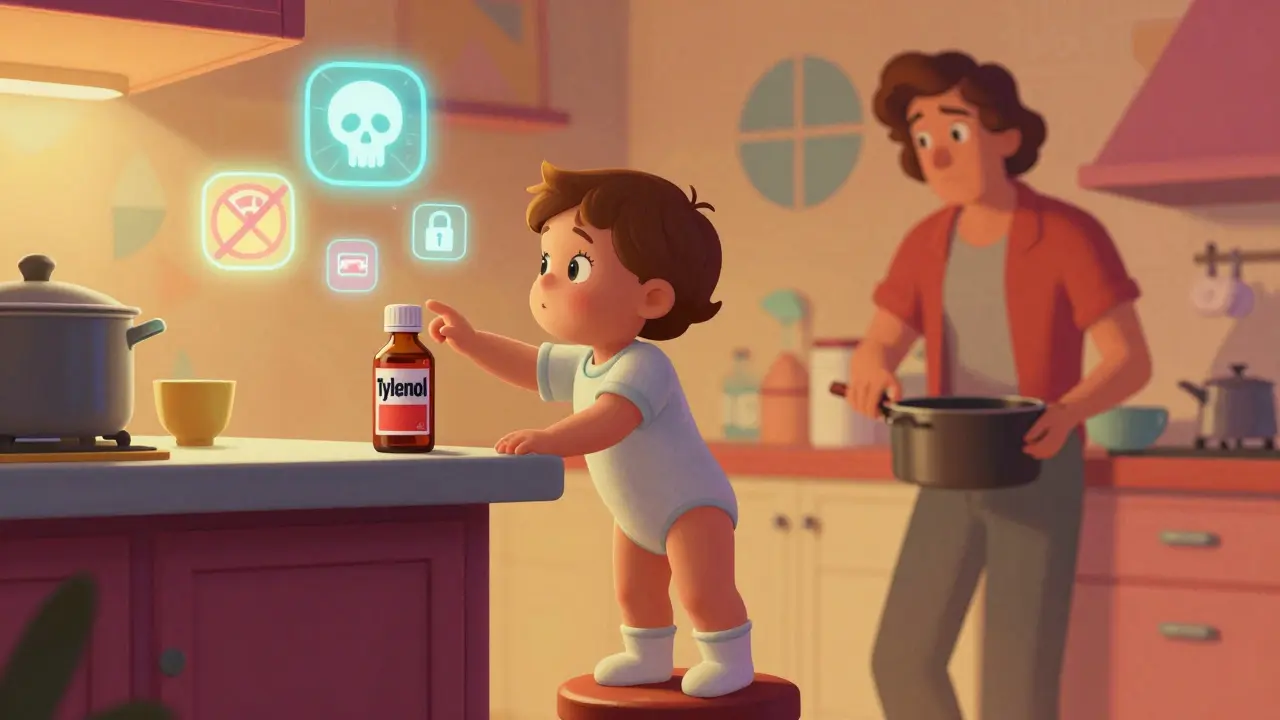
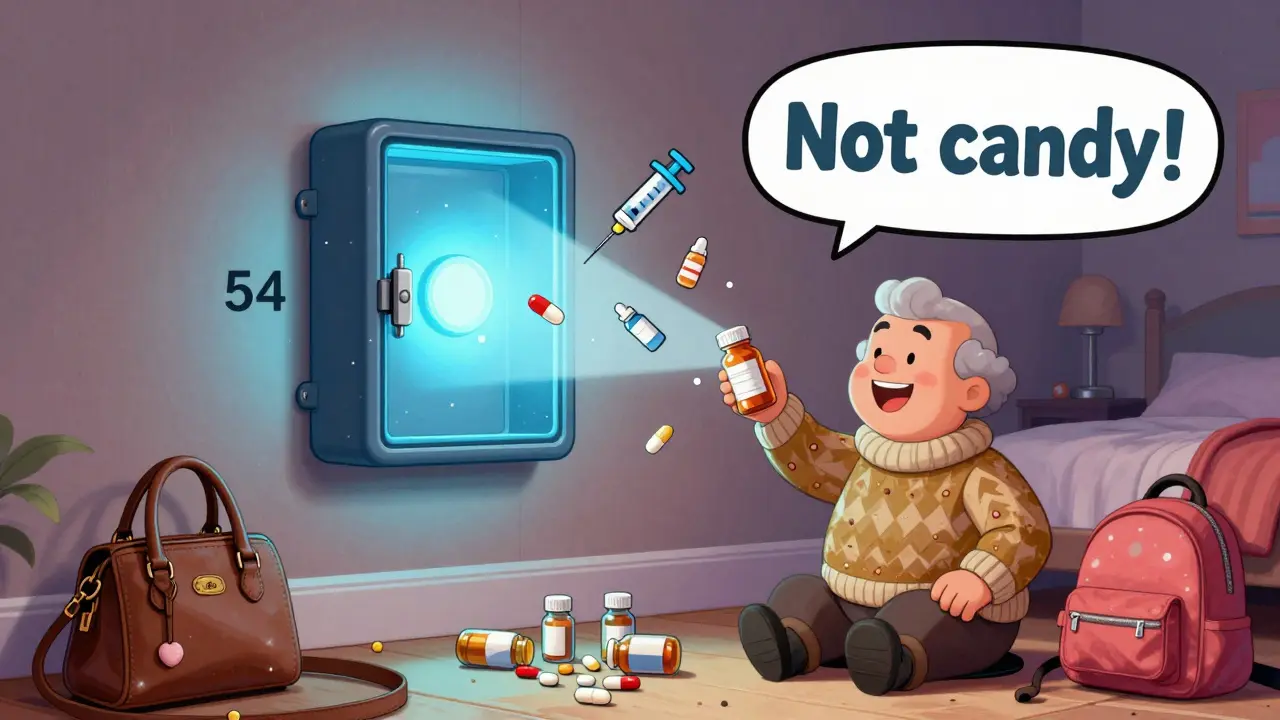
Every year, more than 90 percent of accidental medication poisonings in children happen right in the home-often while a parent or caregiver is nearby. It’s not a matter of neglect. It’s a matter of oversight. A pill left on a nightstand. A bottle in a purse on the floor. Medicine called ‘candy’ to get a child to take it. These aren’t rare mistakes. They’re common, preventable errors that lead to emergency rooms, poison control calls, and sometimes worse.
Where Kids Find Medicine (And Why It’s Not Where You Think)
Most parents assume they’re safe if they keep medicine up high. But toddlers can climb. By 18 months, many can pull themselves up on furniture, use the toilet as a step stool, or stand on chairs to reach countertops. A 2022 study from Nationwide Children’s Hospital found that 78 percent of poisoning incidents involved medicines stored below 4 feet-the average reach of a toddler. Even if you think your cabinet is ‘out of sight,’ a child might see it from their perspective. Get down on your hands and knees. Look around every room. What do you see? Medicines don’t just live in the bathroom cabinet. They show up in purses, coat pockets, bedside tables, and even on the kitchen counter after a quick dose. Visitors-especially grandparents-often bring their own meds. One study showed households with frequent visitors had a 35 percent higher chance of a child accessing medicine. A pill bottle left on a dresser while visiting? That’s a hazard.The Biggest Mistakes Parents Make (And How to Fix Them)
Mistake 1: Relying on child-resistant caps. Child-resistant doesn’t mean child-proof. These caps are designed to slow down a curious child, not stop them. Persistent toddlers can figure them out in minutes. A 2022 report from UCSF Benioff Children’s Hospital found that over 40 percent of poisoning incidents occurred when parents thought the container was secure. The fix? Always lock the medicine away-even if it’s in a child-resistant bottle. Mistake 2: Storing medicine in bags or pockets. A purse on the floor, a jacket hanging by the door, a backpack left in the living room-these are all prime targets. In fact, 30 percent of exposures come from medicines left in visitors’ belongings. Keep all medications in one locked location. No exceptions. Mistake 3: Using kitchen spoons to measure doses. A teaspoon isn’t a teaspoon. A regular kitchen spoon can hold anywhere from 3 to 7 milliliters. The standard dose for a toddler? Usually 5 mL. That 20-40 percent variation? It can mean underdosing-or overdosing. The American Academy of Pediatrics says to always use the dosing tool that comes with the medicine: a syringe, dropper, or cup with clear milliliter markings. Keep it with the bottle. Never guess. Mistake 4: Calling medicine ‘candy’. It’s tempting. ‘Take your medicine, it’s like candy!’ But research from the AAP shows this practice makes kids 3.2 times more likely to take medicine on their own. If a child thinks medicine tastes good and looks like candy, they’ll go looking for it. Say it plainly: ‘This is medicine. It’s not food.’Which Medications Are Most Dangerous?
Not all pills are created equal. Some are deadly in tiny amounts.- Acetaminophen (Tylenol)-Overdose can cause liver failure. Just a few extra teaspoons can be toxic.
- Ibuprofen (Advil, Motrin)-Can cause stomach bleeding and kidney damage in small children.
- Aspirin-Never given to kids under 18. Can trigger Reye’s syndrome, a rare but deadly condition.
- Liquid nicotine (from e-cigarettes)-As little as 0.5 mL can be fatal to a toddler. This is not a joke. One sip can stop a child’s breathing.
How to Lock Up Medicine the Right Way
A locked cabinet isn’t enough. You need the right kind of lock.- Use automatic-locking safety latches that snap shut when the cabinet door closes. These are better than simple child locks.
- Install magnetic locks at least 54 inches above the floor. That’s beyond the reach of most toddlers, even when standing on furniture.
- Don’t use drawer locks alone. Toddlers can open drawers with a chair or stool.
- Consider a medication lock box-many pharmacies now offer them for free to families with young children. One program saw a 41 percent drop in access incidents after families used them.
When Accidents Happen (And They Can)
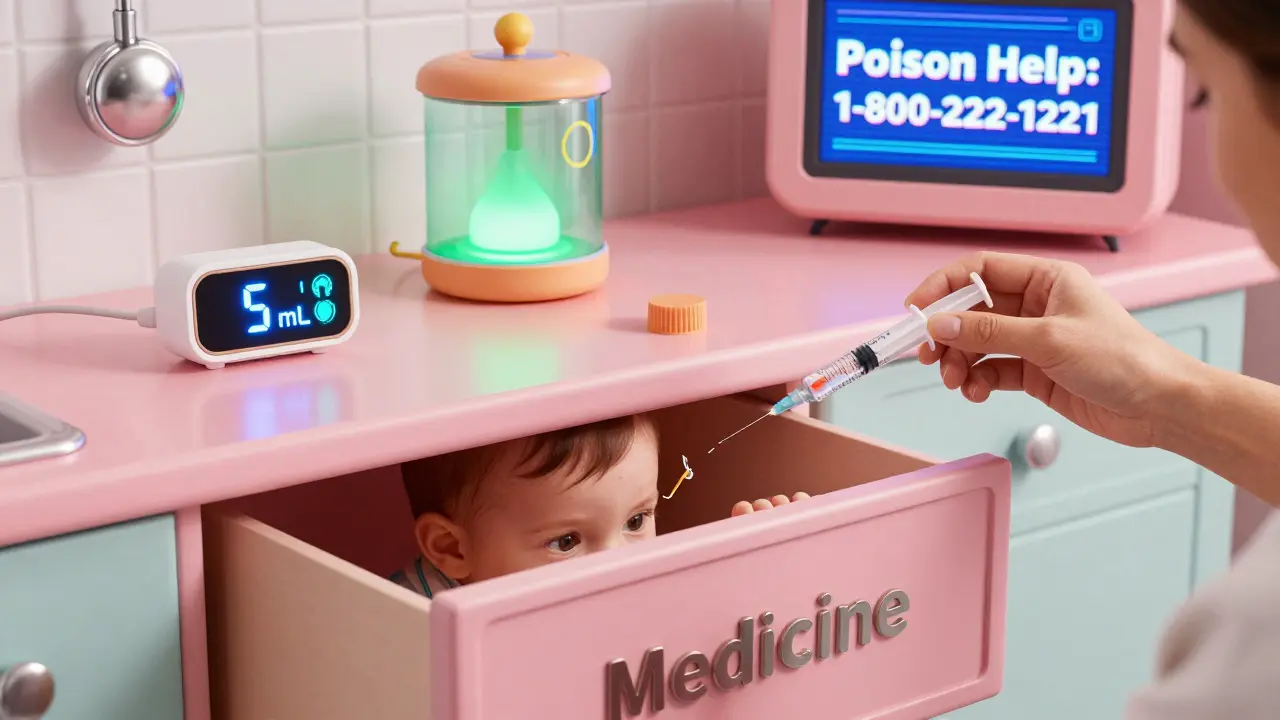
No matter how careful you are, accidents can still happen. That’s why preparation matters.- Post the Poison Help number (1-800-222-1222) on your fridge, near the phone, and on your phone’s speed dial. Homes with visible postings respond 47 percent faster in emergencies.
- Save the webPOISONCONTROL online tool in your phone’s bookmarks. It gives instant, expert advice without needing to call.
- Don’t wait for symptoms. If you suspect your child swallowed medicine-even a tiny amount-call immediately. Poison Control says 89 percent better outcomes happen when help is called within 5 minutes.
- Know basic CPR and the Heimlich maneuver. In 12 percent of severe cases, life-saving action is needed before paramedics arrive.
High-Risk Times and Places
Poisonings don’t just happen at night. In fact, 58 percent occur between noon and 6 p.m.-when parents are busy cooking, cleaning, or supervising other kids. It’s the busiest, most distracted time of day. Also, rural households face a 22 percent higher risk of severe outcomes. Why? Longer ambulance response times. If you live outside a city, make sure your poison control number is even more visible. Keep a first aid kit with activated charcoal (if recommended by your doctor) and know the nearest emergency center.What’s New in Prevention
Technology is starting to help. Pilot programs for ‘smart’ medicine containers are showing promise. These devices track when a dose is taken and send alerts if someone opens the bottle without permission. In early tests, they reduced unsupervised access by 63 percent. Pharmacies are also expanding free lock box programs. Ask your pharmacist. Many offer them to families with toddlers at no cost. And schools? Programs like ‘Over-the-Counter Medicine Safety’ are teaching kids in grades 5-8 how to spot unsafe medicine storage. Since 2015, communities with active campaigns have seen a 19 percent drop in pediatric exposures.Final Checklist: Your Home, Your Safety
Do this once a month:- Check every cabinet, drawer, bag, and coat pocket for medicine.
- Confirm all medicine is in original containers with clear labels.
- Test your lock. Can your child open it? Try it yourself from their height.
- Make sure your poison control number is posted and saved.
- Remove any medicine you no longer need. Don’t store old prescriptions.
- Teach older siblings: ‘Medicine is not a toy.’
What should I do if my child swallows medicine?
Call Poison Control immediately at 1-800-222-1222 or use the webPOISONCONTROL tool online. Don’t wait for symptoms. Don’t try to make your child vomit. Don’t give them milk or food unless instructed. Keep the medicine container handy-poison control will ask for the name, dose, and amount swallowed.
Are child-resistant caps enough to keep kids safe?
No. Child-resistant caps are designed to slow down children, not stop them. Many toddlers can open them within minutes. The only reliable protection is storing medicine in a locked cabinet or lock box, out of reach and out of sight.
Can I store medicine in the bathroom?
It’s not ideal. Bathrooms are humid, which can weaken some medications. More importantly, toddlers can climb on the toilet or sink to reach cabinets. Store medicine in a locked cabinet in a cooler, drier room like a bedroom closet or kitchen cabinet, at least 54 inches high.
Why is liquid nicotine so dangerous for toddlers?
Liquid nicotine from e-cigarettes is highly concentrated. Just 0.5 milliliters-a drop or two-can be fatal to a toddler. It’s absorbed quickly through the mouth and skin. Even empty bottles can leave dangerous residue. Always store e-cigarettes and vape juice in a locked container, away from children.
How do I safely dispose of old or unused medicine?
Don’t flush or throw it in the trash. Many pharmacies offer free medicine take-back bins. If none are nearby, mix pills with coffee grounds or cat litter in a sealed bag before throwing them away. Remove all personal info from bottles. Never leave empty containers where a child can find them.

Kelly Beck
Thank you for this. I had no idea toddlers could climb onto the toilet to reach the cabinet. I just thought ‘high shelf’ was enough. Now I’m going to check every bag, coat, and purse in the house. I even found my mom’s blood pressure pills in my purse from last week. 😅

Wesley Pereira
Child-resistant caps are a joke. I’ve seen my 2-year-old open them in 47 seconds. My sister swears she ‘just left it on the counter for a sec’ and now we have a kid who thinks Tylenol is gummy bears. We bought a lockbox. Best $20 I ever spent. 🙃

Isaac Jules
Why are we even talking about this like it’s a parenting flaw? It’s capitalism. Pharma companies design bottles to look like candy. They market liquid nicotine like it’s a vape accessory. You think parents are the problem? Look at the fucking corporations that profit from this mess. Also, your ‘lockbox’ won’t save you if your kid finds the vape pen under the couch. #CorporateGuilt

Melanie Clark
My mother-in-law brought her arthritis meds over last weekend. Left them on the coffee table. Said ‘it’s just a few pills’ and ‘I’m not gonna die from it’. She’s 72. She doesn’t get it. I had to lock her meds in my bedroom. She called me a fascist. I don’t care. My daughter is 15 months. I will not risk her life for her convenience. 🤷♀️

Ashley S
So now we’re policing grandparents and turning medicine into a horror movie? Next they’ll ban sugar because kids might eat too much. This is fearmongering dressed as parenting advice. My kids took aspirin as toddlers and they’re fine. Maybe stop treating kids like fragile glass figurines?

Indra Triawan
Is it not the soul’s responsibility to guard against chaos? We lock doors, we lock hearts, we lock medicine-yet the child, innocent vessel of curiosity, is condemned for seeking the unknown. Is safety not a cage? And is the child not the true philosopher, reaching for what is forbidden? The pill, the candy, the truth-they are one.

Jeane Hendrix
Just wanted to add-don’t forget about topical meds. I had a kid who got into my mom’s lidocaine cream. Thought it was lotion. Burned her tongue. Took 3 hours to get to the ER. Always lock ALL meds, even the ‘harmless’ ones. And use the dosing syringe. Kitchen spoons are a myth. I used one once. Never again.

Dana Termini
Thank you for sharing this. I’m a new mom and I felt so guilty after reading this-like I was failing my kid. But then I realized: I’ve locked everything, I use the syringe, I never call it candy. I’m not perfect, but I’m consistent. That’s enough. We’re doing better than we think.

Joann Absi
THIS IS WHY AMERICA IS FALLING APART. We’re raising a generation of wimps who can’t even touch a pill without a lockdown protocol. My grandpa gave me aspirin as a kid and I turned out fine. Now we have parents treating their kids like radioactive waste. Lock boxes? Seriously? Get a grip. This isn’t a war zone. It’s a home.

Lily Lilyy
You are doing such important work. I’m from India and we don’t talk about this enough. My cousin’s baby nearly died from her grandma’s diabetes pills. I’m sharing this with every family I know. Keep going. You’re saving lives. 💪❤️
Isaac Jules
Wow. So now we’re locking up medicine because some mom left her purse on the floor? Let me guess-next they’ll ban stairs because toddlers fall. Or ban water because babies drown in bathtubs. This is absurd. The real problem? Lazy parenting wrapped in a fancy infographic. Lock boxes? Please. Just watch your damn kids.
Write a comment