Recent POST



When a pacemaker is implanted, an insulin pump is delivered, or a surgical robot performs a procedure, the last thing a patient should worry about is whether the device will fail. But behind every medical device that reaches a hospital or home is a complex web of quality control measures designed to catch errors before they reach people. This isn’t about perfection-it’s about preventing harm. And the standards that make this possible have changed dramatically in recent years, especially with the FDA’s 2026 update that finally aligned U.S. rules with global ones.
Why Quality Control Isn’t Just Bureaucracy
Many assume quality control in medical manufacturing is just paperwork: logs, checklists, audits. But it’s far more. It’s the difference between a device working as intended and one that could cause infection, malfunction, or death. The FDA estimates that strong quality systems prevent about 30% of device failures that would otherwise reach patients. That’s not a small number-it’s hundreds of thousands of avoided adverse events each year. Dr. Jeffrey Shuren, head of the FDA’s Center for Devices and Radiological Health, put it plainly: "Robust quality management systems are the foundation of device safety." Think of it this way: a single faulty component in a ventilator can lead to oxygen delivery failure. A software glitch in a glucose monitor might give a diabetic dangerously wrong readings. These aren’t hypotheticals. They’ve happened. And every documented procedure, every tested batch, every traceable serial number exists to stop that from happening again.The Two Standards That Changed Everything
For decades, medical device manufacturers faced a split world. In the U.S., they followed the FDA’s 21 CFR Part 820-the Quality System Regulation (QSR). In Europe and most other countries, they had to meet ISO 13485:2003. The rules overlapped but weren’t the same. That meant companies spent extra time, money, and resources to comply with both systems. For small firms, it was a barrier to global sales. Then came the game-changer. On January 31, 2024, the FDA announced the Quality Management System Regulation (QMSR), which officially adopted ISO 13485:2016 as the new U.S. standard. Effective February 2, 2026, manufacturers in the U.S. must now comply with ISO 13485:2016 instead of the old QSR. This isn’t just a name change-it’s a structural shift. ISO 13485:2016 doesn’t just list what to do; it requires manufacturers to think about risk at every step: from design to supplier selection to how a device is used in the real world. This harmonization means one system replaces two. For companies selling globally, it cuts redundant documentation by up to 30%. It also means faster approvals. Manufacturers with ISO 13485 certification report 40% faster regulatory reviews in 38 countries that recognize the standard. For patients, it means safer devices reaching market faster and more reliably.What’s Actually Required? The Core Elements
ISO 13485:2016 isn’t vague. It spells out exactly what a quality system must include. Here are the key pieces that every medical device manufacturer must have in place:- Design controls: Every product must be designed with defined inputs (what the patient needs), outputs (how it works), and verification steps. No guesswork.
- Document control: Every procedure, test, and change is documented and version-tracked. If a batch is recalled, you can trace it back to the exact shift, machine, and operator.
- Supplier management: 41% of FDA warning letters in 2023 cited failures in supplier oversight. You can’t outsource safety. Vendors must be audited and approved.
- Process validation: You can’t just say a machine works-you have to prove it works consistently under real production conditions. This includes temperature, pressure, and timing controls.
- Corrective and preventive action (CAPA): When something goes wrong, you don’t just fix it-you find out why and stop it from happening again. This isn’t optional.
- Risk management (ISO 14971): Every device must have a risk file. What could go wrong? How likely is it? How do you reduce the risk? This isn’t a one-time task-it’s updated throughout the product’s life.
These aren’t suggestions. They’re mandatory. And they’re enforced through inspections. In 2023, FDA inspections rose 22% from 2021, with an average of 7.3 nonconformities found per inspection. That’s why companies are investing heavily-not just to pass audits, but to avoid shutdowns.
Real-World Impact: Numbers That Matter
The data doesn’t lie. Facilities with mature quality systems don’t just survive-they thrive.- Facilities with strong systems achieve 99.97% first-pass yield (devices that pass inspection the first time). Those with weak systems? Only 98.2%. That’s a 17-fold drop in defects.
- Manufacturers using ISO 13485:2016 with integrated risk management saw 35% fewer field actions-recalls, safety alerts, or corrections-than those relying on basic compliance.
- One Class III device maker prevented a Class I recall (the most serious type) by using a traceability matrix to catch an unvalidated software change affecting 5,000 implanted devices.
But it’s not all smooth sailing. A 2023 survey of 212 quality managers found that 68% spent more time on paperwork than on improving processes. That’s the trap: thinking documentation = quality. Dr. Marc Jacobi, a former FDA reviewer, warned that "paper quality systems" fail when real problems arise. You can have perfect records and still have broken machines. The goal isn’t to fill binders-it’s to understand the process.
Technology Is Changing the Game
Old-school quality control relied on manual checks, paper logs, and human inspections. Today, smart manufacturers are using digital tools to get ahead.- QMS software: Platforms like Greenlight Guru (rated 4.7/5 by 147 users) offer built-in templates for FDA and ISO compliance. Manufacturers using integrated systems report 32% higher audit success rates.
- AI and machine learning: Early adopters are feeding production data into algorithms that predict defects before they happen. One study showed 25-40% fewer defects using AI-driven analysis.
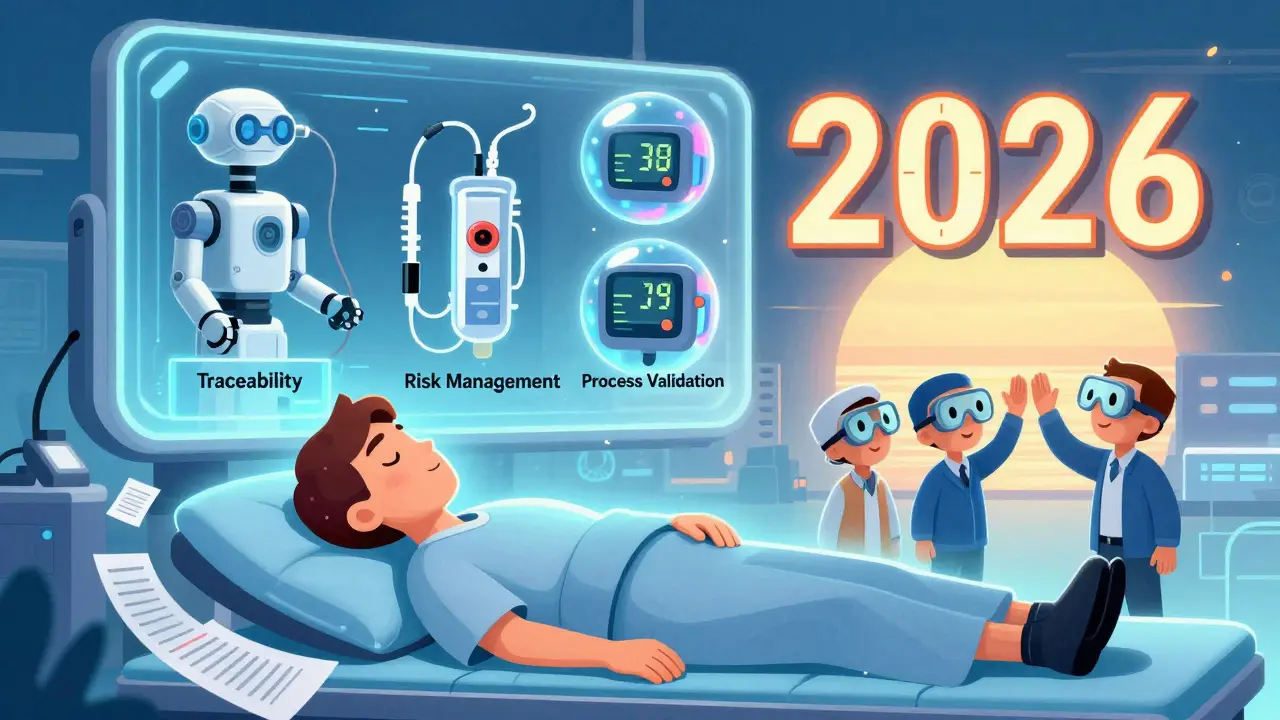
- Traceability: Modern systems link every component to its source, every batch to its test results, and every design change to its impact. This isn’t just for audits-it’s for real-time problem-solving.
By 2027, Gartner predicts 60% of medical device quality systems will use AI analytics. That could cut human error by up to 50%. But technology doesn’t replace human judgment-it enhances it. The best systems combine automation with trained professionals who know what the numbers mean.
The Transition: What Manufacturers Are Doing Now
The deadline is February 2, 2026. That gives manufacturers two years to switch. The FDA broke the transition into three phases:- Awareness (Feb-Aug 2024): Learning the new rules.
- Implementation planning (Sept 2024-Feb 2025): Mapping gaps between old and new systems.
- Full implementation (Mar 2025-Jan 2026): Training, testing, and auditing.
Industry analysts say 70% of major manufacturers will be dual-compliant by Q3 2025. But smaller firms-with fewer than 50 employees-are struggling. Training staff, updating software, and revalidating processes takes time and money. For them, the transition isn’t just compliance-it’s survival.
Tools like the FDA’s free Quality System Manual and ISO’s $338 implementation guide are helping. But the real win? Companies that treat this as a chance to improve-not just a requirement to check off.
The Bigger Picture: Safety Is the Only Goal
At the end of the day, none of this matters if it doesn’t protect people. The World Health Organization says 1 in 20 device failures could cause serious harm without proper controls. That’s why every SOP, every audit, every software update exists-not for regulators, not for auditors, but for the person lying on the operating table, waiting for their device to work.The new system isn’t perfect. It’s still complex. Paperwork is still heavy. Training is still hard. But it’s more unified, more risk-focused, and more global than ever before. And that’s what matters. Because when quality control works, it doesn’t make headlines. It just lets people live.
What is ISO 13485:2016 and why does it matter for medical devices?
ISO 13485:2016 is the international standard for quality management systems specific to medical device manufacturing. It requires companies to manage risk at every stage-from design and sourcing to production and post-market monitoring. Unlike older standards, it doesn’t just list requirements; it demands a proactive, risk-based approach. Since the FDA adopted it as its new U.S. standard effective February 2, 2026, manufacturers must follow it to sell devices in America. It’s now the global benchmark for safety and compliance.
How does the FDA’s new QMSR rule affect U.S. manufacturers?
The FDA’s QMSR Final Rule replaces the old 21 CFR Part 820 (Quality System Regulation) with ISO 13485:2016 as the mandatory standard, effective February 2, 2026. This means U.S. manufacturers no longer need to maintain separate compliance systems for domestic and international markets. It reduces redundant paperwork, cuts compliance costs by an estimated $400 million annually, and aligns U.S. rules with those used in the EU, Canada, Australia, and 38 other countries. Manufacturers must complete their transition by the deadline or face regulatory action.
What are the biggest challenges in implementing ISO 13485:2016?
The biggest challenges include: integrating legacy equipment with modern digital systems (57% of manufacturers report this issue), shifting from paperwork-focused compliance to true process understanding, training staff on risk management (ISO 14971), and managing supplier quality-41% of FDA warning letters in 2023 cited supplier audit failures. Smaller companies often struggle with limited resources, while others get stuck in "paper quality" traps-having perfect documentation but flawed processes.
How do quality control systems prevent patient harm?
They prevent harm by catching errors before devices leave the factory. This includes testing electrical safety (like 1,500-volt dielectric tests per IEC 60601-1), verifying software functionality, ensuring sterile packaging integrity, and tracking every component’s origin. Statistical process control and risk analysis help predict where failures might occur. When a defect is found, corrective actions stop it from recurring. The FDA estimates this prevents 30% of potential device failures that could otherwise reach patients.
Is AI really making a difference in medical device quality control?
Yes. Early adopters are using AI to analyze production data in real time-spotting patterns that humans miss. One study showed 25-40% fewer defects when machine learning flagged anomalies in temperature, pressure, or assembly torque before a batch was completed. AI doesn’t replace inspectors-it helps them focus on real risks. Gartner predicts 60% of medical device quality systems will use AI-driven analytics by 2027, potentially cutting human error by up to 50%.

Joseph Charles Colin
ISO 13485:2016 isn’t just another standard-it’s a paradigm shift from reactive compliance to proactive risk mitigation. The requirement for continuous risk analysis throughout the product lifecycle means manufacturers can’t just bolt on quality after the fact. You’re forced to ask: What’s the failure mode? What’s the severity? What’s the detection probability? This isn’t bureaucracy-it’s engineering discipline. And when you integrate this with traceability systems linked to IoT-enabled production lines, you get real-time feedback loops that catch anomalies before a single device leaves the floor. That’s how you prevent Class I recalls-not by adding more forms, but by embedding intelligence into the process.

Andrew Jackson
The FDA finally got it right. For too long, American manufacturers were held to a different standard than the rest of the world-while Europe, Canada, and Australia moved forward with sensible, harmonized rules. Now, finally, we’re aligning with global best practices instead of clinging to outdated, domestically isolated regulations. This isn’t a concession-it’s a reaffirmation of American leadership in medical innovation. The $400 million in annual savings? That’s money reinvested into R&D, not into lawyers and auditors. If you’re still complaining about paperwork, you’re missing the point: safety isn’t optional, and neither is excellence.

John Sonnenberg
Let me be perfectly clear: this isn’t about compliance. It’s about survival. One unvalidated software patch. One overlooked supplier audit. One batch of defective capacitors. And suddenly, a child on a ventilator stops breathing. I’ve seen the reports. I’ve read the autopsy logs. This isn’t theoretical. It’s visceral. The FDA didn’t just update a regulation-they rewrote the moral contract between industry and the public. And if you think documentation is tedious, try explaining to a widow why her husband’s pacemaker failed because someone didn’t check the torque on a screw. There are no bonuses for cutting corners. Only consequences.

Chelsea Deflyss
so uhh… ai is supposed to fix everything now? lol. i work in med device quality and 80% of the ‘ai predictions’ are just false alarms from bad training data. we spent 3 months tuning a model that flagged 1200 ‘defects’-turns out 1198 were just dust on the camera lens. now we have 3 new hires just to review ai alerts. cool tech. terrible ROI.

PAUL MCQUEEN
Interesting. But let’s be honest-this whole system is built on the assumption that people are rational, trained, and motivated. What about the night shift tech who’s been working 14-hour days for a week? The manager who skips validation because ‘it’s always worked before’? The vendor who cuts costs by swapping a component without telling anyone? The standard doesn’t fix human nature. It just gives you more paperwork to pretend it does. I’ve seen companies with perfect ISO audits and zero real safety culture. The system rewards box-ticking, not problem-solving.

glenn mendoza
I want to thank everyone who’s worked tirelessly behind the scenes to make this transition possible. The quality engineers, the auditors, the trainers, the software developers-none of you get enough recognition. This isn’t glamorous work. No one cheers when a device passes inspection. No one posts about it on LinkedIn. But when a diabetic wakes up with stable glucose levels, or a heart patient breathes easy after surgery, that’s because of what you do. The data proves it: fewer defects, fewer recalls, fewer tragedies. This is the quiet heroism of engineering. And it matters.

Chima Ifeanyi
Harmonization? Please. The FDA didn’t adopt ISO 13485:2016 because it’s better-it’s because they were forced to by global supply chain pressure. Meanwhile, the EU has already moved to MDR 2017/745 with stricter post-market surveillance. The U.S. is still playing catch-up. And let’s not pretend this reduces costs-small manufacturers are being crushed under the weight of certification fees, consultant fees, and software licensing. This isn’t progress-it’s consolidation. Big players win. Small ones die. And patients? They get fewer choices. That’s not safety. That’s monopoly.

Alex Ogle
I’ve spent 18 years in this field. I’ve seen the old QSR days-paper binders taller than a person, auditors with clipboards, people signing off on things they never read. Then came the digital shift. First, it was spreadsheets. Then, cloud-based QMS. Now, AI-driven anomaly detection. The tools have changed. But the heartbeat of this system? Still the same: someone, somewhere, cared enough to double-check. To question. To pause. To say, ‘Wait, this doesn’t feel right.’ No algorithm replaces that instinct. No template replaces that courage. The real innovation isn’t in the software-it’s in the person who refuses to let a batch ship because the torque reading was 0.2 Nm off. That’s not compliance. That’s integrity. And it’s still alive.
Write a comment