Recent POST
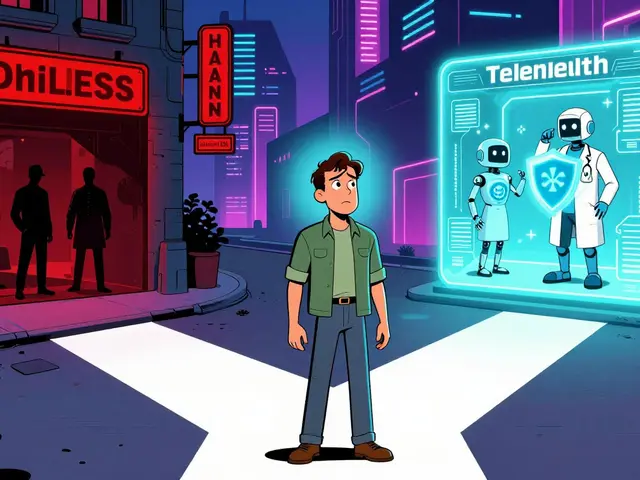


When you pick up a generic pill at the pharmacy, you might assume it’s just a cheaper copy. But here’s the truth: generic drugs aren’t copies. They’re exact matches - legally, scientifically, and clinically - to the brand-name versions. The U.S. Food and Drug Administration (FDA) doesn’t just approve them because they’re cheaper. They approve them because they’ve passed one of the most rigorous testing systems in medicine.
The system that makes this possible is called the Abbreviated New Drug Application, or ANDA. It was created by the Hatch-Waxman Act of 1984. Before this law, generic manufacturers had to run full clinical trials just like brand-name companies. That cost millions and took years. The new system changed everything. Instead of starting from scratch, generic makers could rely on the safety and effectiveness data already proven by the original drug. All they had to prove was one thing: that their version works the same way in your body.
What Does "Works the Same Way" Actually Mean?
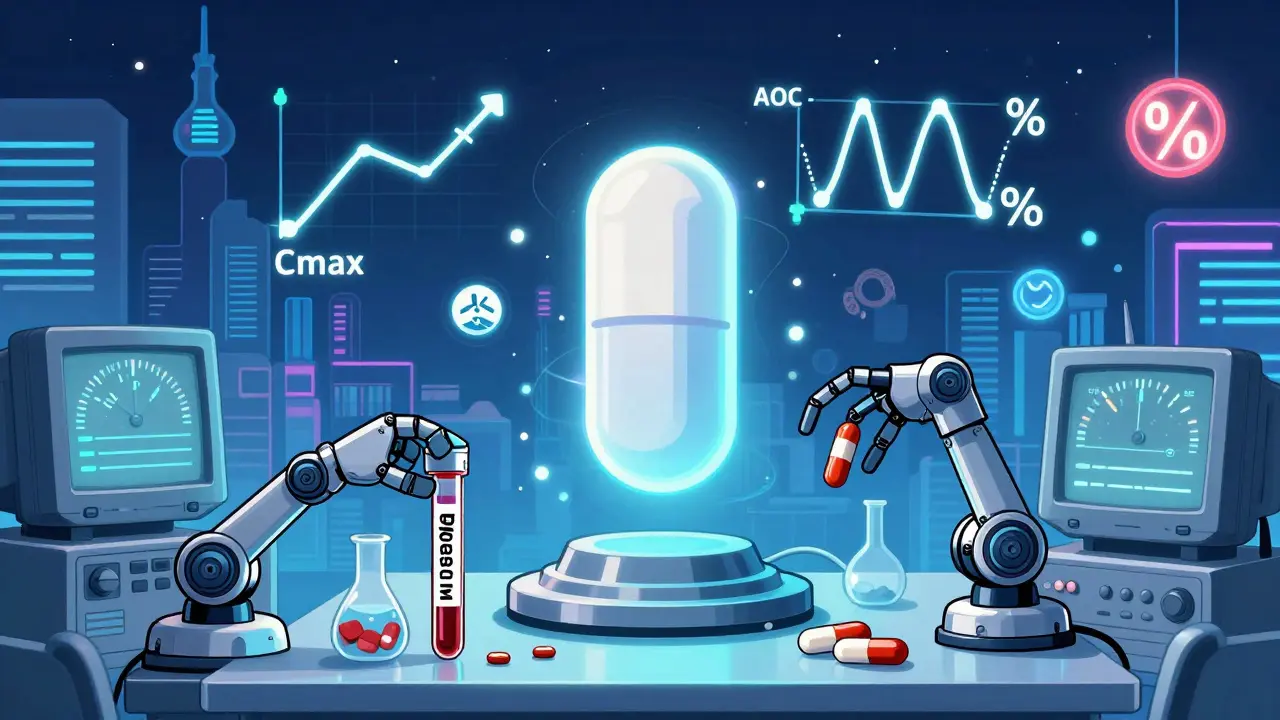
It’s not about looking alike or tasting the same. It’s about what happens inside you after you swallow the pill. The FDA requires bioequivalence - meaning the generic drug must deliver the same amount of active ingredient into your bloodstream at the same speed as the brand-name drug.
Here’s how they test it: healthy volunteers take both the brand-name drug and the generic version, in separate sessions. Blood samples are taken over time to measure how much of the drug enters the bloodstream and how fast. The key numbers are Cmax (the highest concentration reached) and AUC (how much drug is absorbed over time). For most drugs, the generic’s numbers must fall within 80% to 125% of the brand’s. That’s not a guess. It’s a scientifically validated range based on decades of data.
But not all drugs are treated the same. For drugs with a narrow therapeutic index - like warfarin, levothyroxine, or lithium - even small differences can matter. For these, the FDA tightens the range. Levothyroxine generics, for example, must stay within 95% to 105% of the brand’s absorption. That’s tighter than a tailor’s seam. The FDA doesn’t just trust the numbers - they verify them with repeated testing and real-world monitoring.
Strength, Purity, and Stability: The Hidden Rules
It’s not enough for the drug to work the same way. It has to be made the same way. Every generic must contain the exact same active ingredient, in the exact same strength, in the exact same form - tablet, capsule, injection, etc. No more, no less.
But what about the other ingredients? The fillers, dyes, coatings? Those don’t have to match. But they do have to be safe. And more importantly, they can’t change how the drug behaves. A coating that dissolves too fast? That’s a problem. A filler that clumps? That’s a problem. The FDA calls these Critical Quality Attributes (CQAs). Manufacturers must prove they control every one of them.
Stability is another big deal. A drug that works today must still work six months from now. The FDA requires manufacturers to test their generic under extreme conditions - high heat, high humidity - to make sure it doesn’t break down. They must prove it stays within approved strength and purity limits throughout its shelf life. This isn’t a one-time test. It’s ongoing.
Manufacturing: Where Most Generics Fail
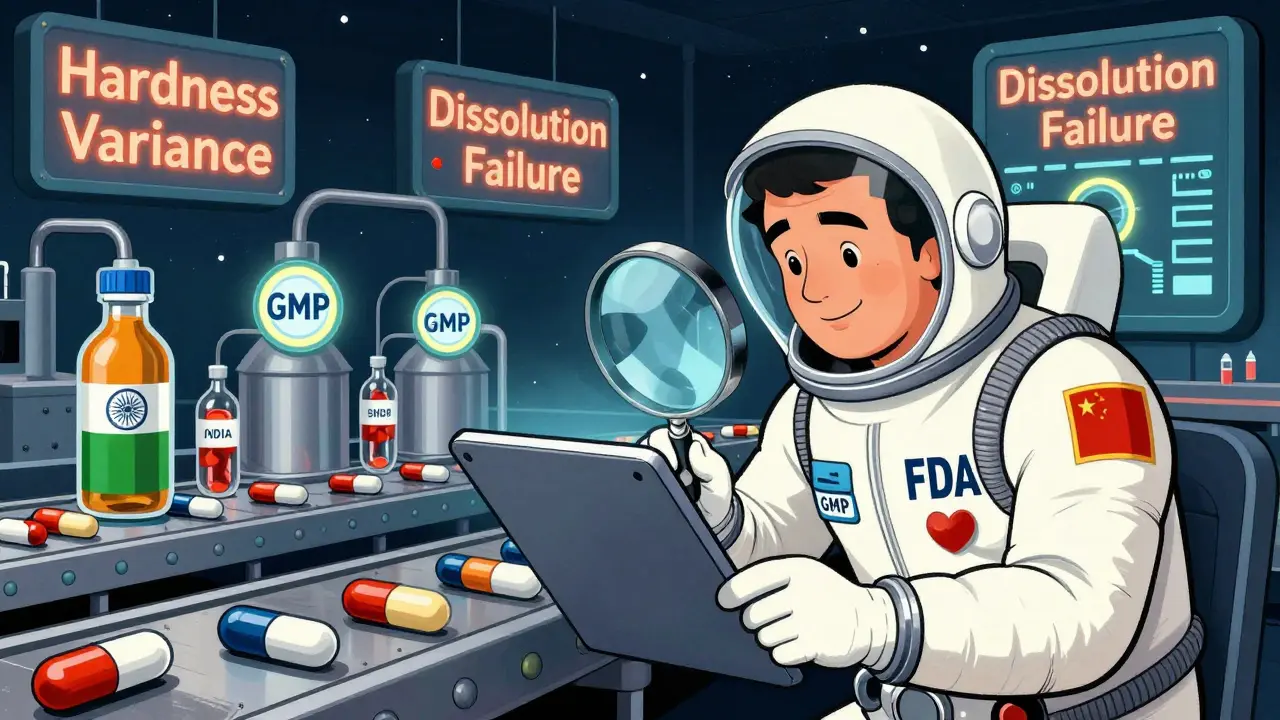
Here’s the surprising part: most generic applications don’t get approved on the first try. In fact, less than 10% do. Why? Because the real challenge isn’t science - it’s manufacturing.
The FDA inspects every factory that makes generic drugs. They check every step: how raw materials are handled, how tablets are pressed, how batches are tested. They require proof that every batch is consistent. One study found that 45% of generic manufacturers struggle with cGMP (Current Good Manufacturing Practices) violations during inspections. That’s not because they’re cutting corners. It’s because the standards are insane.
Take Teva Pharmaceuticals. Their regulatory team says new companies are shocked by what the FDA demands: data from three consecutive commercial-scale batches, each showing identical hardness, disintegration time, and dissolution profile. One company got a Complete Response Letter in 2021 because their tablet hardness varied across batches. That’s not a small error. That’s a failure to control quality. And it delayed approval for months.
There are 1,200 pre-approval inspections every year. Each one takes weeks. Each one can be a make-or-break moment. And it’s not just U.S. factories. The FDA inspects facilities in India, China, and Europe. If a plant fails, the whole supply chain is blocked.
Complex Drugs: The New Frontier
Simple pills? Easy. But what about inhalers, injectables, or creams that release medicine slowly? These are called complex generics. They’re harder to replicate because they rely on physical properties - particle size, viscosity, spray pattern - not just chemistry.
The FDA approved only 3 out of 27 generic EpiPen applications between 2015 and 2020. Why? Because the auto-injector device had to perform identically to the original. A 5% difference in needle length or pressure? That could mean the difference between life and death. The same goes for topical creams. A generic asthma inhaler must deliver the exact same particle size to reach deep into the lungs. Too big? It hits the throat. Too small? It’s exhaled.
These products now make up a growing share of the market. In 2023, the FDA approved the first generic of Humira - a complex biologic drug that had been protected by patents for over a decade. It took years of collaboration between the manufacturer and the FDA just to figure out how to test it.
Why It Works - And Why It Matters
Generic drugs account for 90% of all prescriptions filled in the U.S. But they cost only 23% of what brand-name drugs do. That’s not magic. That’s regulation. Every generic approved since 1984 has had to prove it’s as safe, as strong, and as effective as the original.
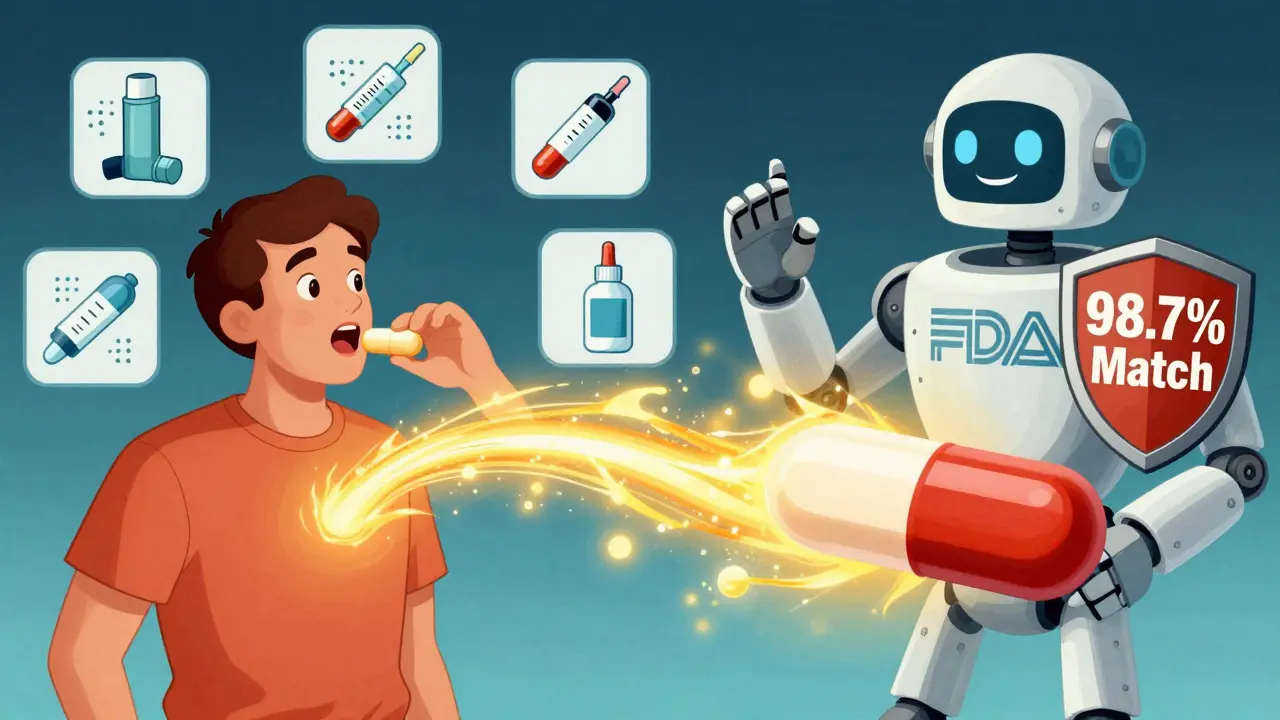
Post-market studies show that 98.7% of generic drugs perform identically to their brand-name counterparts in real-world use. The American Medical Association confirmed this after reviewing 15 years of data. Patients don’t get worse outcomes. Hospitals don’t see more side effects. Insurance companies save billions.
The savings are real. In 2022 alone, generics saved the U.S. healthcare system $373 billion. That’s money that goes to other treatments, other patients, other needs.
What You Should Know
If you’re prescribed a generic, you can trust it. The FDA doesn’t lower its standards just because the price is lower. They raise the bar. They demand proof - not promises. They test, inspect, and verify every single step.
Some people worry about switching from brand to generic. That’s understandable. But the science is clear: for nearly every drug, the switch is safe and effective. The only exceptions are a handful of narrow therapeutic index drugs - and even those have stricter rules.
The real story here isn’t about cost. It’s about control. The FDA doesn’t just approve generics. They police them. And that’s why you can take a $5 generic with the same confidence as a $50 brand.
Are generic drugs really as effective as brand-name drugs?
Yes. The FDA requires generic drugs to have the same active ingredient, strength, dosage form, and route of administration as the brand-name drug. They must also prove bioequivalence - meaning they deliver the same amount of medicine into your bloodstream at the same rate. Studies show that 98.7% of generic drugs perform identically to brand-name versions in real-world use.
Why do some generic drugs look different from the brand-name version?
The active ingredient must be identical, but inactive ingredients - like colorants, fillers, or coatings - can differ. These don’t affect how the drug works. Differences in appearance are often due to trademark laws, which prevent generics from looking exactly like the brand-name product. This has no impact on safety or effectiveness.
What happens if a generic drug fails FDA approval?
If a generic application doesn’t meet FDA standards, it gets a Complete Response Letter. This outlines exactly what’s missing or wrong - whether it’s bioequivalence data, manufacturing inconsistencies, or labeling errors. The manufacturer must fix the issue and resubmit. Many applications fail on the first try; less than 10% are approved in the initial review cycle.
Are all generic drugs made in the U.S.?
No. The FDA inspects manufacturing facilities worldwide, including in India, China, and Europe. Over 50% of generic drugs sold in the U.S. are made overseas. The FDA holds foreign facilities to the same cGMP standards as U.S. plants. Facilities that fail inspections are blocked from exporting to the U.S. until they fix the problems.
How long does it take to get a generic drug approved?
For a standard generic, the FDA aims to complete its review within 10 months. But the full process - from starting development to approval - usually takes 32.7 months on average. Complex generics, like inhalers or extended-release formulations, can take 47 months or more due to the extra testing and manufacturing challenges involved.

Tatiana Barbosa
I've been prescribing generics for over a decade and never had a single patient report a difference in effectiveness. The FDA's bioequivalence standards are brutal-like, *brutal*. If a generic doesn't hit that 80-125% window, it gets tossed. No second chances. And for drugs like levothyroxine? They're tighter than a drum. You want peace of mind? Trust the data, not the price tag.

Brandon Osborne
Yeah right. I took a generic for my blood pressure and felt like I was being slowly poisoned. My doctor said it was 'bioequivalent' but my body didn't get the memo. These companies are cutting corners and the FDA is asleep at the wheel. I'm not some lab rat.

Susan Kwan
Wow. So you took one generic, felt weird, and now the entire system is broken? That's not science, that's anecdote with a megaphone.

Joseph Charles Colin
Bioequivalence isn't just a number-it's a pharmacokinetic fingerprint. Cmax and AUC are validated metrics derived from over 40 years of population pharmacokinetic modeling. When a generic hits 95-105% for narrow TI drugs, it's not luck-it's engineering. The real miracle is that 90% of prescriptions are filled with these precisely calibrated molecules, and we take them for granted.

Ken Cooper
so like… i had no idea that the FDA actually inspects factories in india and china? like, full on? like, they show up unannounced? and if the tablets are too hard or too soft? they shut it down? i thought it was all just paperwork. this is wild. also, i just realized my asthma inhaler is basically a precision jet engine. mind blown.

MANI V
You think this is about safety? It's about control. The FDA doesn't care if you live or die-they care if the paperwork matches the model. I've seen plants in India get shut down because a worker used the wrong glove. Not because it contaminated anything. Just because the protocol said 'nitrile' and they used 'latex'. This isn't medicine. It's bureaucracy with a lab coat.

Andy Cortez
I got a generic for my anxiety med and it felt like someone replaced my brain with wet sand. I went back to brand. Paid double. Felt like a human again. The system is rigged. They don't test real people. They test college kids on a treadmill. Who cares if it 'works' in a lab if it makes you feel like a zombie in real life?

Ryan Vargas
Let’s be real. The FDA is a regulatory puppet of Big Pharma. The ANDA system? A clever illusion. Brand-name companies own the patents, own the data, own the testing protocols. Generics are forced to replicate their own failure. The 80-125% window? That’s not science-it’s a compromise carved out by lobbyists who don’t want competition to actually compete. The real reason generics are cheap? Because they’re not allowed to innovate. They’re only allowed to copy. And that’s why you feel different on them. Because you’re not taking a drug-you’re taking a shadow.

John McDonald
I work in a hospital pharmacy. We switch patients to generics every day. No increase in readmissions. No rise in side effects. The data doesn't lie. If someone feels off, it's often the placebo effect-or they're stressed about the switch. I've seen people panic because their pill changed color. Same active ingredient. Same dose. Same results. It's wild how much psychology plays into this.

Joshua Smith
I'm curious-how often do generics get approved on the first try? Like, is it really less than 10%? That seems insane. I guess I always thought the hard part was making the drug, not proving you made it right.
Tatiana Barbosa
Exactly. Less than 10%. And that’s after they’ve spent 2-3 years and millions trying to get it right. Most companies fail because they think manufacturing is just pressing pills. It’s not. It’s controlling every variable from humidity in the room to the torque on the tablet press. One millisecond off on the drying cycle? Your tablet crumbles in your hand. The FDA doesn’t care about your budget. They care about your consistency.

PAUL MCQUEEN
I didn't read all that. But I heard generics are made in China. So no thanks.

glenn mendoza
The rigorous regulatory framework governing generic pharmaceuticals represents a monumental achievement in public health policy. The scientific rigor, combined with unwavering adherence to current Good Manufacturing Practices, ensures that patients receive therapeutically equivalent interventions at a fraction of the cost. This system exemplifies the harmonious convergence of innovation, accountability, and patient-centered care.
Write a comment