Recent POST


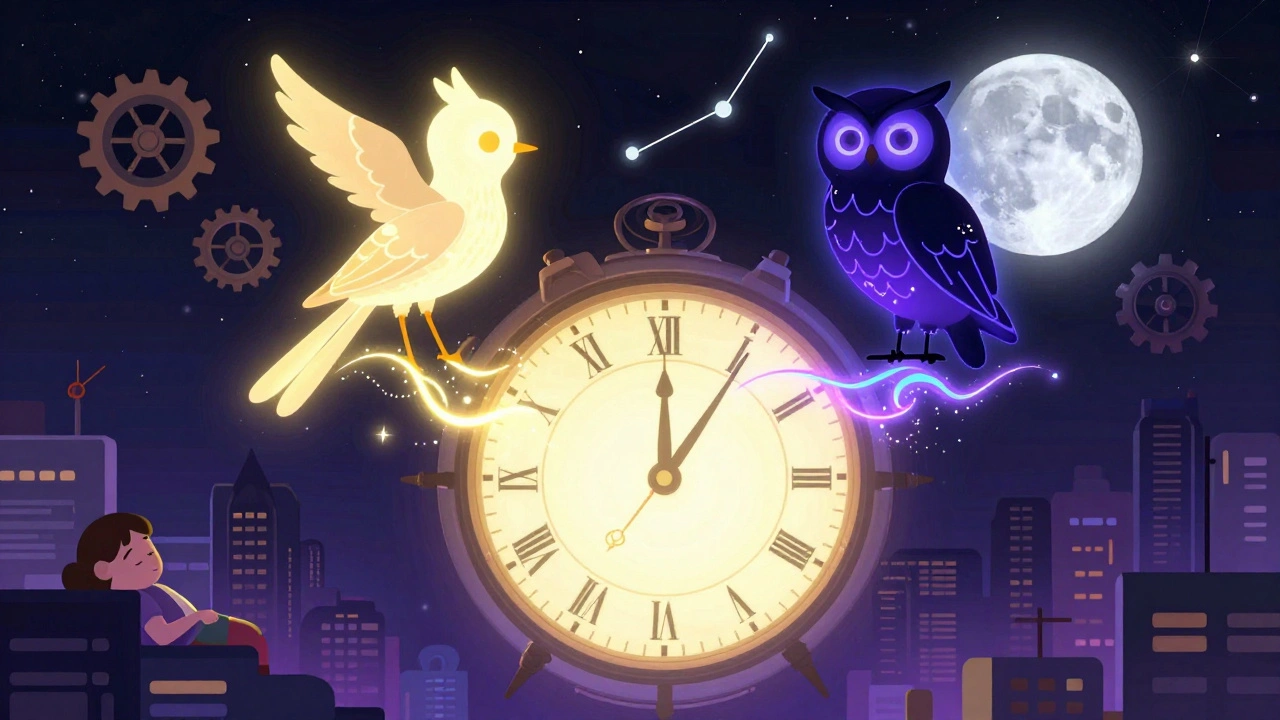
Most people think waking up early is a matter of willpower. But what if your body just isn’t built for 6 a.m. alarms? What if your brain doesn’t wake up until noon - and that’s not laziness, it’s biology? This isn’t about discipline. It’s about your chronotype - the internal clock that decides when you’re naturally alert, focused, and ready to sleep.
What Exactly Is a Chronotype?
Your chronotype isn’t a preference. It’s not something you can just ‘train’ out of yourself overnight. It’s a biological rhythm shaped by genes, light exposure, and evolution. Think of it like your body’s personal time zone. Some people are morning larks - they wake up naturally before sunrise, feel sharp by 8 a.m., and crash by 9 p.m. Others are night owls - they’re sluggish before noon, come alive after 8 p.m., and don’t feel sleepy until after midnight. Research from the Munich ChronoType Questionnaire (MCTQ) shows that about 40% of people are larks, 30% are owls, and the rest fall somewhere in between. That means if you’re an owl struggling through a 9-to-5 job, you’re not broken. You’re just in the minority. The key metric? Sleep midpoint. That’s the halfway point between when you fall asleep and when you wake up on free days - no alarms, no obligations. For larks, it’s around 3 a.m. For owls, it’s closer to 7 a.m. That’s a four-hour difference in biological timing. And it’s not just about sleep. It affects your focus, mood, metabolism, and even how long you live.Why Night Owls Are Set Up to Fail
Society runs on lark time. Schools start at 7:30 a.m. Work meetings begin at 8 a.m. Even gym classes are scheduled before lunch. But for night owls, this isn’t just inconvenient - it’s harmful. Baylor University’s 2023 study found that evening-type college students who had to wake up early got an average of 6.2 hours of sleep per night - nearly an hour less than morning types. They were more likely to nap during the day, drink caffeine after 4 p.m., and scroll through social media in bed. The result? Worse grades, more fatigue, and higher stress levels. It gets worse. A 2018 study of over 430,000 people showed night owls had a higher risk of dying during the study period than morning types. They were 27% more likely to be obese, 30% more likely to develop type 2 diabetes, and 29% more likely to suffer from depression. Why? Because their bodies are constantly fighting against the clock. This mismatch between biological time and social time is called social jet lag - and it’s real.Morning Larks Aren’t Perfect Either
Larks aren’t immune to problems. They’re more likely to be female, according to SleepWatch data, and they get about 48 more minutes of sleep per night than owls. They also have more consistent sleep patterns - 7 percentage points higher rhythm stability. But that doesn’t mean they’re happier or healthier overall. Their advantage is mostly social. They wake up feeling rested. They’re productive before most people even get out of bed. They don’t need coffee to function before noon. But here’s the catch: their biological rhythm is less common. In a world built for owls to adapt, larks get the easy ride. And here’s something surprising: a 2023 study from Imperial College London found that among older adults, night owls actually performed better on cognitive tests than morning larks. That flips the old belief that early risers are smarter. It suggests that as we age, our chronotype might shift what kinds of mental strengths we have - not that one type is superior.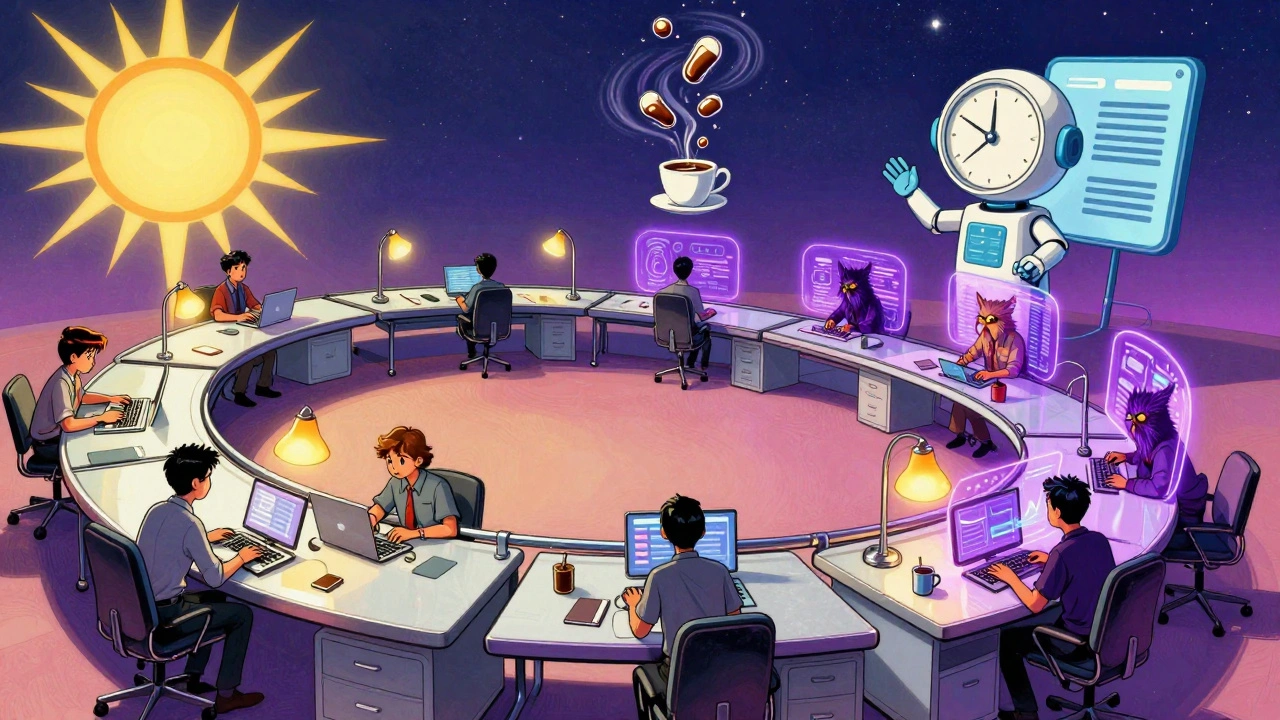
Your Chronotype Is (Mostly) Fixed - But Not Completely
You can’t turn a night owl into a morning lark with willpower alone. Genetics play a big role. A 2001 University of Utah study found a gene mutation that causes some people to wake up at 4:30 a.m. naturally - no matter how hard they try to sleep later. That’s not a habit. That’s biology. But your chronotype isn’t carved in stone. Research from the University of Colorado Boulder showed that after just one week of camping without artificial light, participants’ sleep schedules synced with sunrise and sunset. The differences between larks and owls nearly vanished. Light is the most powerful reset button your body has. Baylor University’s 2023 study found that 28% of college students shifted their chronotype over a single semester - not because they changed jobs or moved cities, but because they adjusted small habits: getting morning sunlight, cutting caffeine after 5 p.m., avoiding screens before bed, and waking up at the same time every day - even on weekends. It’s not about becoming a lark. It’s about reducing the gap between your biology and your schedule.How to Fix Your Schedule Without Changing Who You Are
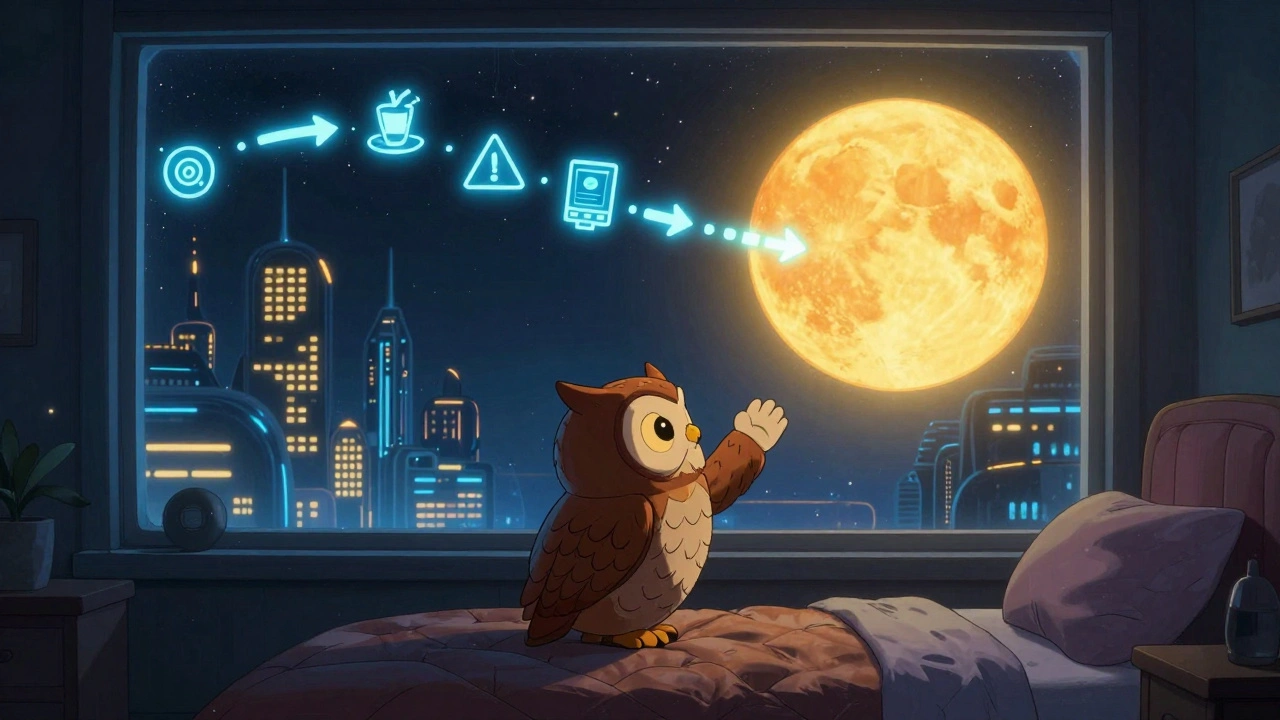
You don’t need to become a morning person. You just need to stop fighting your body. Here’s how:- Get bright light within 30 minutes of waking. Natural sunlight is best. If it’s dark outside, use a 10,000-lux light box. This tells your brain it’s time to be awake - even if you’re an owl.
- Keep your wake time consistent. No matter what day it is. Sleeping in on weekends throws your rhythm off. That’s why social jet lag hurts so much.
- Cut caffeine after 5 p.m. Owls tend to drink coffee later, but caffeine lingers in your system for up to 8 hours. If you’re still awake at 1 a.m., it’s not because you’re wired - it’s because you had a latte at 4 p.m.
- Make your bedroom pitch black. Even a little light from a charger or LED clock can disrupt melatonin. Use blackout curtains. Cover every light.
- Stop scrolling in bed. Owls spend an average of 40 minutes on social media before sleep. That’s not relaxation - it’s mental stimulation that delays sleep onset.
What Employers and Schools Are Starting to Do
The old model - everyone works the same hours - is crumbling. A 2023 Gartner survey found that 42% of global companies now offer flexible scheduling based on chronotype. Remote work made this easier. 67% of remote-first companies allow employees to choose their core hours. Only 38% of office-based companies do the same. Gen Z is more likely to be an owl than any previous generation. 52% of Gen Z workers identify as night owls, compared to just 31% of Baby Boomers. Companies that ignore this are losing productivity. Studies show that when work hours align with chronotype, performance improves by up to 18%. Startups like ChronoHealth are building algorithms that recommend optimal work times based on your sleep patterns. By 2030, the National Sleep Foundation predicts 65% of knowledge-based workplaces will use chronotype-informed scheduling. The cost of ignoring this? $411 billion a year in lost productivity in the U.S. alone.What You Can Do Today
You don’t need to quit your job or change your life. Start small. If you’re a lark: protect your mornings. Don’t schedule meetings before 9 a.m. if you can help it. Use your peak hours for deep work. If you’re an owl: don’t apologize for being late. But do start shifting your schedule by 15 minutes every few days. Get outside in the morning. Turn off screens an hour before bed. Stop drinking coffee after 5 p.m. Track your sleep midpoint for a week. Use a simple app or just write down when you fall asleep and wake up on free days. Calculate the midpoint. That’s your true chronotype. You’re not lazy. You’re not broken. You’re just out of sync with a world that wasn’t built for you. The fix isn’t forcing yourself to wake up earlier. It’s adjusting your environment so your biology can thrive - on your terms.Why This Matters More Than Ever
In a world of remote work, flexible hours, and AI assistants that never sleep, the old 9-to-5 grind is becoming obsolete. Your chronotype isn’t a weakness - it’s a design feature. The future belongs to people who work with their biology, not against it. If you’ve spent years feeling guilty for being tired at 8 a.m., or judged for staying up late - stop. You’re not failing. You’re just a night owl in a lark’s world. And now, you know how to change that.Can you change your chronotype?
Yes, but not overnight. Chronotypes are strongly influenced by genetics, so you can’t turn a night owl into a morning person like flipping a switch. But you can shift your sleep schedule by 1-2 hours over several weeks using light exposure, consistent wake times, and limiting caffeine and screens at night. Research shows 28% of students shifted their chronotype during a single semester by making small, consistent changes.
Are night owls less intelligent than morning larks?
No. Older studies suggested morning types performed better on cognitive tests, but a 2023 study from Imperial College London found the opposite in older adults - night owls scored higher. Cognitive performance depends more on timing than chronotype. A night owl taking a test at 8 p.m. will outperform a lark taking the same test at 7 a.m. if both are tested at their peak alertness. The issue isn’t ability - it’s mismatched scheduling.
Why do I feel worse on Monday mornings?
That’s social jet lag. If you sleep later on weekends, your body shifts its internal clock. When Monday rolls around and you have to wake up early, your body thinks it’s still Saturday night. The bigger the gap between your weekend and weekday sleep times, the worse you feel. Keeping your wake time consistent - even on weekends - reduces this effect dramatically.
Is it healthy to be a night owl?
Being a night owl isn’t inherently unhealthy - but forcing yourself into a lark schedule is. Night owls who can align their work and sleep times with their biology have no increased health risks. The problem is societal pressure. When you’re forced to wake up early, you get less sleep, eat poorly, drink more caffeine, and experience chronic stress - all of which raise your risk for obesity, diabetes, and depression.
How do I find out my chronotype?
Calculate your sleep midpoint on free days. Write down when you fall asleep and wake up without an alarm. Add those times together and divide by two. If your midpoint is around 3 a.m., you’re a lark. If it’s near 7 a.m., you’re an owl. Most people fall between 4:30 a.m. and 5:30 a.m. - that’s the average. You don’t need an app. Just track it for a week.

Carole Nkosi
Let me get this straight - society built an entire economy on the backs of morning larks while calling night owls lazy? That’s not biology, that’s capitalism with a side of moral superiority. You think waking up at 5 a.m. is discipline? Nah. It’s just privilege disguised as virtue. I’ve seen CEOs brag about their 4 a.m. routines while their interns are crashing from sleep deprivation. Wake up, people - your schedule isn’t sacred, it’s engineered.

an mo
Chronotype alignment is a non-negotiable KPI for cognitive ROI. The social jet lag metric correlates directly with cortisol dysregulation and downstream metabolic syndrome risk - particularly in sedentary knowledge workers. Organizations ignoring chronobiological optimization are essentially subsidizing burnout. The $411B productivity loss isn’t anecdotal - it’s actuarial. If your HR department still uses 9-to-5 as a rigid framework, they’re operating in a pre-neuroscience era.

aditya dixit
This is one of the most thoughtful pieces I’ve read on sleep and productivity. I’m an owl who used to feel broken until I learned about sleep midpoint. Now I wake at 9 a.m. every day - even on weekends - and get morning light. It’s not about becoming a lark. It’s about giving your body a chance to breathe. Small changes, big results. Keep sharing this kind of science, not just slogans.

Lynette Myles
They’re lying about the light therapy. The real reason owls are ‘fixed’ is because the government and Big Pharma want you dependent on melatonin pills and antidepressants. They don’t want you syncing with the sun - they want you on a schedule they control. Look at the sleep industry. Billions made off your confusion.

Annie Grajewski
okay but like… why do people think they can just ‘shift’ their chronotype?? like i get the sunlight thing but my body literally screams at me at 6am like ‘who do you think you are??’ and i’m not even caffeine dependent. also why is everyone acting like owls are the new cool kids? i’m just tired. i don’t need a TED talk to tell me i’m not lazy. i just need to not be forced to exist in a world that hates my biology. 🙄

Mark Ziegenbein
Look - I’ve spent 17 years in corporate America and let me tell you something: the 9-to-5 grind is a relic of the industrial age, and anyone who still defends it is either brainwashed or complicit. I’m a night owl. I write my best work between 11 p.m. and 4 a.m. I’ve delivered billion-dollar strategies while everyone else was dreaming. And yet I’m told to ‘get up earlier’ like I’m a child who won’t eat their vegetables. This isn’t about sleep. This is about power. Who gets to define normal? And why does normal always mean ‘convenient for the majority’? The future belongs to those who refuse to conform - and that includes our circadian rhythms.

Rupa DasGupta
Ugh I’m so tired of this. I’m a night owl and I hate how everyone acts like it’s some kind of ‘journey’ or ‘hack’. I just want to sleep when I’m tired and wake up when I’m not dead. But nooo, I have to ‘optimize’ my rhythm like I’m a robot on a factory line. And don’t even get me started on people who say ‘just get morning light’ - like I don’t live in a city with no windows and a boss who thinks ‘flexible hours’ means ‘work at 7 a.m. if you want to be taken seriously’. 😭

Marvin Gordon
My brother’s a night owl. He used to get yelled at for being ‘unproductive’ until he switched to freelance work. Now he’s making more money, sleeping 8 hours, and actually happy. You don’t need to change your biology - you need to change your environment. Find your rhythm, then build a life around it. It’s not selfish. It’s survival.

ashlie perry
They’re watching you. Every time you open your laptop at midnight, they track it. The algorithms know your sleep patterns. They sell your data to employers who use it to ‘optimize’ your work hours. Wake up at 6 a.m. because the system says so - not because you want to. You’re not choosing your rhythm anymore. They are.

Juliet Morgan
Thank you for writing this. I’m a night owl and I’ve spent years feeling guilty. I thought I was broken. I thought I needed to ‘fix’ myself. But reading this? It felt like someone finally saw me. I started turning off screens an hour before bed and now I sleep better than I have in 10 years. It’s not magic. It’s just respect. For your body. For your rhythm. For you.

Norene Fulwiler
In my village in Kerala, people wake with the sun and sleep when it’s dark. No alarms. No caffeine after noon. No screens at night. We didn’t need studies to tell us this was right. We just lived it. Maybe the answer isn’t in tech or apps - maybe it’s in remembering how humans used to live before the clock became our god.
Write a comment