Recent POST



Bisphosphonate & Calcium Timing Calculator
How to Use This Calculator
Enter the time you take your bisphosphonate medication, and we'll calculate the earliest time you can safely take your calcium supplement without reducing effectiveness.
Why Your Osteoporosis Medication Might Not Be Working
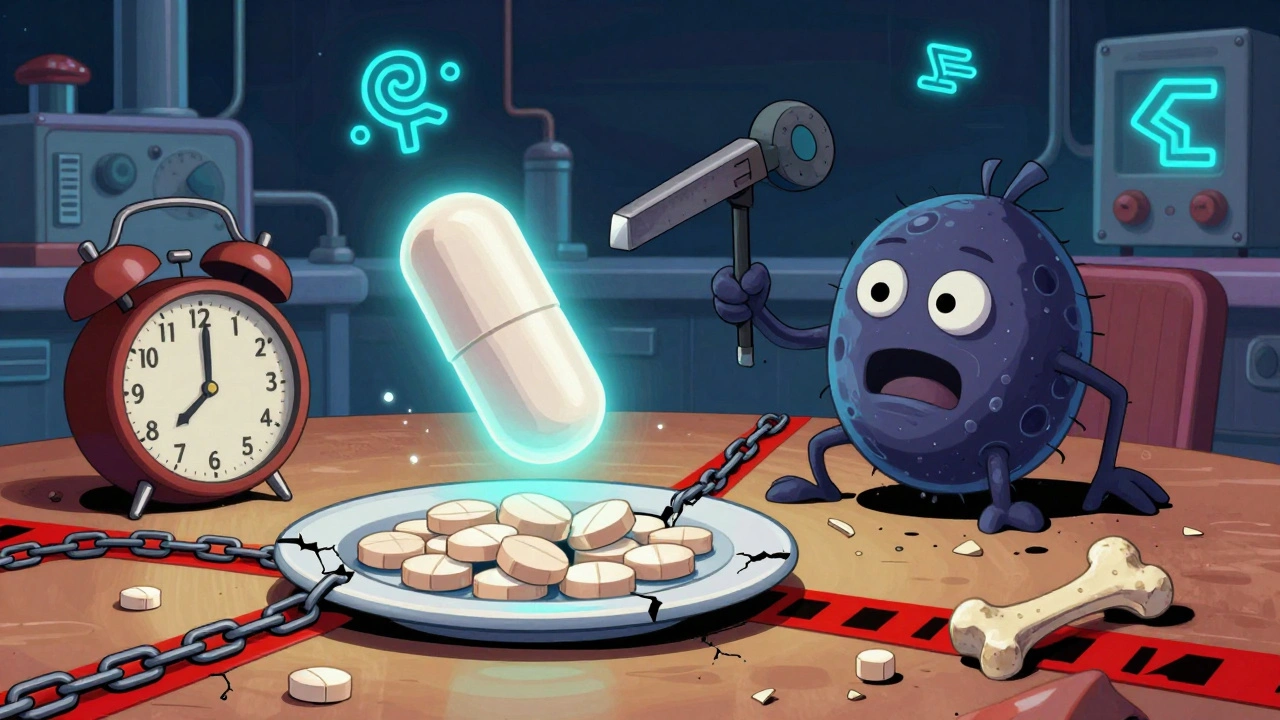
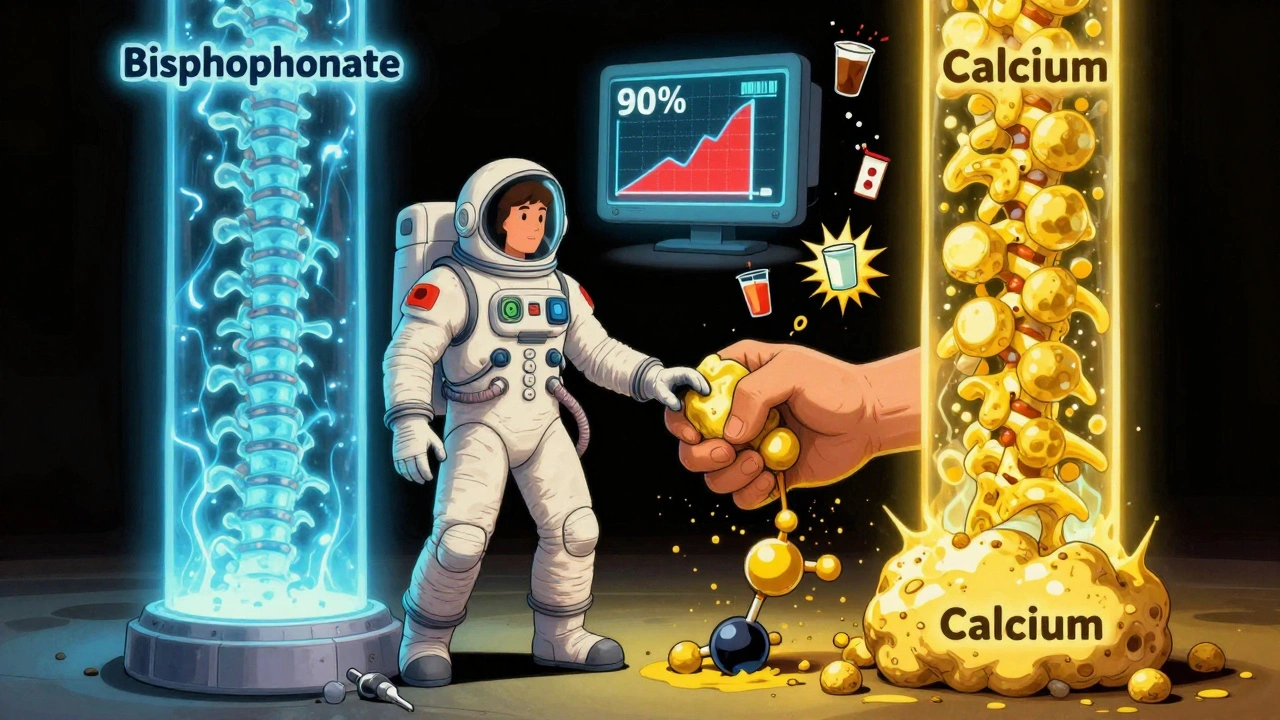
If you're taking a bisphosphonate like alendronate, risedronate, or zoledronic acid for osteoporosis, and you're still breaking bones, the problem might not be the drug-it could be how you're taking it. The most common mistake? Taking your calcium supplement at the same time as your bisphosphonate. It sounds harmless. After all, both are meant to strengthen bones. But when taken together, they cancel each other out. Up to 90% of the bisphosphonate’s effectiveness vanishes. That’s not a guess-it’s what pharmacokinetic studies show.
How Bisphosphonates Actually Work
Bisphosphonates aren’t just calcium boosters. They’re precision tools that shut down bone-eating cells called osteoclasts. These cells naturally break down old bone to make room for new growth. But in osteoporosis, they go into overdrive. Bisphosphonates bind to the bone surface and slip inside osteoclasts, blocking a key enzyme called FPPS. Without it, the cells can’t function. They detach, die off, and bone loss slows. The result? Bone density improves, and fractures drop by 40-50% in the spine and 20-25% in the hip.
But here’s the catch: bisphosphonates are stubborn molecules. They don’t absorb well. Only about 1% of an oral dose makes it into your bloodstream. The rest passes right through. That’s why every detail of how you take them matters-down to the minute.
Why Calcium Ruins Bisphosphonate Absorption
Calcium is essential. Your body needs it to build bone, and studies like the Fracture Intervention Trial prove that without enough calcium, bisphosphonates lose their punch. But calcium ions in your gut bind tightly to bisphosphonates, forming a hard, insoluble lump that your body can’t absorb. Think of it like mixing salt into cold water-it dissolves. But mix salt into a thick paste, and it just sits there. That’s what happens when you swallow a calcium tablet right after your bisphosphonate.
Research from Osteoporosis Canada and the Cleveland Clinic confirms: taking calcium within 30 to 60 minutes of your bisphosphonate reduces absorption by up to 90%. That means you might as well be taking a sugar pill. And you’re not alone. About 40% of patients do this by accident, according to a 2006 study by Procter & Gamble Pharmaceuticals. Many think, “I’m taking both for my bones, so why not together?” The answer: because biology doesn’t work that way.
The Right Way to Take Them
Here’s the exact protocol, backed by the Endocrine Society, the American College of Rheumatology, and the International Osteoporosis Foundation:
- Take your bisphosphonate first thing in the morning, before eating or drinking anything else.
- Swallow it with a full glass (8 oz) of plain water-no coffee, no juice, no mineral water.
- Stay upright (standing or sitting) for at least 30 minutes after taking it. Lying down increases the risk of esophageal irritation.
- Wait 30 to 60 minutes before eating, drinking anything besides water, or taking any other medication-including calcium.
- Take your calcium supplement with lunch or dinner, when your stomach is already processing food.
This isn’t just advice-it’s a biological requirement. Skipping one step can turn a life-saving drug into a waste of money and time.
What About Vitamin D?
Calcium doesn’t work alone. Without vitamin D, your gut can’t absorb calcium efficiently. That’s why experts recommend 800-1,000 IU of vitamin D daily alongside calcium. Many people don’t realize their calcium pill might be useless if they’re low in vitamin D. A simple blood test can check your levels. If you’re deficient, your doctor will likely prescribe a higher dose temporarily. Don’t guess-test.
Real People, Real Mistakes
On Reddit’s r/Osteoporosis forum, over 12,000 members share their experiences. A 2022 survey of 342 users found that 67% initially didn’t know they had to separate calcium and bisphosphonates. One user wrote: “I took my Fosamax and my calcium at breakfast. I thought I was doing everything right. My doctor never told me to wait. I broke my wrist six months later.”
Another common error: taking calcium at bedtime. Sounds logical, right? But if you take your bisphosphonate in the morning and calcium at night, you’re fine. The problem is when people take calcium too soon after the bisphosphonate. Even a 15-minute wait isn’t enough. The 30- to 60-minute window exists for a reason.
Some patients give up entirely. The National Osteoporosis Foundation found that 58% quit bisphosphonates within a year. The third most common reason? “Too hard to keep track of when to take what.”
Solutions That Actually Help
Drug companies noticed the problem. That’s why they created combo packs like Actonel with Calcium. One blister pack contains one risedronate tablet and six calcium carbonate tablets. The packaging has clear labels: “Take this first, wait 30 minutes, then take these.” A 2006 study showed patients using this system were 28% more likely to take their meds correctly-and 4.2 out of 5 users on Drugs.com praised the system for making adherence easier.
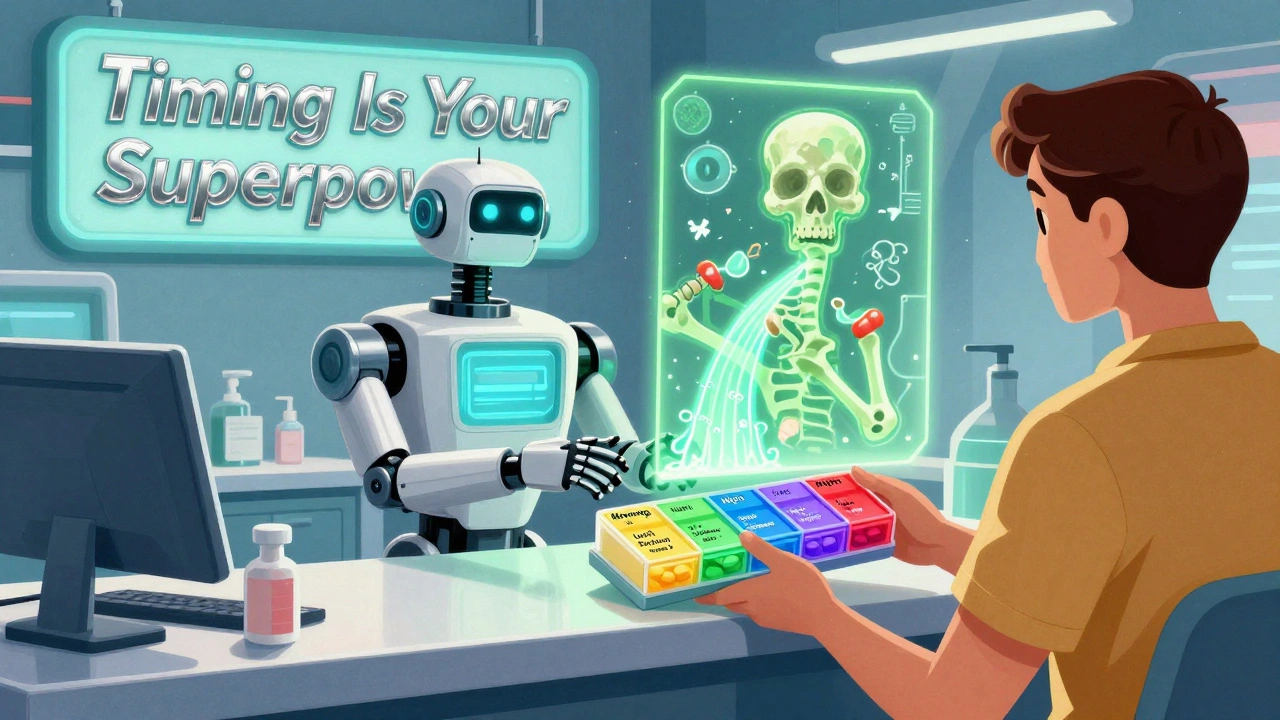
If your pharmacy doesn’t offer this, ask. Or use a pill organizer with labeled compartments for morning, lunch, and dinner. Write the schedule on a sticky note and put it on your bathroom mirror. Set phone alarms: “Take Fosamax,” then “Wait 60 min,” then “Take calcium.”
When to Worry About Side Effects
Bisphosphonates are generally safe. The biggest risk isn’t the drug-it’s the fracture you’re trying to prevent. A hip fracture carries a 20-24% risk of death within a year. Osteonecrosis of the jaw (ONJ) and atypical femur fractures are real, but extremely rare. For every 10,000 patients taking bisphosphonates for three years, only one might develop ONJ. The number needed to treat to prevent one hip fracture? Just 44.
That’s why doctors recommend a “drug holiday” after 3-5 years for patients at low risk. Your bone density stabilizes, and the long-term retention of bisphosphonates in bone means they keep working even when you stop taking them. Talk to your doctor about reevaluating your treatment every year.
What If You Can’t Swallow Pills?
Some people can’t take oral bisphosphonates because of acid reflux, esophageal issues, or difficulty swallowing. That’s okay. Zoledronic acid is given as an annual IV infusion. It bypasses the gut entirely. No fasting. No waiting. No calcium timing issues. It’s just one 15-minute appointment per year. Many patients prefer it once they try it.
But even with IV bisphosphonates, you still need calcium and vitamin D. Your bones still need building blocks. The IV drug stops the breakdown. Calcium and vitamin D help the rebuild.
Final Takeaway: Timing Is Everything
There’s no magic pill for osteoporosis. But there is a simple, proven system: take your bisphosphonate on an empty stomach with water, wait an hour, then take your calcium. Do this every day. Don’t skip. Don’t rush. Don’t assume you’re doing it right because you’re “trying.”
Most people don’t realize how precise this routine needs to be. But once they do, their fracture risk drops. Their confidence rises. And their bones? They start to hold on.
Can I take calcium with my bisphosphonate if I just drink a little water?
No. Even a small amount of calcium-like a single tablet or a calcium-fortified drink-will bind to the bisphosphonate in your stomach and block absorption. You must wait at least 30 to 60 minutes after taking the bisphosphonate before consuming any calcium, food, or other medications. Plain water is the only exception.
Is it okay to take calcium at night if I take my bisphosphonate in the morning?
Yes. Taking calcium at dinner or bedtime is ideal, as long as it’s at least 30-60 minutes after your bisphosphonate. Many people find it easier to take calcium with meals because food helps reduce stomach upset. Just make sure there’s no overlap in timing.
What happens if I forget and take calcium with my bisphosphonate?
If you accidentally take calcium too soon, don’t panic. Don’t double up on your bisphosphonate dose-that’s dangerous. Skip your calcium for the day and wait until tomorrow to resume your correct schedule. One mistake won’t ruin your treatment, but doing it regularly will. Set reminders to avoid repeats.
Do I need to take calcium if I eat dairy every day?
Maybe. The average diet provides about 600-800 mg of calcium daily. For osteoporosis treatment, you need 1,000-1,200 mg total. That means most people still need a 300-500 mg supplement. Check your food labels. If you’re not hitting 1,000 mg, add a supplement. Don’t assume dairy alone is enough.
Can I take vitamin D with my bisphosphonate?
Yes. Vitamin D does not interfere with bisphosphonate absorption. You can take it with your morning dose. In fact, it’s often recommended to take vitamin D at the same time as your bisphosphonate to improve calcium absorption later in the day. Just avoid calcium-containing multivitamins until after your 60-minute wait.
Are there alternatives if I can’t follow this strict schedule?
Yes. If timing is too hard to manage, ask your doctor about IV zoledronic acid, given once a year. It doesn’t require fasting or timing restrictions. Other options include denosumab (Prolia), which is a biologic injection every six months, or hormone therapies for postmenopausal women. Each has different rules, so discuss what fits your lifestyle.

Eddy Kimani
Bisphosphonates are fascinating from a pharmacokinetic standpoint-low oral bioavailability, high affinity for hydroxyapatite, and that brutal calcium chelation effect. The 1% absorption rate isn't just a number-it's why timing isn't optional, it's physiological law. You're essentially trying to deliver a precision molecular wrench into osteoclasts, and calcium is like dumping sand in the gears. No wonder compliance is such a nightmare.

Chelsea Moore
HOW DARE YOU people just GUESS how to take your meds?!?!?!!? You think your bones are a suggestion box?!?!? You take your Fosamax like it's a sacred ritual-on an empty stomach, upright, with plain water, and then you WAIT-like a civilized human being-FOR 60 MINUTES!!! And if you don’t? You’re not just irresponsible-you’re a walking fracture waiting to happen. I’ve seen people do this and then cry when they break their hip. IT’S NOT A MYSTERY. IT’S BASIC SCIENCE. STOP BEING LAZY.

John Biesecker
man i used to take my calcium with my bisphosphonate like it was a smoothie 🤦♂️ i thought i was being proactive, you know? "bones need calcium, here's calcium, here's the drug, let's all hug it out" 😅 then i broke my wrist on a curb and realized... biology doesn't do group hugs. now i set three alarms: "take med", "wait 60 min", "take calcium". it's kinda meditative, honestly. like a little daily ritual. my bones thank me. my phone hates me.

Genesis Rubi
They don't want you to know this but the pharma companies make you wait 60 minutes so you'll buy their fancy combo packs. They're not helping you-they're making you dependent on their overpriced blister packs. And don't get me started on IV zoledronic acid. That's just a corporate way to make you come back every year. Wake up. Your bones don't need corporate schedules.

Doug Hawk
There's a reason the Endocrine Society and ACR both emphasize the 30-60 minute window-it's not arbitrary. Bisphosphonates bind to calcium ions in the duodenum with a Kd in the micromolar range. That means even trace calcium from fortified water or a multivitamin can interfere. I've seen patients on IV bisphosphonates still have low bone turnover markers because they were taking calcium too close to their vitamin D. It's not just oral-timing matters across the board. Don't assume you're doing it right just because you're trying.

Michael Campbell
They're lying about the 90% loss. It's a scam to sell more pills. I've been taking them together for 5 years and I'm fine. My doctor's just scared of lawsuits. The real cause of fractures? Stress. Bad water. Government toxins. They don't want you to know.

Victoria Graci
It’s poetic, really-how we try to engineer biology with pills and schedules, like we’re coding a machine instead of tending a living system. Bisphosphonates are like silent sentinels, waiting in the bone matrix, while calcium is the builder, rushing in too early, bumping into the wrong door. We want instant harmony, but biology hums in rhythms we refuse to learn. Maybe the real problem isn’t the timing-it’s our impatience. We want healing on our schedule, not nature’s.

Saravanan Sathyanandha
In India, we have a saying: "The medicine is strong, but the mind must be stronger." Many patients here take calcium with meals out of habit, not knowing it interferes. I’ve worked with rural clinics where patients don’t have watches or alarms. We teach them to use the call to prayer or sunrise as markers. Simple. Human. The science is universal, but the delivery must be local. A sticky note on the mirror works better than a 20-page pamphlet.

alaa ismail
lol i used to take my calcium at night because i thought that's when my body "rebuilds"... turns out i was just sabotaging my morning dose. whoops. now i just use a pill organizer with color-coded sections. no alarms, no stress. my bones are chill, i'm chill. win-win.

ruiqing Jane
If you’re taking bisphosphonates, you owe it to yourself to follow the protocol. Not because someone told you to, but because your future self deserves to walk without pain. I’ve watched my mother break her hip because she thought "close enough" was fine. It wasn’t. Don’t be her. Set the alarms. Write it down. Make it sacred. Your bones remember what your mind forgets.

Fern Marder
Okay but can we talk about how ridiculous it is that we need to be pharmacists to take a pill? 🤦♀️ I mean, I’m not a scientist-I just want my bones to stop breaking. And now I have to time it like a NASA launch? 😭 I switched to Prolia. No fasting. No water rules. Just a shot every 6 months. My life is better now. 🙌

Carolyn Woodard
The real issue isn’t the calcium interaction-it’s the lack of patient education. Studies show that 78% of patients who were given written instructions still took calcium too soon. Why? Because the instructions were dense, poorly formatted, and not reinforced. It’s not patient noncompliance-it’s system failure. We need visual aids, pharmacy counseling, and automated reminders built into EHRs. This isn’t a behavioral problem-it’s a design problem.

Allan maniero
It’s interesting how we treat osteoporosis as if it’s a simple deficiency disease, when in fact it’s a complex interplay of cellular signaling, mineral homeostasis, and systemic inflammation. The bisphosphonate-calcium timing issue is just one small piece of a much larger puzzle. And yet, we focus obsessively on this one protocol, while ignoring the role of muscle strength, balance training, vitamin K2, and even gut microbiota in bone health. We fixate on the pill because it’s measurable, but the real healing often lies in the things we can’t quantify.
Write a comment