Recent POST

What Is Herpes Simplex Virus?
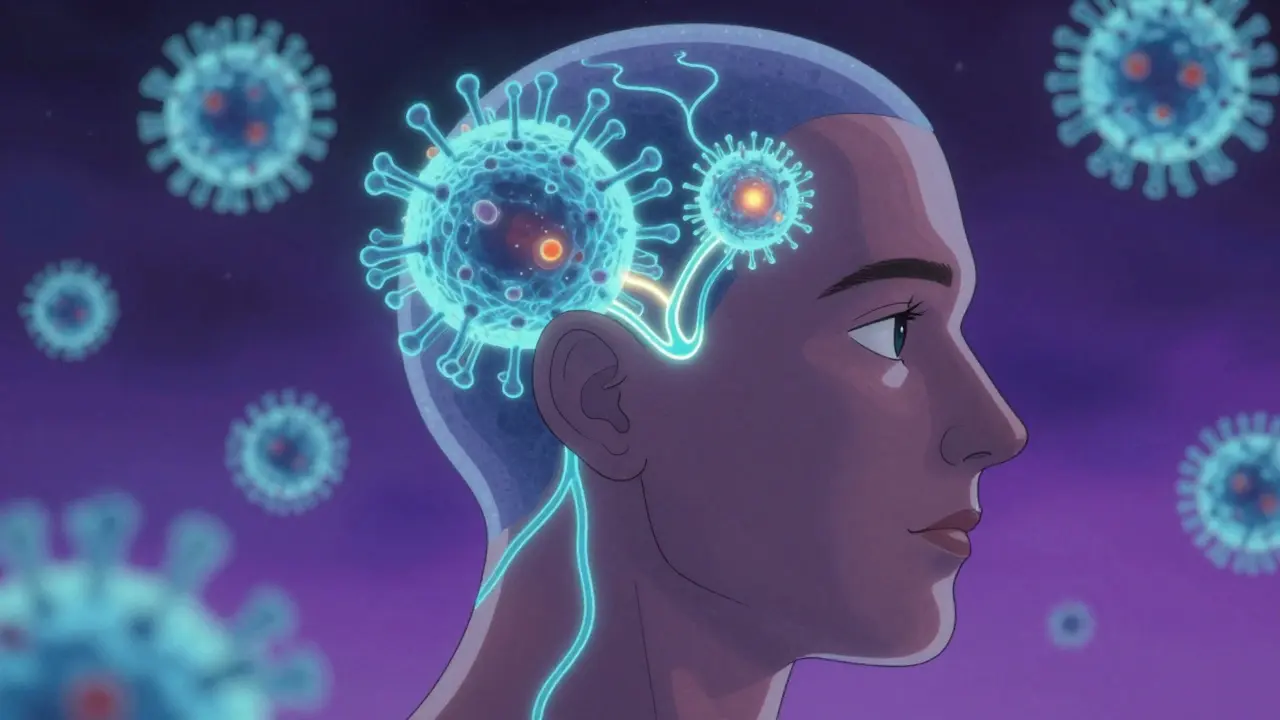
Herpes Simplex Virus (HSV) isn't one virus-it's two. HSV-1 and HSV-2 are closely related but behave very differently in the body. Both are enveloped, double-stranded DNA viruses that infect humans for life. After the first infection, they hide in nerve clusters called ganglia: HSV-1 mostly in the trigeminal ganglion near your face, HSV-2 in the sacral ganglion near your lower spine. They don’t disappear. They just go quiet. Then, for reasons we still don’t fully understand, they wake up and cause outbreaks.
Think of it like a hidden fire. You can’t see it most of the time. But when it flares, you feel it. About 67% of people under 50 worldwide carry HSV-1. That’s nearly 4 billion people. HSV-2 is less common but still affects 13% of people aged 15-49-roughly 491 million. The numbers vary by region, age, and gender. Women are more likely to have HSV-2 than men. In the U.S., Black Americans have a rate more than double that of White Americans.
HSV-1 vs. HSV-2: What’s the Difference?
For decades, we thought HSV-1 = cold sores, HSV-2 = genital herpes. That’s still mostly true-but not always. Today, about 30-50% of new genital herpes cases in high-income countries are caused by HSV-1. Why? Oral sex. The virus moves. A cold sore on your lip can transmit HSV-1 to your partner’s genitals. And HSV-2 can sometimes show up on the mouth, though it’s rare.
Here’s the real difference: recurrence. If you have HSV-1 on your genitals, you might get one outbreak every 2-5 years. With HSV-2? Four to five times a year, on average. Asymptomatic shedding-when the virus is active but you have no symptoms-is also more common with HSV-2. Studies show it sheds on 10-20% of days in people with HSV-2, compared to 5-10% for HSV-1. That’s why transmission risk is higher.
There’s also a difference in complications. HSV-1 causes 98% of herpes keratitis-a serious eye infection that can lead to blindness. It’s the leading infectious cause of corneal scarring in the U.S. HSV-2, on the other hand, is behind 70% of neonatal herpes cases. That’s when a baby catches the virus during birth. It’s rare-about 1 in 3,200 births-but dangerous. HSV-1 causes more severe outcomes in newborns than HSV-2.
What Do Herpes Outbreaks Look Like?
Outbreaks follow a pattern. It starts with a warning. A tingling, burning, or itching sensation in the area where blisters will appear. For HSV-1 on the lip, it’s often right before a cold sore forms. For HSV-2 on the genitals, it’s a similar sensation in the pubic area, buttocks, or inner thighs. This prodrome lasts less than 6 hours in recurrent cases, but can last longer during the first outbreak.
Then come the blisters. Small, fluid-filled sores, usually in clusters. They’re 0.5 to 1.5 cm wide. They don’t itch like chickenpox-they hurt. They turn into open sores, then crust over, and heal without scarring. The whole process takes 7 to 21 days for a first outbreak. Recurrent ones are faster: 5 to 10 days.
Primary HSV-1 infection in kids often looks like gingivostomatitis: fever up to 40°C, swollen gums, mouth ulcers, bad breath, trouble swallowing. About 5-10% of these kids end up in the hospital. Primary genital HSV-2? 93% have painful ulcers. 78% have trouble peeing. 65% have swollen lymph nodes in the groin. Half have discharge. And 40% feel generally sick-fever, muscle aches, headache.
Most people don’t realize they have herpes until they have an outbreak. Some never have one. But even without symptoms, the virus can still spread. That’s why so many people are infected without knowing it.

How Is Herpes Diagnosed?
Doctors don’t just guess. If you have sores, they’ll swab them. The best test is PCR-it detects the virus’s DNA. It’s 95-98% accurate. Viral culture is older and less reliable (70-80% accurate). Blood tests exist too. Type-specific serologic tests look for antibodies to HSV-1 or HSV-2 using glycoprotein G (gG) markers. These are 97-98% accurate but only after 12-16 weeks post-infection. That’s because your body takes time to build antibodies.
Testing right after symptoms start gives the clearest result. Waiting too long? The virus may be gone from the sore, and you’ll get a false negative. That’s why timing matters. If you’ve had unprotected sex and are worried, get tested. Even if you don’t have symptoms, a blood test can tell you if you’ve been exposed.
Antiviral Therapy: What Works and What Doesn’t
There’s no cure. But there are three main antivirals that help: acyclovir, valacyclovir, and famciclovir. They don’t kill the virus. They slow it down. That means fewer outbreaks, shorter healing times, and less spreading.
For a first genital outbreak, the CDC recommends acyclovir 400mg three times daily for 7-10 days. Valacyclovir 1g twice daily for 7-10 days works just as well-and you take it fewer times a day. Studies show these drugs cut healing time from 19 days to 10, and pain from 12 days to 8.
For recurrent outbreaks, you can take the same drugs but only when you feel the warning signs. That’s called episodic therapy. If you start within 24 hours of the first tingle, you can reduce the outbreak by half. Delay treatment past 72 hours? The benefit drops sharply.
For people with frequent outbreaks (six or more a year), daily suppressive therapy is an option. Valacyclovir 500mg once a day cuts transmission to partners by 48%. For HSV-1 genital cases, this isn’t always needed-recurrences are rare. But for HSV-2? It’s life-changing. One study found people on daily therapy had 75% fewer outbreaks.
For severe cases-like herpes encephalitis or infections in immunocompromised patients-higher doses are used. IV acyclovir at 5-10mg/kg every 8 hours. For eye infections, topical trifluridine drops are applied hourly. They cut healing time from 21 days to 14.
What About Resistance and New Treatments?
Most people respond well. But in people with weak immune systems-like those with HIV and low CD4 counts-resistance is growing. About 10% of HSV isolates in this group don’t respond to acyclovir. That’s when doctors switch to foscarnet or cidofovir. In 2023, the FDA approved pritelivir, a new drug that blocks the virus’s replication machinery. In trials, it reduced viral shedding by 87% in 48 hours-better than foscarnet. It’s now used for acyclovir-resistant cases.
There are also new drugs in the pipeline. Helicase-primase inhibitors like amenamevir and pritelivir are showing 90% viral suppression in 24 hours. That’s faster than current drugs. Therapeutic vaccines are being tested too. One called GEN-003 reduced shedding by 50% in early trials. Not a cure. But a big step.
The Real Challenge: Stigma and Mental Health
Herpes isn’t just a physical condition. It’s emotional. A 2023 survey by the American Sexual Health Association found 74% of people with herpes feel anxiety about stigma. 45% say it’s hurt their relationships. 32% waited over six months to tell a partner.
Online communities show how deep this runs. One Reddit user wrote: “First outbreak lasted 18 days. Fever hit 39.2°C. I couldn’t pee without numbing spray.” Another said: “I tried acyclovir. Nausea was unbearable. Switched to famciclovir. No side effects. Outbreaks are gone.”
Cost is another barrier. In the U.S., valacyclovir costs $35-$60 a month with insurance. Without it? $300-$400. Many people skip doses or stop because they can’t afford it. And even when they can, only 65% stick with daily therapy for a full year.
Knowledge helps. After three outbreaks, 85% of people learn to recognize the warning signs. That’s when they gain control.
What Can You Do Right Now?
- If you have sores, get swabbed ASAP. Don’t wait.
- If you’ve had unprotected sex and are unsure, get a blood test after 16 weeks.
- If you have frequent outbreaks, talk to your doctor about daily suppressive therapy.
- If you’re on antivirals, take them as prescribed-even if you feel fine.
- If you’re in a relationship, talk openly. Transmission risk drops by nearly half with daily therapy.
- If you’re pregnant, tell your provider. HSV-2 can be managed to prevent passing it to your baby.
Herpes is common. It’s manageable. It’s not a moral failure. It’s a virus. And like all viruses, it responds to science-not shame.

Sabrina Sanches
I had my first outbreak last year and thought I was dying. Turns out? It’s manageable. Started valacyclovir on day two and my healing time cut in half. No more panic. Just peace. You’re not broken. You’re just carrying a common virus. Seriously. Breathe.

Shruti Chaturvedi
In India we don’t talk about this enough. My cousin got HSV-2 and her family thought it was punishment. She stopped taking meds because of shame. This post is important. Knowledge saves lives. No stigma. Just science.

Katherine Rodriguez
67% of people under 50 have HSV-1? That’s not a virus. That’s a national emergency. Why isn’t the CDC doing more? Why is this still not mandatory in sex ed? We’re living in a pandemic of denial and it’s ridiculous.

Devin Ersoy
Let’s be real - herpes is the new ‘socially acceptable’ STD. Everyone’s got it. My ex had HSV-1 on her lips and I got it on my butt from a kiss. Not tragic. Just… inconvenient. Funny how we panic over a virus that’s older than the pyramids. Honestly? It’s like having a cold that occasionally throws a party.

Scott Smith
The data on asymptomatic shedding is critical. People think no symptoms = no risk. That’s dangerously wrong. I work in public health. I’ve seen too many cases where transmission happened during ‘quiet’ periods. Testing. Disclosure. Medication. These aren’t optional. They’re basic responsibility.

Sally Lloyd
Did you know the CDC’s numbers are manipulated? They exclude asymptomatic carriers in some surveys. And why is there no mention of the pharmaceutical industry’s role in promoting antivirals? Who profits? Who owns the patents? The real story isn’t in the article. It’s in the shadows.

Emma Deasy
I cannot express, with adequate gravitas, the profound emotional and psychological toll that this virus inflicts upon the human spirit. The stigma, the isolation, the whispered confessions in the dead of night - these are not merely medical phenomena. They are existential crises wrapped in a single, misunderstood DNA strand. I weep for those who suffer in silence. And I beg you - if you are reading this - do not wait. Seek help. Speak. Be heard.

tamilan Nadar
In my village in Tamil Nadu, we used neem leaves and turmeric paste. It worked. Not as fast as antivirals maybe, but it didn’t cost a fortune. People heal differently. Science is great. Tradition has heart too. No need to shame either.

Adam M
Stop overcomplicating it. Take the pill. Don’t have sex during outbreaks. Tell your partner. Done.
Write a comment