Recent POST
You might think you know the difference between a generic pill and its brand-name counterpart. You take the cheaper one, save money, and get the same result. Simple, right? Now imagine that same scenario but with complex injections for autoimmune diseases or cancer. The rules change completely. In the world of biologic drugs, there is no such thing as a "generic." Instead, we have biosimilars, which are highly similar versions of reference biologic products that are not chemically identical but demonstrate no clinically meaningful differences in safety, purity, and potency. This distinction isn't just semantic; it drives massive price differences, regulatory hurdles, and real-world savings for patients.
If you are looking at your prescription bill and wondering why a biologic costs thousands while a small-molecule generic costs pennies, you are facing the most significant cost driver in modern healthcare. As of 2024, biologic drugs account for only 5% of prescriptions in the U.S. but represent 51% of total drug spending. Understanding the gap between brand biologics and biosimilars is essential for anyone managing chronic conditions, navigating insurance formularies, or simply trying to understand why healthcare costs remain so high.
The Fundamental Difference: Chemistry vs. Biology
To understand the cost difference, you first need to understand what you are buying. Traditional generics are copies of small-molecule drugs. Think of acetaminophen. Whether it comes from Tylenol or a store brand, the chemical structure is exactly the same: C8H9NO2. It is synthesized in a lab through precise chemical reactions. If the molecule matches, the drug works the same way.
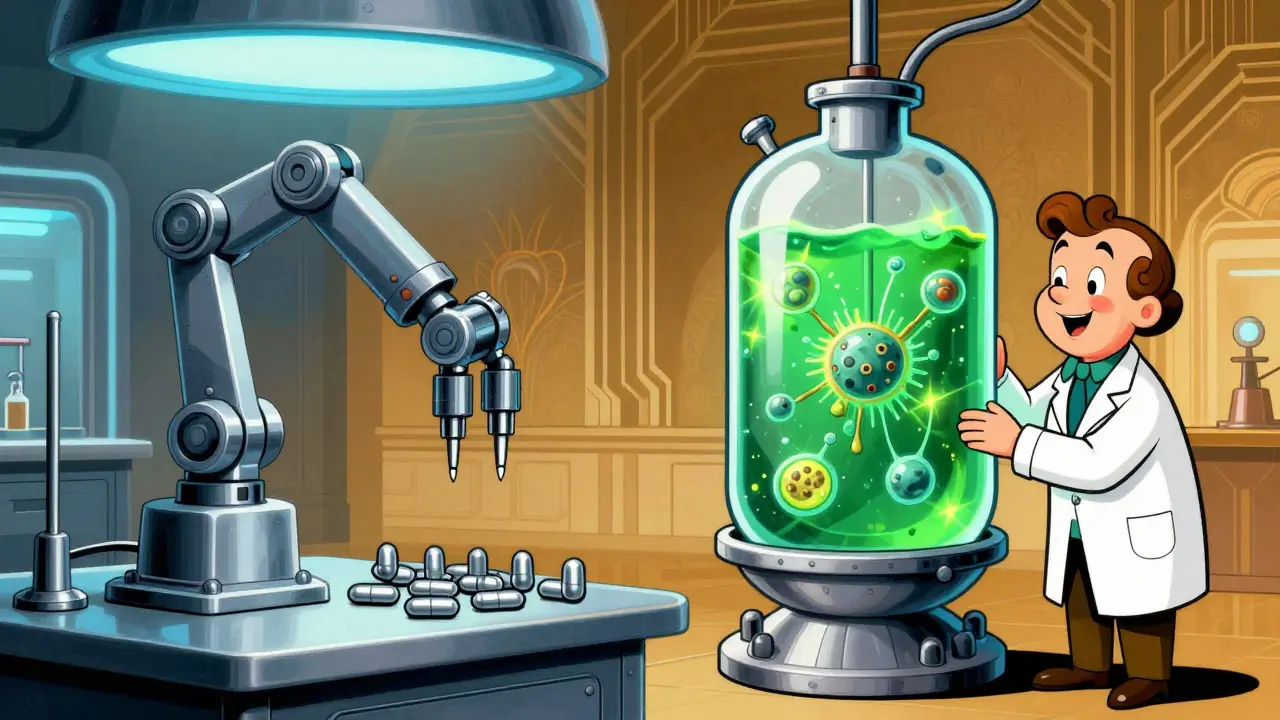
Biologics are different. They are large, complex molecules made by living cells-bacteria, yeast, or animal cells. Because they are grown rather than built, no two batches are ever perfectly identical. There is natural variation. Therefore, a biosimilar cannot be an exact copy. It must be "highly similar" to the original reference product, with no clinically meaningful differences. This complexity requires extensive testing to prove equivalence, which adds to development time and cost, though still significantly less than developing a new drug from scratch.
| Feature | Traditional Generic | Biosimilar |
|---|---|---|
| Molecular Structure | Identical to brand | Highly similar, not identical |
| Manufacturing Process | Chemical synthesis | Living cell cultures |
| Regulatory Pathway | Abbreviated New Drug Application (ANDA) | Biosimilar License Application (BLA) |
| Interchangeability | Automatic substitution allowed | Requires specific "interchangeable" designation |
| Typical Discount | 79-85% lower than brand | 40-50% lower at launch |
The Price Gap: How Much Do You Actually Save?
The headline number is striking. According to data from Brown & Brown's Q3 2025 pharmaceutical pricing report, the average cost for a 30-day prescription of a brand reference biologic was $2,104. In contrast, a biosimilar biologic averaged $919. That is a 56.3% reduction in cost. For a patient paying out-of-pocket or hitting a deductible, this difference can mean the difference between adherence and rationing medication.
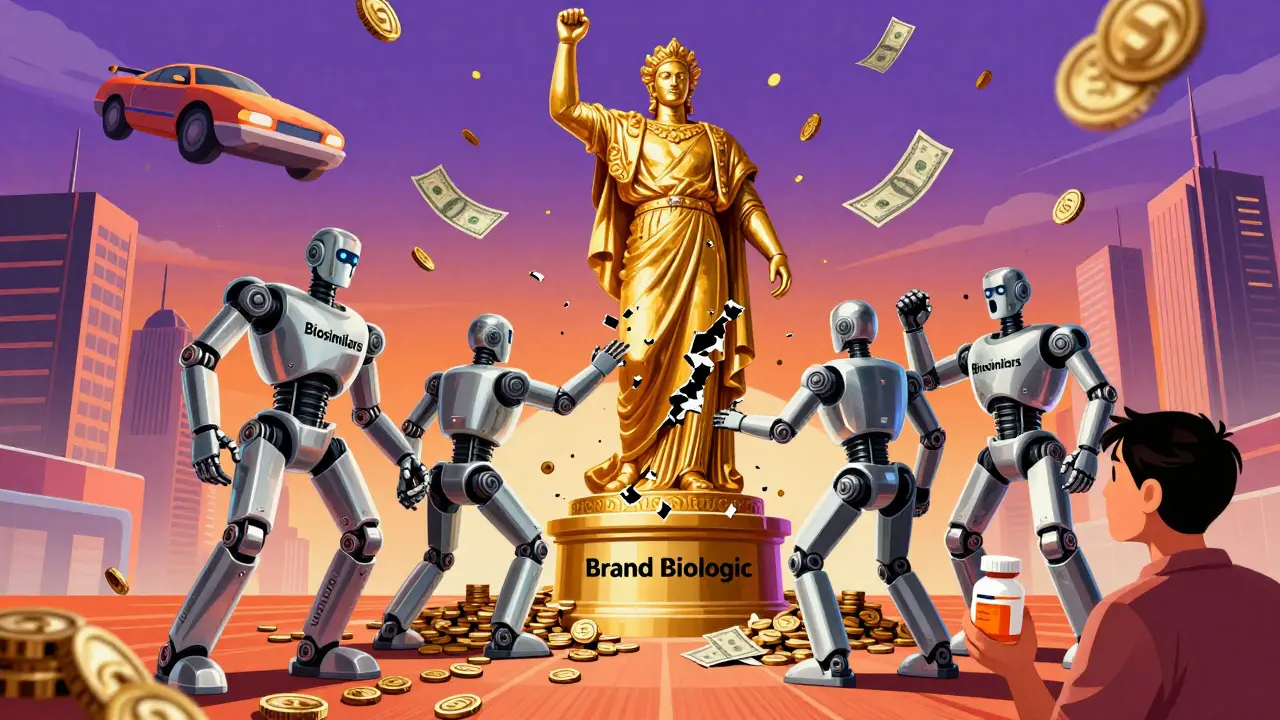
However, the savings story gets more nuanced over time. When a biosimilar first launches, it typically enters the market at a discount of roughly 40% below the reference product, according to the Association for Accessible Medicines (AAM) 2024 Savings Report. But competition drives prices down further. Once multiple biosimilars enter the market, discounts deepen. We saw this clearly with adalimumab (Humira). When Humira lost patent protection in 2023, it had been generating over $21 billion annually. Within months, biosimilars captured approximately 65% of the market share. Sandoz’s Hyrimoz alone took 14% share, often priced at an 80% discount compared to Humira’s original list price of around $80,000 per patient annually.
It is also worth noting that the entry of biosimilars doesn't just help those who switch. It puts pressure on the brand name too. Reference biologics themselves have seen average price reductions of 33% following biosimilar entry into the market, according to AAM data. So even if you stay on the brand, the market dynamics shift in your favor.
Why Aren't More People Switching? The Adoption Barrier
If biosimilars are cheaper and equally effective, why isn't everyone using them? As of October 2025, the FDA has approved 76 biosimilars. Yet, their market share remains stubbornly below 20%. Compare this to traditional generics, which account for 90% of all prescriptions written. Something is blocking the flow.
The primary culprit is a combination of legal maneuvering and financial incentives misaligned with patient welfare. Brand pharmaceutical companies deploy what experts call "patent thickets." These are dense webs of secondary patents covering everything from formulation to dosing schedules, designed to delay biosimilar market entry. The Community Specialty Pharmacy (CSRxP) 2025 fact sheet notes that these tactics effectively "game the U.S. patent system," keeping cheaper alternatives off shelves for years after the core patent expires.
Then there are Pharmacy Benefit Managers (PBMs). PBMs negotiate rebates with drug manufacturers. Often, they secure higher rebates from expensive brand-name drugs than from biosimilars. This creates a "rebate wall." Even if a biosimilar is cheaper upfront, the PBM might financially benefit more from steering patients toward the brand because of the backend rebate. This disconnect means that the lowest cash price doesn't always win in formulary decisions.
Safety and Efficacy: Is "Similar" Good Enough?
This is the question that keeps many patients and doctors awake at night. Can you trust a drug that isn't an exact copy? The scientific consensus is clear. Dr. Sarah Y. Vinson, Director of the FDA's Office of Therapeutic Biologics and Biosimilars, stated in September 2025 that "FDA-approved biosimilars are as safe and effective as the branded drugs."
The approval process is rigorous. Developers must conduct extensive analytical studies to show structural similarity, followed by pharmacokinetic and pharmacodynamic studies to ensure the body processes the drug similarly. Clinical trials are required to confirm efficacy and safety in relevant patient populations. The FDA does not approve a biosimilar unless it demonstrates no clinically meaningful differences from the reference product.
Real-world evidence supports this. Post-market surveillance data consistently shows comparable adverse event profiles. However, perception lags behind science. Some physicians remain hesitant to switch patients who are stable on a brand product, fearing any potential variability. This "if it ain't broke, don't fix it" mentality contributes to slow adoption rates.

The Future Outlook: Policy Changes and Market Shifts
The landscape is shifting. Recognizing the missed opportunity for savings, the Biden administration launched the "Biosimilars Action Plan" detailed in the HHS November 2025 fact sheet. The goal is to remove barriers and align incentives. The Office of the Assistant Secretary for Planning and Evaluation estimates that properly aligning these incentives could save $42.9 billion in medical costs by 2027.
Regulatory reforms are also underway. The FDA released draft guidance in September 2025 aimed at simplifying biosimilarity studies and reducing unnecessary clinical testing. This should lower development costs, which currently range from $100 million to $250 million per product according to the Biotechnology Innovation Organization (BIO). Lower barriers to entry mean more competitors, which historically leads to lower prices.
Industry analysts at Evaluate Pharma project that biosimilar market penetration will jump from current levels of 15-20% to 35-40% by 2030. This growth could generate an additional $125 billion in annual savings. The cumulative impact is already visible: the U.S. Department of Health and Human Services reported that biosimilars generated $56 billion in healthcare savings since 2015, with $20 billion saved in 2024 alone.
What Should Patients and Providers Do?
If you are a patient prescribed a biologic, here are practical steps to manage costs:
- Ask about biosimilars: Specifically ask your doctor if a biosimilar or interchangeable version is available for your condition. Many providers are aware of them but may not proactively suggest them due to inertia.
- Check your formulary: Contact your insurance provider to see which products are covered at the lowest tier. Sometimes the brand is preferred due to rebate structures, but patient assistance programs can offset costs.
- Understand interchangeability: Not all biosimilars are designated "interchangeable." Only interchangeable biosimilars can be substituted at the pharmacy without the prescriber's intervention, depending on state laws. If your biosimilar is not interchangeable, your doctor needs to write a specific prescription for it.
- Monitor your response: While switching is generally safe, communicate openly with your healthcare team about any changes in symptoms or side effects after transitioning to a biosimilar.
For healthcare systems and payers, the focus must shift from rebate maximization to net cost reduction. Aligning PBM incentives with patient out-of-pocket costs is critical. Additionally, supporting physician education on biosimilar safety can reduce hesitation and accelerate appropriate utilization.
Are biosimilars as safe as brand-name biologics?
Yes. The FDA requires rigorous testing to prove that biosimilars have no clinically meaningful differences in safety, purity, and potency compared to the reference product. Extensive clinical trials and post-market surveillance support their equivalent safety profiles.
Can my pharmacist automatically substitute a biosimilar for my brand biologic?
Only if the biosimilar is designated as "interchangeable" by the FDA and your state allows automatic substitution. Non-interchangeable biosimilars require a specific prescription from your doctor. Check with your pharmacist and provider to understand local regulations.
How much can I expect to save by switching to a biosimilar?
Savings vary by product and payer. On average, biosimilars launch at a 40-50% discount to the reference product. With increased competition, discounts can reach up to 80%. Out-of-pocket costs for patients using biosimilars are typically 23% lower than for reference biologics.
Why aren't biosimilars more widely used if they are cheaper?
Barriers include "patent thickets" created by brand companies to delay entry, rebate structures that favor expensive brands for Pharmacy Benefit Managers (PBMs), and physician/patient hesitation due to perceived risks despite evidence of safety.
What is the difference between a generic and a biosimilar?
Generics are chemically identical copies of small-molecule drugs. Biosimilars are highly similar versions of complex biologic drugs made from living cells. Because biologics cannot be perfectly copied, biosimilars undergo different, more extensive testing to prove similarity rather than identity.