Recent POST




Imagine feeling a sharp, knife-like pain every time you go to the bathroom - not just during, but for 30 to 90 minutes after. That’s what many people with anal fissures experience. It’s not just discomfort. It’s a cycle of pain, fear, and avoidance that can make sitting, walking, or even laughing unbearable. And yet, most people don’t talk about it. They suffer in silence, thinking it’s just a bad hemorrhoid or something they caused by eating wrong. The truth? Anal fissures are more common than you think - and they’re not your fault.
What Exactly Is an Anal Fissure?
An anal fissure is a small tear in the lining of the anal canal, the short passage that connects the rectum to the outside of the body. It’s not a cut you can see with the naked eye unless it’s chronic, but you’ll definitely feel it. Most tears happen in the back (posterior) of the anus - about 90% of cases - and the rest show up in the front (anterior). These tears don’t heal on their own if they stick around longer than eight weeks. That’s when they become chronic. The main trigger? Straining during bowel movements. Hard stools from constipation are the #1 cause. But it’s not just about diet. Childbirth, diarrhea, Crohn’s disease, and even anal sex can lead to tears. In babies, it’s often linked to formula or early solid foods. In adults, it’s usually tied to low fiber intake, dehydration, or holding in stool too long.Why Does It Hurt So Much?
It’s not just the tear itself. The real problem is what happens after. When you pass stool and the tear opens up, it triggers a reflex - your internal anal sphincter (a muscle you can’t control) goes into spasm. This muscle normally stays tight to hold in stool, but when it spasms, it squeezes so hard it cuts off blood flow to the torn area. That’s why healing stalls. The pain makes the muscle clamp down, and the clamping stops healing. It’s a loop: pain → spasm → less blood → no healing → more pain. Doctors measure this muscle pressure. Normal resting pressure is 15-20 mmHg. In someone with a chronic fissure, it can spike to 25-30 mmHg or higher. When pressure stays above 25 mmHg, healing drops to under 20%. Below that, 85% of cases heal on their own within six weeks.What Are the Signs You Have a Fissure?
The symptoms are hard to miss:- Sharp, burning pain during and after bowel movements - often lasting over an hour
- Bright red blood on toilet paper or in the bowl (not dark or mixed with stool)
- Itching or irritation around the anus
- A small skin tag near the tear (called a sentinel pile - a sign it’s chronic)
- Feeling like you haven’t fully emptied your bowels
First-Line Treatment: Food, Water, and Warm Baths
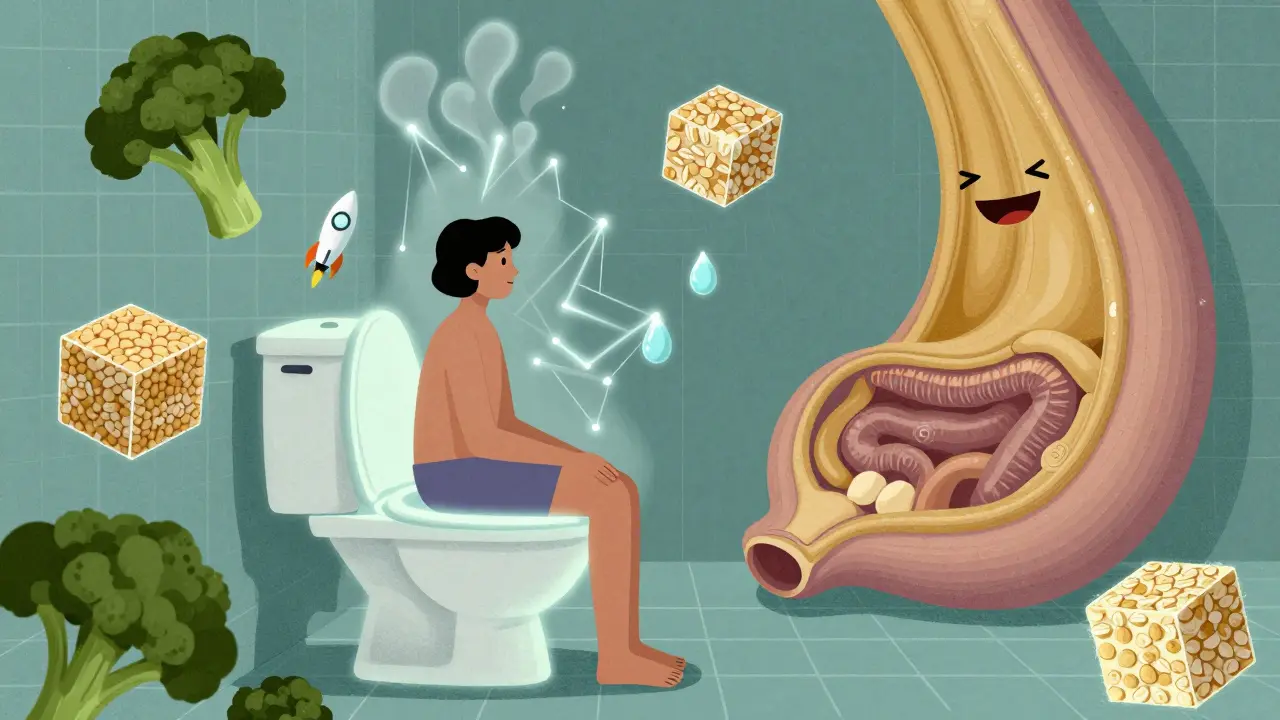
Before you reach for creams or pills, start here - because 82% of acute fissures heal with these three simple steps:- Eat 25-35 grams of fiber daily. That’s about 2 cups of cooked lentils, or 3 cups of broccoli, plus a pear and a bowl of oatmeal. Most people in Western countries eat only 15 grams. Increase slowly - jumping to 40 grams can make bloating worse. The goal is soft, easy-to-pass stools, not diarrhea.
- Drink 2.5 to 3 liters of water every day. Fiber without enough water turns into a brick. Water keeps stool soft and helps fiber do its job.
- Take sitz baths. Sit in warm (not hot) water for 10-20 minutes, 3-4 times a day - especially after bowel movements. This relaxes the sphincter, increases blood flow, and cleans the area gently. No soap. Just warm water.
Topical Medications: What Actually Works
If diet and baths aren’t enough after 2-3 weeks, topical ointments can break the pain-spasm cycle. Not all are created equal:- Nitroglycerin (Rectiv): 0.2-0.4% ointment. Helps relax the muscle. Works in 45-68% of cases. But 1 in 3 people get bad headaches. Not ideal if you’re already sensitive to pain.
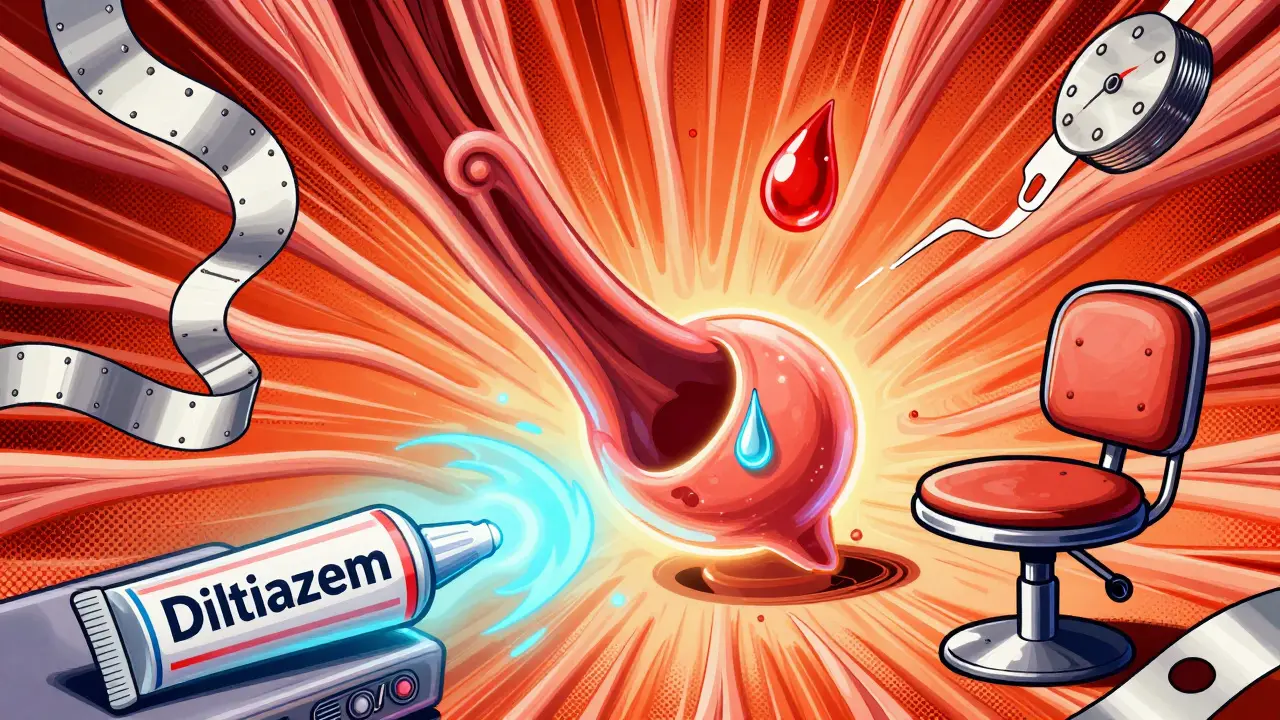
- Diltiazem (2%): A calcium channel blocker. Healing rate: 65-75%. Fewer side effects than nitroglycerin. Often recommended as first-choice medication by European guidelines in 2023.
- Nifedipine (0.3%): Similar to diltiazem. 70% healing rate. Less likely to cause dizziness or headaches. Preferred by Mayo Clinic’s colorectal team.
Botox and Surgery: When to Go Deeper
If ointments don’t work after 8-12 weeks, or if the fissure is clearly chronic (with a skin tag and swollen papilla), it’s time to consider stronger options.- Botox injections: A small amount (15-30 units) is injected directly into the internal sphincter. It temporarily paralyzes the muscle, reducing pressure and allowing healing. Success rate: 50-80%. But 40% of people see the fissure come back within a year. It’s a middle ground - less invasive than surgery, but not always permanent.
- Internal sphincterotomy: The gold standard for chronic cases. A tiny cut is made in the sphincter muscle to permanently reduce pressure. Healing rate? 92-98%. Most people return to work in 3-4 days. But there’s a catch: 14% develop minor incontinence - usually just a bit of gas or occasional spotting. For many, it’s worth it. The trade-off is better than living with daily pain.
What Can Go Wrong? Red Flags to Watch For
Not every anal pain is a fissure. Up to 10% of people diagnosed with fissures actually have something else:- Crohn’s disease (inflammatory bowel disease)
- Anal cancer
- Sexually transmitted infections like herpes or syphilis
- Chronic diarrhea from other causes
- You’re over 50 and have new anal symptoms
- The pain isn’t centered in the back or front
- You have weight loss, fever, or blood mixed with stool
- The fissure doesn’t improve after 8 weeks of treatment

Real People, Real Results
One patient from Perth, 34, had chronic fissures for 11 months. She tried fiber, sitz baths, even nitroglycerin - nothing stuck. Her pain made her miss work and avoid social events. She switched to diltiazem ointment, applied exactly as directed. Within 72 hours, the stabbing pain dropped by 60%. After six weeks, the tear was gone. No surgery. No Botox. Just consistency. Another man, 42, ignored his symptoms for months. He thought it was “just hemorrhoids.” When he finally saw a specialist, the fissure had turned chronic with a skin tag. He had a sphincterotomy. He says: “I didn’t realize how much pain I was living with until it was gone.”Preventing Recurrence
Healing is one thing. Staying healed is another. Fissures have a high recurrence rate - up to 30% - if you go back to old habits.- Keep eating 25+ grams of fiber daily - even after you feel better.
- Drink water before meals, not just when you’re thirsty.
- Don’t delay bowel movements. The longer you hold it, the harder it gets.
- Avoid straining. If you’re pushing, stop. Walk around. Try again later.
- Use a footstool when pooping. Elevating your feet mimics a squatting position, which straightens the rectum and reduces pressure.
Final Thoughts: You’re Not Alone
Anal fissures are embarrassing to talk about - but they’re not rare. One in 10 adults will get one. They’re not caused by poor hygiene, promiscuity, or weakness. They’re caused by hard stools and tight muscles. And they’re fixable. The key is starting early. Don’t wait until the pain controls your life. Eat more fiber. Drink more water. Soak in warm baths. If that doesn’t work, ask your doctor about diltiazem or nifedipine. Surgery isn’t failure - it’s freedom.Healing takes time. But with the right steps, you can get back to living without fear of the next bowel movement.

Sidra Khan
Okay but why is everyone acting like this is some groundbreaking medical revelation? I’ve had fissures since I was 19 and the only thing that actually worked was surgery. Everything else is just fancy placebo with a side of fiber.

Steven Mayer
Posterior fissures account for 85-90% of cases due to the biomechanical vulnerability of the midline posterior mucosa. The internal anal sphincter hypertonicity is measurable via anorectal manometry, with resting pressures exceeding 25 mmHg correlating with impaired perfusion and delayed healing. First-line therapy must target neurogenic spasm via calcium channel blockers - diltiazem demonstrates superior efficacy to nitroglycerin in randomized controlled trials with fewer systemic side effects.
Topical application requires precise dosing: 1.25-inch ribbon, 2x daily, for minimum 8 weeks. Compliance is the primary reason for therapeutic failure - not pharmacological inadequacy.
Footstool use alters anorectal angle from 90° to 110°, reducing straining by 30%. This is biomechanically equivalent to squatting, which is evolutionarily optimal for defecation.
Stem cell therapy remains investigational. Phase II trials from Johns Hopkins show 73% mucosal regeneration at 8 weeks, but long-term recurrence data is absent. Don’t mistake experimental for established.

Ademola Madehin
bro i had one of these for 8 months and i was crying every time i sat down. i tried everything - aloe, coconut oil, even that weird indian herb my grandma swore by. nothing. then i tried diltiazem like the post said and within 3 days i felt like a new man. i didn’t even tell my friends i was in pain. they thought i was just moody. turns out i was just leaking blood every time i pooped.
you think it’s embarrassing? it’s worse when you’re scared to go to the doctor because you think they’ll judge you. they won’t. they’ve seen it all.

Andy Grace
Thanks for sharing this. I’ve been avoiding the topic because I thought it was something I brought on myself - like I was just ‘not eating right.’ But the part about sphincter spasm and blood flow really clicked. I’ve been doing the sitz baths and upping fiber, but I didn’t know why they worked. Now I get it. I’ll stick with it for the full 6 weeks.

Charles Barry
Let me guess - Big Pharma paid the Cleveland Clinic to push diltiazem. Nitroglycerin’s been around since the 1800s. Why replace it? Because they want you buying a new $120 tube every month. And don’t get me started on ‘stem cell injections’ - that’s how they get you to pay $20k for a placebo. The real cure? Stop eating processed garbage and squatting like a human being. Not some corporate-approved ointment.
Also - why are you all ignoring the fact that 70% of fissures resolve on their own? You’re being manipulated into medical dependency.

Joe Jeter
So you’re telling me I’m supposed to eat 35 grams of fiber? That’s like 7 cups of broccoli. Who has time for that? I’m not a rabbit. And sitz baths? I’m not taking a 20-minute bath after every poop. That’s not hygiene - that’s a spa day with a side of shame.
Also - why is everyone acting like this is new? My grandpa had this in the 70s and they just told him to ‘stop holding it in.’ Problem solved.

Bartholomew Henry Allen
HEALING IS A PRIVILEGE. YOU NEED TIME. YOU NEED WATER. YOU NEED FIBER. YOU NEED TO NOT WORK 80 HOURS A WEEK. AMERICA IS BROKEN. YOU ARE NOT SICK. YOU ARE OPPRESSED.
THEY WANT YOU TO BUY OINTMENTS. THEY WANT YOU TO SEE DOCTORS. THEY WANT YOU TO FEEL ASHAMED. THEY DO NOT WANT YOU TO SQUAT.

Andrea Di Candia
This was so well-written. I’ve been through this and I still cry thinking about how alone I felt. I thought I was the only one who couldn’t laugh without flinching. The part about the sphincter spasm? That’s the key. It’s not just the tear - it’s your body fighting itself. I’m so glad someone laid this out without judgment. You’re right - it’s not your fault. And you deserve to be pain-free.

bharath vinay
They’re hiding the truth. Fissures are caused by 5G radiation and glyphosate in the water supply. The FDA knows. That’s why they only promote ‘diet and water’ - to keep you distracted while they poison you with diltiazem. I’ve been using a copper bracelet and drinking lemon water in the morning. My fissure vanished in 3 days. No drugs. No surgery. Just truth.
They don’t want you to know that squatting is banned in hospitals because it reduces their billing codes. Ask yourself - why does every toilet in America force you to sit like a dog?

Dan Gaytan
I’ve been dealing with this for 2 years. I thought I was broken. Reading this made me feel seen. I started the sitz baths last week and I swear - the burning is already less. I didn’t realize how much I was holding back just to avoid pain. I’m going to keep going. Thank you for writing this like a human.

Wilton Holliday
You’re not alone. I had a chronic fissure for 14 months. Tried everything - even the nitroglycerin, which gave me migraines so bad I threw up. Switched to nifedipine. Didn’t even feel the headaches. Took 8 weeks. But when it healed? I cried. I went for a walk without wincing. I sat on the couch and watched TV without thinking about the next poop. That’s the real win. Keep going. It’s worth it.

Harsh Khandelwal
Man, this post got me. I used to think I was just ‘constipated’ - turns out I was basically living in a torture chamber every time I had to go. I tried the fiber thing and thought I’d die from bloating. But I stuck with it. Now I eat lentils like they’re candy. And I got one of those footstools - best $12 I ever spent. My ass is finally chillin’.

Delilah Rose
I’ve been thinking about this a lot since I read your post - not just medically, but philosophically. The way our society treats bodily functions as shameful, as something to hide, as if pain in the anus is a moral failing rather than a physiological one… it’s heartbreaking. We’re taught to be quiet about our bodies, especially the ones that don’t perform perfectly. And yet, this is one of the most common, treatable conditions out there. The fact that we’ve normalized suffering around it says more about our culture than it does about the condition itself. Healing isn’t just about fiber and ointments - it’s about reclaiming the right to speak about our bodies without fear. Thank you for giving people permission to say, ‘I’m hurting,’ without shame.
Write a comment