Recent POST



Statins & Grapefruit Risk Checker
Check Your Statin Safety
Select your statin to see if grapefruit is safe for you and get personalized recommendations.
Results
Every year, millions of people take statins to lower their cholesterol and protect their hearts. But if you love grapefruit, you might be putting yourself at risk - not because of the fruit itself, but because of what it does to your medication. The combination of statins and grapefruit isn’t just a myth. It’s a well-documented, scientifically proven interaction that can increase the chance of serious side effects, including muscle damage that could lead to kidney failure. And here’s the scary part: you don’t have to eat a whole grapefruit. Just one small glass of juice can be enough.
How Grapefruit Messes With Your Statins
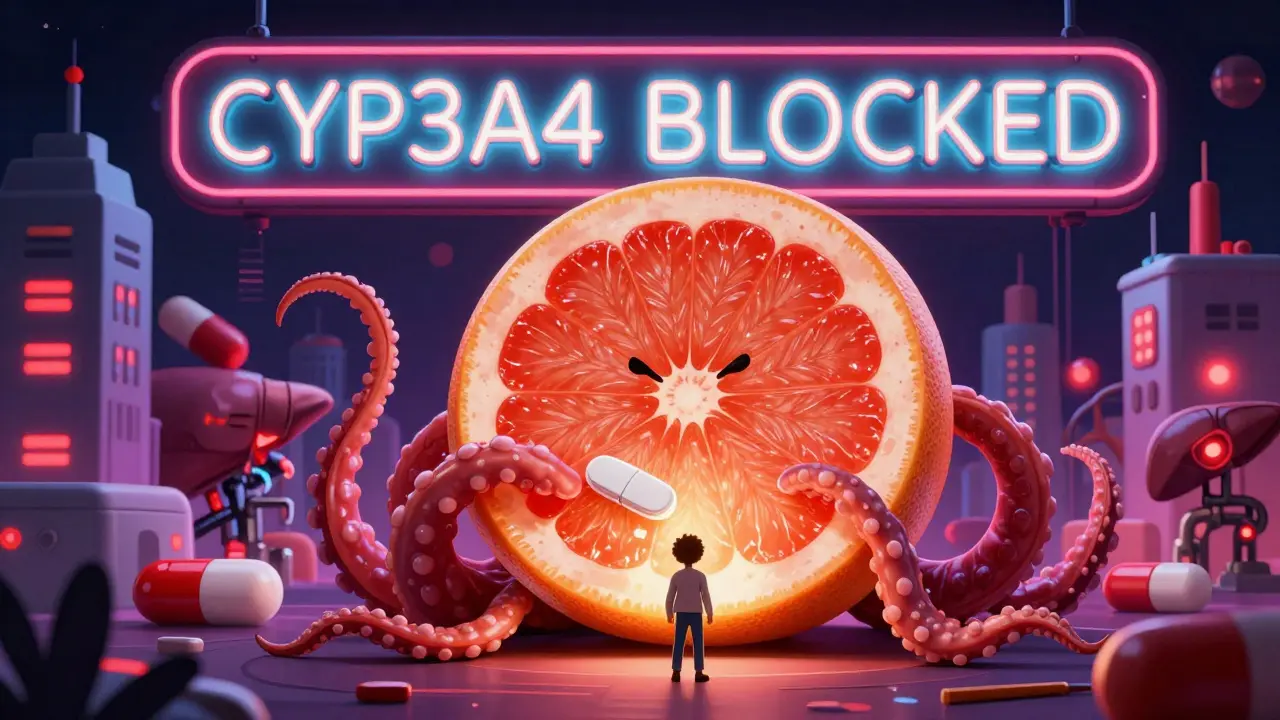
Statins like simvastatin, lovastatin, and atorvastatin work by blocking an enzyme your liver uses to make cholesterol. But before these drugs even reach your bloodstream, they pass through your gut - and that’s where grapefruit steps in. Grapefruit contains chemicals called furanocoumarins. These aren’t sugar or acid. They’re powerful inhibitors that latch onto an enzyme in your intestines called CYP3A4.
This enzyme normally breaks down about half of all oral medications, including these statins. When furanocoumarins block it, your body can’t process the drug the way it should. Instead of being broken down and cleared, the statin builds up in your blood. The result? You’re getting a much stronger dose than your doctor prescribed - sometimes 3 to 4 times stronger.
What makes this even more dangerous is that the effect lasts for days. A 2012 study showed that even if you drink grapefruit juice in the morning and take your statin at night, the enzyme is still blocked. It’s not about timing. It’s about the lasting damage to your body’s ability to metabolize the drug.
Which Statins Are Most Affected?
Not all statins react the same way. The interaction depends on how your body breaks them down. Here’s the breakdown:
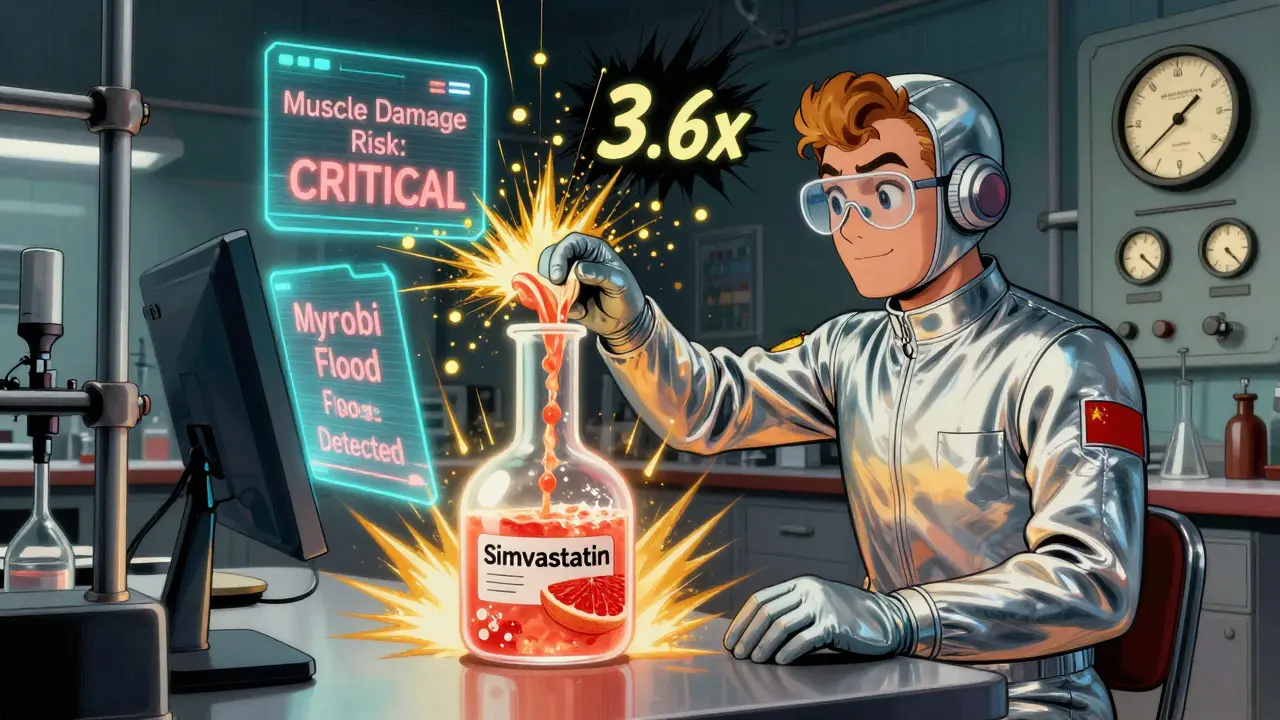
- High risk: Simvastatin (Zocor), lovastatin (Mevacor), and atorvastatin (Lipitor) - all rely heavily on CYP3A4. Simvastatin is the worst offender. One study found that grapefruit juice increased simvastatin levels by 3.6 times. That’s not a small bump - that’s a dangerous spike.
- Moderate risk: Atorvastatin shows a 2- to 3-fold increase, so it’s still risky, especially at higher doses.
- Low to no risk: Fluvastatin, pravastatin, rosuvastatin (Crestor), and pitavastatin don’t use CYP3A4 much. They’re broken down by other pathways, so grapefruit barely touches them.
That’s why switching statins can be the safest solution. If you love grapefruit and are on simvastatin, talk to your doctor about switching to rosuvastatin or pravastatin. You’ll still get the heart protection - without the risk.
What Happens When Statin Levels Rise Too High?
Most people think statin side effects mean a little muscle soreness. That’s common - about 5 to 10% of users feel it. But when grapefruit boosts the drug level, that soreness can turn into something far worse: rhabdomyolysis.
Rhabdomyolysis is when muscle cells break down and spill their contents into your blood. The most dangerous part? Myoglobin - a protein from muscle tissue - floods your kidneys. This can cause acute kidney injury. In 30 to 40% of cases, patients need dialysis. Some don’t survive.
One documented case involved a 40-year-old woman on 20 mg of simvastatin. She drank grapefruit juice every day for 10 days. Then she woke up with severe muscle pain, dark urine, and weakness. Her creatine kinase (a muscle damage marker) was 10 times higher than normal. She spent a week in the hospital.
The scary part? You might not notice until it’s too late. Early signs include muscle pain, weakness, and dark, tea-colored urine. But some people feel fine until their kidneys start failing. That’s why doctors say: don’t wait for symptoms. Prevent it.
How Much Grapefruit Is Too Much?
The FDA updated its guidance in 2021. Here’s what they say:
- Simvastatin: Avoid grapefruit completely. No exceptions.
- Atorvastatin: Limit to no more than one small glass (200 mL) per day. That’s about 7 ounces - less than a standard cup.
- Other statins: You’re likely safe with moderate amounts (up to one glass daily).
But here’s the catch: grapefruit juice isn’t the only problem. Fresh grapefruit, grapefruit extract, even some citrus-flavored sodas or supplements can contain the same chemicals. If it’s from a grapefruit, assume it’s risky.
And don’t think skipping the juice and eating the fruit is safer. The furanocoumarins are in the pulp and peel, not just the juice. One whole grapefruit can have the same effect as a glass of juice.
Why Don’t All Doctors Warn Patients?
A 2021 survey found that only 38% of statin users knew about the grapefruit interaction - even though 67% of medication labels include the warning. Why the gap?
Many doctors assume patients read labels. Many patients don’t. Others think, “I’ve been drinking grapefruit for years - nothing happened.” But risk doesn’t show up overnight. It builds silently. One glass a week might be fine. One glass every day? That’s when the danger rises.
Pharmacists are often the first line of defense. When you pick up your statin prescription, ask: “Is grapefruit safe with this?” If they don’t mention it, ask again. You have the right to know.
What Should You Do?
Here’s what to do if you take statins and love grapefruit:
- Check your statin name. Is it simvastatin or lovastatin? Then stop grapefruit entirely.
- If you’re on atorvastatin, limit grapefruit to one small glass per day - and stick to it.
- If you’re on rosuvastatin, pravastatin, or fluvastatin, you’re likely safe. Still, avoid large amounts.
- Don’t assume timing helps. Even if you take your pill 12 hours after drinking juice, the enzyme is still blocked.
- Ask your doctor about switching. If you can’t give up grapefruit, ask if you can switch to a statin that doesn’t interact. It’s often a simple fix.
- Watch for symptoms. Muscle pain, weakness, or dark urine? Call your doctor immediately. Don’t wait.
And remember: stopping your statin because you’re scared of grapefruit is far more dangerous than drinking a little juice. Statins reduce heart attacks and strokes by 25 to 35%. The goal isn’t to avoid grapefruit at all costs - it’s to avoid the dangerous combo.
What’s Next?
Researchers are now looking at whether it’s possible to breed grapefruit without furanocoumarins - a “statin-safe” version. Early trials show promise, but it’s still years away. For now, the solution is simple: know your statin. Know your fruit. And don’t guess.
Can I eat grapefruit if I take rosuvastatin or pravastatin?
Yes. Rosuvastatin (Crestor) and pravastatin (Pravachol) are not broken down by the CYP3A4 enzyme, so grapefruit doesn’t affect them significantly. You can safely enjoy one small glass of grapefruit juice per day. Still, avoid excessive amounts - moderation is always wise.
Is it safe to eat grapefruit in the morning and take my statin at night?
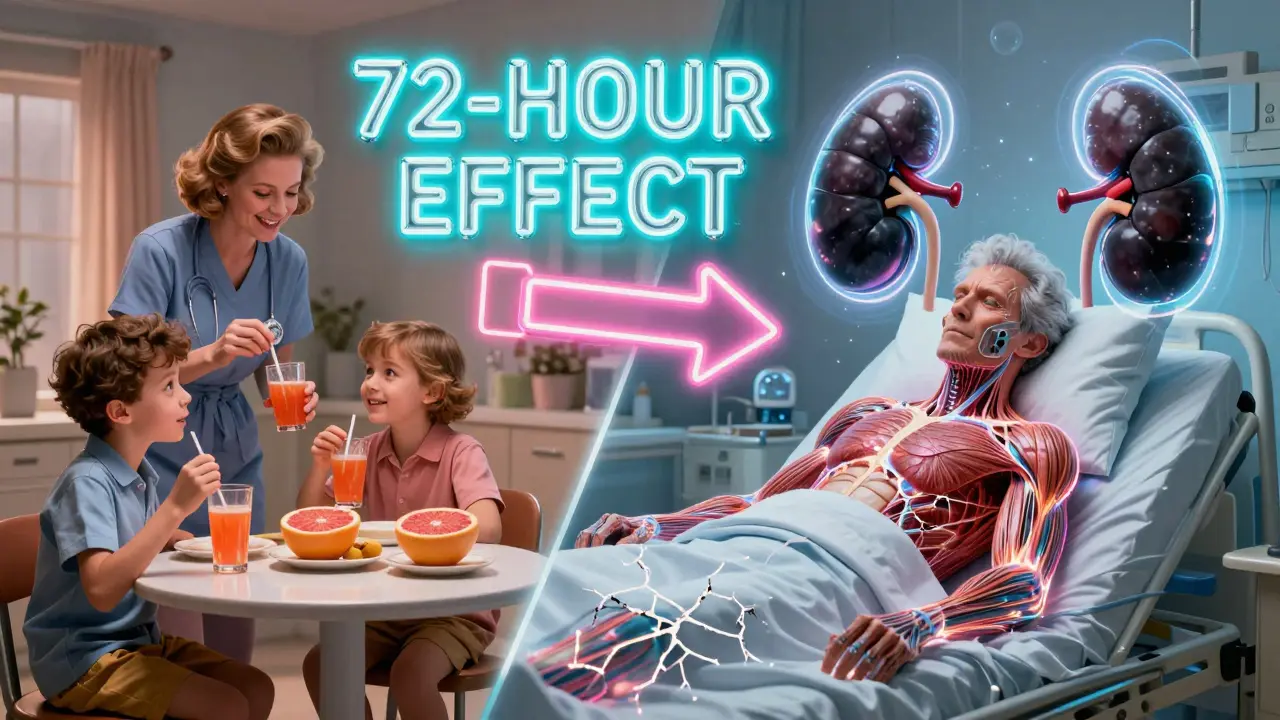
No. The enzyme-blocking effect of grapefruit lasts up to 72 hours. Even if you separate the timing, the furanocoumarins remain active in your gut and liver. It’s not about when you take it - it’s about whether the enzyme is still blocked.
Does grapefruit affect all statins the same way?
No. Simvastatin and lovastatin are the most affected, with levels rising 3 to 4 times. Atorvastatin increases by 2 to 3 times. But fluvastatin, pravastatin, rosuvastatin, and pitavastatin are minimally affected or unaffected because they use different metabolic pathways.
What if I accidentally ate grapefruit while on simvastatin?
One small amount is unlikely to cause harm. But if you do it regularly - even just a few times a week - your risk goes up. If you’ve been doing this for weeks or months, talk to your doctor. They may suggest a blood test to check for muscle damage or switch you to a safer statin.
Are there other fruits I should avoid with statins?
Yes. Seville oranges (used in marmalade), pomelos, and tangelos also contain furanocoumarins and can cause the same interaction. Regular sweet oranges and lemons are safe. Always check the type - if it’s a citrus fruit that looks or tastes like grapefruit, assume it’s risky.

Kenneth Jones
Just stopped grapefruit cold turkey after reading this. My simvastatin script was literally screaming at me from the label. Glad I didn't ignore it.

Kevin Siewe
I've been on pravastatin for 5 years and drink grapefruit juice every morning. This article gave me peace of mind. Knowing which statins are safe makes all the difference. Don't panic, just check your script.

Jacob Hessler
frankly i dont get why doctors dont just tell people this. i mean its not rocket science. grapefruit + simva = bad news. why make it a puzzle?

Darlene Gomez
I used to think this was just an old wives' tale until my uncle ended up in the ICU after a week of grapefruit juice and Lipitor. He didn't even know it was a problem. We need better public education. This isn't about being paranoid-it's about being informed. And honestly, if you're going to take a daily pill for your heart, the least you can do is read the damn label.

Kevin Y.
Thank you for the comprehensive breakdown. As a pharmacist, I can't tell you how many patients I've had come in asking about grapefruit. It's astonishing how often the warning is overlooked. I always ask, 'Do you know which statin you're on?' More often than not, they don't. This is exactly the kind of clear, science-backed info we need circulating.

Blessing Ogboso
In Nigeria, grapefruit isn't common, but we have pomelo and bitter orange-both equally risky. I’m glad this article mentioned them. Cultural context matters. In my community, many believe natural = safe, so when someone says 'it's just fruit,' they don't hear the danger. We need to reframe this: it’s not about avoiding fruit, it’s about matching the right fruit to your medication. Knowledge isn’t just power-it’s survival.

Marissa Staples
I read this and immediately checked my meds. Turns out I'm on rosuvastatin. So I'm still drinking my grapefruit juice. But now I know why. That's the difference between fear and informed choice. Also, I just learned that tangelos are risky. Who knew?

Rachele Tycksen
sooo i just realized i been eating grapefruit with my simva for like 3 years... oops? i guess i should call my doc before i turn into a human pincushion?

Katie Putbrese
People keep acting like this is some big conspiracy. It’s not. It’s basic pharmacology. If you’re too lazy to read your prescription label, don’t blame the system when your muscles start dissolving. I’ve seen it. It’s not pretty. Stop being irresponsible with your health. This isn’t a suggestion-it’s a warning. And if you’re still drinking grapefruit juice after this? You’re just asking for trouble.
Write a comment