Recent POST



Bleeding Risk Interaction Estimator
Estimated Relative Risk Increase
0%
Select your medications to see the estimated risk increase based on clinical data.
Taking a medication for depression while also using a blood thinner might seem like two separate health goals, but inside your body, these drugs interact in a way that can be dangerous. If you are using SSRIs is a class of antidepressants known as Selective Serotonin Reuptake Inhibitors alongside anticoagulants, you face a significantly higher risk of major bleeding. Specifically, research shows that this combination can increase the risk of bleeding by about 33% compared to using blood thinners alone. This isn't just a theoretical worry; it's a clinical reality that requires careful monitoring, especially during the first few months of treatment.
Why Your Blood Doesn't Clot as Well
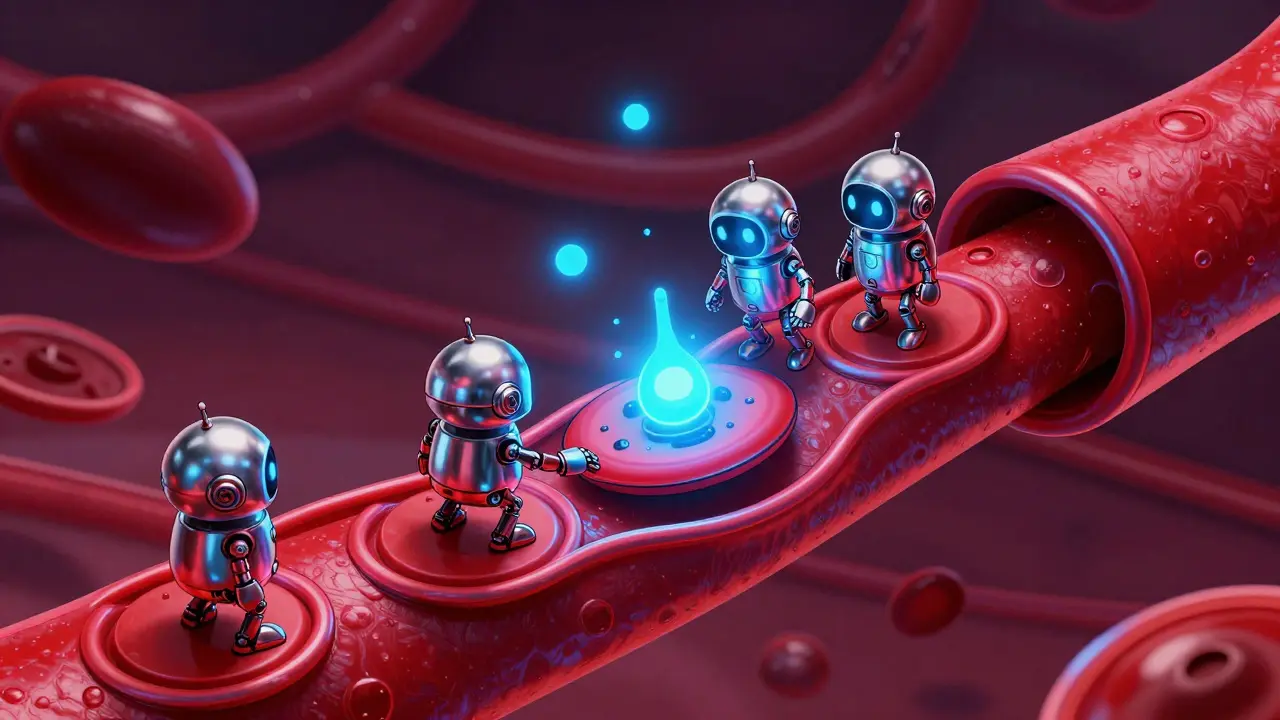
To understand why this happens, we have to look at Platelets, which are the small blood cells responsible for plugging leaks in your blood vessels. Most people think serotonin only works in the brain, but platelets actually rely on serotonin to stick together and form clots. SSRIs work by blocking the reuptake of serotonin. While this helps your mood, it also stops platelets from absorbing the serotonin they need to function. Essentially, the medication depletes the "glue" that allows platelets to aggregate.
How much does this actually affect your blood? Data suggests that therapeutic doses of SSRIs can decrease platelet serotonin uptake by up to 90%, reducing overall platelet aggregation by 30% to 40%. It is important to note that this effect is strictly related to platelets. A 2025 study by Mokhtarian et al. used thrombin generation assays to prove that common SSRIs like citalopram do not actually disrupt the coagulation cascade or affect clotting factors. In plain English: the blood thinners handle the proteins in your blood, and the SSRIs disable your platelets. When both happen at once, your body's primary and secondary defense systems against bleeding are both compromised.
Where the Bleeding Actually Happens
Not all bleeding is created equal. When these two drug classes interact, the risks are concentrated in specific areas of the body. The most common site is the gastrointestinal tract, which accounts for 58% of all major bleeding cases in this patient group. This is often because the gut lining is sensitive and prone to small erosions that, under normal circumstances, would heal quickly but fail to do so when platelets are impaired.
More alarming is the risk of intracranial hemorrhage-bleeding in the brain-which makes up 17% of cases. While less frequent than stomach bleeds, these are far more severe. The remaining 25% of cases are distributed across other major sites. To put the absolute risk into perspective, the rate of major bleeding jumps from 1.8 events per 100 person-years for those on anticoagulants alone to 2.4 events when an SSRI is added. While that might seem like a small number, it translates to roughly 6 additional major bleeding events for every 1,000 patients per year.
Comparing the Different Medications
You might wonder if some blood thinners or antidepressants are safer than others. There are two main types of anticoagulants: VKAs (Vitamin K Antagonists) like Warfarin, and DOACs (Direct Oral Anticoagulants) like rivaroxaban or apixaban. While both increase risk when paired with SSRIs, some data suggest DOACs might have a slightly lower risk profile (a 22% increase versus 28% for VKAs), though the difference isn't always statistically significant.
| Combination Type | Relative Risk Increase (IRR) | Risk Level |
|---|---|---|
| Anticoagulant alone | Baseline (1.0) | Standard |
| DOAC + SSRI | 1.22 | Moderate |
| Warfarin (VKA) + SSRI | 1.28 | Moderate-High |
| Warfarin + Dual Antiplatelet Therapy | ~4.0 | Very High |
When it comes to the antidepressants, you might expect the most potent ones to be the most dangerous. Surprisingly, that isn't the case. Research comparing paroxetine (high potency) to escitalopram (lower potency) showed identical bleeding risks. However, Sertraline remains the most common choice for patients on blood thinners because it generally has fewer interactions with other medications overall.
The Critical Window and Monitoring
Timing is everything. The risk of a major bleed isn't constant over the years of treatment. The danger peaks during the first 30 days of starting the combination therapy. This "danger zone" is when your body is adjusting to the depleted serotonin levels in your platelets. After six months, the risk tends to decline substantially, though it never returns to the baseline of someone not taking an SSRI.
Because of this, doctors often implement strict monitoring protocols during the first 90 days. If you are on Warfarin, your doctor might check your INR (International Normalized Ratio) twice a week during that first month. For others, regular Complete Blood Count (CBC) tests and fecal occult blood tests (to check for hidden gut bleeding) are recommended. If you notice unusual bruising, nosebleeds that won't stop, or dark, tarry stools, you should contact your provider immediately.
Alternative Options for High-Risk Patients
If you have a high bleeding risk-often measured by a HAS-BLED score of 3 or higher-your doctor might suggest avoiding SSRIs entirely. There are other antidepressants that don't interfere with platelet serotonin uptake. For example, Mirtazapine or Bupropion are often recommended as safer alternatives because they don't have the same effect on the blood's ability to clot.
The decision isn't always simple. For about 87% of patients with moderate-to-severe depression who are also on anticoagulants, SSRIs are still the first-line choice because they are highly effective. The goal isn't necessarily to stop the medication, but to manage the risk. This involves weighing the severity of the depression against the risk of a bleed and choosing the drug with the cleanest profile for that specific patient.
Do all SSRIs increase bleeding risk equally?
Based on current data, the potency of the SSRI doesn't seem to change the risk level. For instance, paroxetine and escitalopram show similar risk increases. However, sertraline is frequently preferred by clinicians due to its generally lower rate of other drug-drug interactions.
When is the risk of bleeding highest?
The risk is most acute during the first 30 days of starting the combined therapy. By the six-month mark, the risk typically decreases, though it remains higher than if you were only taking an anticoagulant.
What are the signs of internal bleeding I should look for?
You should watch for "coffee-ground" vomit or black, tarry stools (signs of GI bleeding), unexplained bruising, frequent nosebleeds, or sudden, severe headaches which could indicate an intracranial event.
Are DOACs safer than Warfarin when taking SSRIs?
There is some evidence suggesting a slightly lower relative risk increase with DOACs (22%) compared to VKAs like Warfarin (28%), but this difference is often not statistically significant. Both require careful monitoring.
What antidepressants are safer alternatives for those at risk of bleeding?
Mirtazapine and Bupropion are often suggested for patients with a high HAS-BLED score because they do not significantly impair platelet function through serotonin depletion.

Ben Jima
This is a really important breakdown of a tricky interaction. For anyone feeling anxious about this, just remember that the key is working closely with your doctor to manage those first few months. Staying proactive with your health is the best way to handle these risks!

Daniel Runion
Wow... just wow!!! Who actually thinks these statistics are "reliable" anyway??? It's all just numbers on a page to keep us scared!!! Total joke!!!!

Jon Moss
Been through this with a parent. It's definitely scary when you first read the risks, but the monitoring really helps.

William Zhigaylo
The sheer negligence of patients who ignore these warnings is astounding. It is an absolute failure of basic intellectual competence to disregard the physiological reality of platelet depletion. If you suffer a gastrointestinal bleed because you felt "fine" without monitoring, you have effectively engineered your own crisis.

Andre Ojakäär
everyone knows sertraline is the gold standard here lol basically just common sense for any clinician worth their salt

James Harrison
It's kind of wild how we try to fix the mind by accidentally messing with the blood. Just another example of the trade-offs we make in modern medicine.

Majestic Blue Band
It is absolutely convenient that they tell us about this "risk" just as they push more of these chemicals on the population, and I find it highly suspicious that the 2025 study is being cited as the absolute truth when we all know the pharmaceutical companies fund the very research that claims certain drugs are "safer" alternatives like Mirtazapine just to keep us cycling through their patent list while they ignore the natural ways to regulate mood and blood flow without turning our internal organs into a sieve of chemical experiments that we are never truly told the full extent of because the real data is locked in a vault in Switzerland.

Eric Mwiti
Oh sure, let's just trust a 33% increase in bleeding risk because a study said so. Truly comforting stuff.

Edwin Perez
Typical industry propaganda. They ignore the root cause of why we need these thinners in the first place and just give us a list of "danger zones" to keep us dependent on more tests and more doctors.

suresh kumar
My cousin took this mix and he turned into a human sponge, just leaking from everywhere like a broken pipe in a monsoon!

Carol Yang
Glad there are options like Bupropion for people who can't do the SSRIs. Everything works out in the end!

Michael Chukwuma
I really appreciate the detail here. It makes me feel less alone in worrying about these interactions.

Karyn Tindall
The idea of a brain bleed is absolutely terrifying! I can't even imagine the stress of that first month!
Write a comment