Recent POST





Generic drugs save the healthcare system billions of dollars every year, but how do we know they work exactly like the brand-name versions? The answer lies in bioequivalence studies, which are systematic clinical investigations designed to prove that a generic drug delivers the same amount of active ingredient into the bloodstream at the same rate as the original reference listed drug. Without these rigorous tests, patients couldn't trust that their cheaper medication would perform identically. This process is not just about chemistry; it’s about human physiology and strict statistical proof.
The foundation for this safety net was built with the Hatch-Waxman Act of 1984 in the United States. Before this law, bringing a generic to market required repeating expensive clinical trials. Today, agencies like the U.S. FDA, the European Medicines Agency (EMA), and Japan's PMDA rely on bioequivalence data instead. According to FDA data from 2022, generic drugs saved the U.S. healthcare system $1.68 trillion between 2010 and 2019. That is a massive impact driven by one core promise: therapeutic equivalence.
Understanding the Core Concept of Bioequivalence
Bioequivalence isn't just about having the same ingredients. It’s about how those ingredients behave inside your body. When you take a pill, it dissolves, absorbs through your gut wall, enters your bloodstream, and reaches the target tissue. A bioequivalence study measures two critical things: the rate and the extent of absorption.
If a generic drug releases its active ingredient too slowly, it might not work when you need it most. If it releases too quickly, you could get side effects from a sudden spike in concentration. The goal is to show that the test product (the generic) and the reference product (the brand-name drug) are statistically indistinguishable in how they move through the body.
- Rate of Absorption: How fast the drug reaches peak concentration in the blood.
- Extent of Absorption: How much of the drug actually gets into the bloodstream overall.
Regulatory bodies require this proof for almost every systemic drug. However, for some products-like certain topical creams or inhalers-pharmacodynamic or clinical endpoint studies might be used instead if blood measurements don’t make sense. But for the vast majority of pills, the gold standard is the pharmacokinetic (PK) approach.
Designing the Study: The Crossover Method
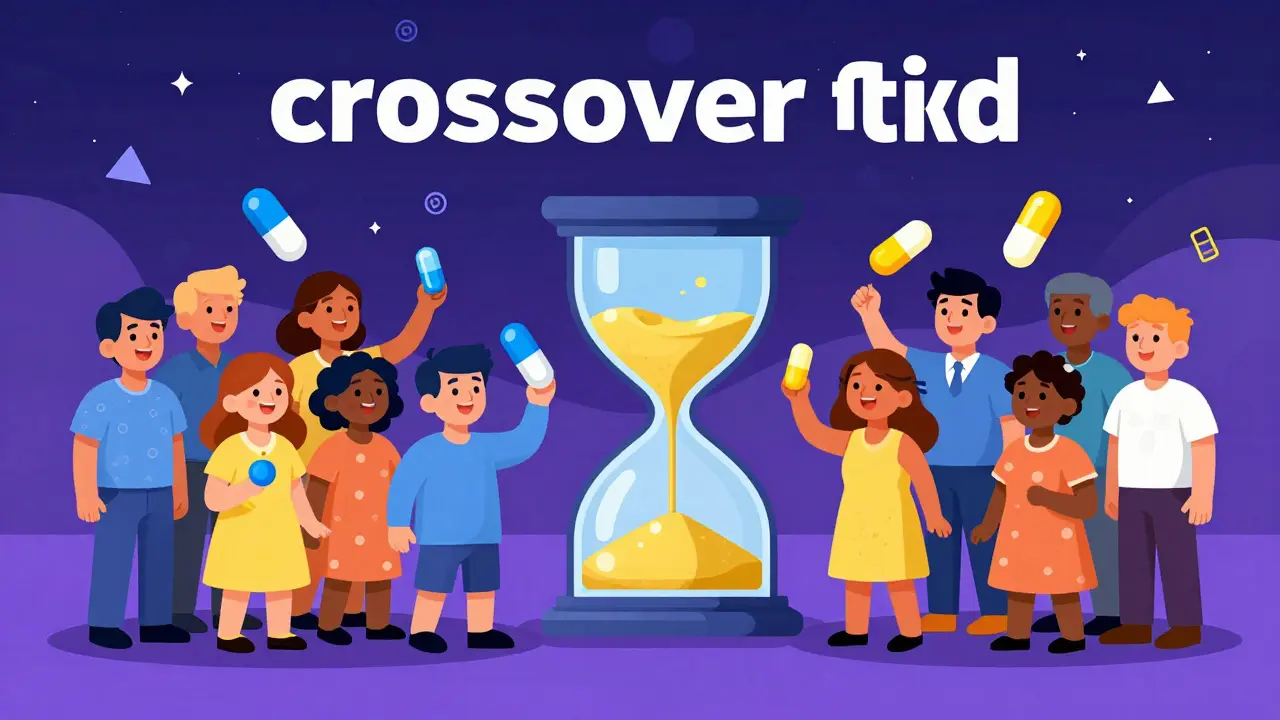
Most bioequivalence studies use a specific structure called a two-period, two-sequence crossover design. This sounds technical, but the logic is simple and elegant. You want to compare the drug against itself in the same people, rather than comparing different groups of people who might have different metabolisms.
Here is how it works in practice. A group of healthy volunteers-usually between 24 and 32 subjects-is recruited. They are split into two sequences. Sequence A takes the Test drug first, then after a break, takes the Reference drug. Sequence B does the opposite: Reference first, then Test. This randomization cancels out order effects.
| Sequence Group | Period 1 Treatment | Washout Period | Period 2 Treatment |
|---|---|---|---|
| Group A | Test Product (Generic) | 5+ Half-Lives | Reference Product (Brand) |
| Group B | Reference Product (Brand) | 5+ Half-Lives | Test Product (Generic) |
The "washout period" is critical. It must last long enough for the drug to completely leave the body before the next dose is given. Typically, this means waiting for at least five elimination half-lives. If a drug stays in the system for 24 hours, the washout needs to be five days. Underestimating this is a common mistake. As one clinical trial veteran noted on Reddit, underestimating the washout for a drug with a 72-hour half-life cost their company $250,000 and three months because they had to repeat the entire study.
Sampling and Pharmacokinetic Parameters
During each period, researchers collect blood samples at precise intervals. This isn't random; it’s a carefully calculated schedule to capture the drug’s journey. You typically need at least seven time points:
- Pre-dose (zero time) to establish baseline.
- One point before the expected peak concentration.
- Two points around the expected peak (Cmax).
- Three points during the elimination phase.
Sampling continues until the area under the curve up to the last measurable concentration (AUCt) represents at least 80% of the total area (AUC∞). This usually requires sampling for 3 to 5 elimination half-lives. For example, if a drug peaks at 2 hours and clears over 12 hours, you might sample every hour for the first few hours, then every few hours for the rest of the day.
The blood plasma is analyzed using highly sensitive methods, typically Liquid Chromatography-Mass Spectrometry (LC-MS/MS). These methods must be validated to ensure precision within ±15%. From this data, two primary pharmacokinetic parameters are calculated:
- Cmax: The maximum concentration of the drug in the blood. This relates to the risk of side effects.
- AUC(0-t): The total exposure to the drug over time. This relates to efficacy.
If the generic has a significantly lower Cmax, it might not work well. If it has a higher Cmax, it might cause toxicity. Both must fall within strict limits compared to the brand name.
Statistical Analysis and Acceptance Criteria
Collecting the data is only half the battle. Proving equivalence requires specialized statistics. You don't just check if the averages are close; you calculate confidence intervals. The industry standard, established by Dr. Donald Schuirmann and now used globally, involves logarithmic transformation of the Cmax and AUC values.
Researchers perform an Analysis of Variance (ANOVA) accounting for sequence, period, treatment, and subject effects. The result is a geometric mean ratio of the test product to the reference product. The regulatory acceptance criterion is universal: the 90% confidence interval for this ratio must fall entirely within 80.00% to 125.00%.
This range might seem wide, but it accounts for natural biological variability. If the confidence interval crosses 80% or 125%, the study fails. For Narrow Therapeutic Index (NTI) drugs-medications where small changes in dose can be dangerous, like warfarin or levothyroxine-the limits are tighter: 90.00% to 111.11%. The FDA introduced these stricter rules in 2019 to ensure patient safety for high-risk medications.
Handling Highly Variable Drugs
Some drugs are naturally inconsistent. Even when the same person takes the same pill twice, their body might absorb it differently due to food, stress, or genetics. If the within-subject coefficient of variation exceeds 30%, the drug is considered "highly variable."
In these cases, a standard crossover study might fail simply because the noise is too high, even if the drugs are equivalent. Regulators offer alternative paths:
- Replicate Crossover Designs: The EMA recommends a 4-period replicate design where subjects receive multiple doses of both products. This allows researchers to separate drug variability from subject variability. This often requires 50 to 100 subjects.
- Reference-Scaled Average Bioequivalence (RSABE): The FDA allows this approach for highly variable drugs. It scales the acceptance limits based on the variability of the reference product. If the brand-name drug varies wildly, the generic is allowed to vary similarly.
Dr. Jennifer Bright, former director of the FDA Office of Generic Drugs, emphasized that pilot studies are non-negotiable for complex generics. She noted that proper pilot execution reduces pivotal study failure rates from 35% to under 10%. Skipping this step is a costly gamble.

Common Pitfalls and Real-World Challenges
Bioequivalence studies are expensive and logistically complex. A single failed study can cost hundreds of thousands of dollars and delay market entry by months. Based on industry surveys and regulatory feedback, here are the most common reasons studies fail or face delays:
- Inadequate Washout: Residual drug from the first period contaminates the second period results. This accounts for 45% of deficient studies per FDA tips.
- Improper Sampling Schedules: Missing the true Cmax or ending sampling too early leads to inaccurate AUC calculations. This causes 30% of issues.
- Statistical Errors: Using the wrong model or failing to account for outliers correctly. This affects 25% of submissions.
- Assay Validation Failures: If the lab method isn't robust, the data is useless. BioAgilytix reported that 22% of studies experience assay-related delays, costing an average of $187,000 per incident.
Subject dropout is another headache. Rates typically run between 5% and 15%. Longer studies or those requiring hospitalization see higher dropouts. To mitigate this, sponsors often recruit extra subjects (over-enrollment) to ensure they still have enough valid data pairs at the end.
Alternative Approaches and Biowaivers
Not every drug needs a full human study. The Biopharmaceutics Classification System (BCS) helps regulators decide when a waiver is possible. BCS Class I drugs are highly soluble and highly permeable. If a generic manufacturer can prove that their tablet dissolves at the same rate as the brand-name tablet in vitro (in a lab beaker), they may get a "biowaiver."
The FDA grants biowaivers for about 27% of generic approvals. This saves money and avoids exposing humans to unnecessary testing. However, this only applies to immediate-release oral solids. Complex products like inhalers, topicals, or modified-release formulations usually require more extensive data, including dissolution testing across pH levels 1.2 to 6.8 with an f2 similarity factor greater than 50.
What is the difference between bioavailability and bioequivalence?
Bioavailability measures how much of a drug reaches the bloodstream compared to an intravenous dose (absolute bioavailability). Bioequivalence compares two oral products (generic vs. brand) to see if they deliver the drug in the same way. You can have high bioavailability but still fail bioequivalence if the rate of absorption differs significantly.
Why are healthy volunteers used instead of patients?
Healthy volunteers provide a consistent baseline without the confounding variables of disease states or other medications. Since bioequivalence focuses on the drug's absorption profile rather than its therapeutic effect on a disease, healthy subjects are sufficient and safer for short-term exposure studies.
How long does a typical bioequivalence study last?
For most immediate-release drugs, the actual study period per subject is 1 to 2 days. However, the total timeline including recruitment, screening, the washout period, and analysis can take 3 to 6 months. For drugs with very long half-lives, the study duration can extend to several weeks.
What happens if a bioequivalence study fails?
If the 90% confidence intervals fall outside the 80-125% range, the application is rejected. Manufacturers must investigate the cause-whether it was formulation issues, manufacturing variability, or protocol errors-and often redesign the product or conduct a new, larger study before resubmitting.
Are bioequivalence standards the same worldwide?
The core principles are harmonized through the International Council for Harmonisation (ICH), but there are differences. For example, the FDA allows reference-scaled average bioequivalence for highly variable drugs, while the EMA prefers replicate crossover designs. Japan's PMDA may require additional dissolution testing for certain products.

victoria catharinaa
honestly this is so important for people who cant afford brand name meds
i get mad when ppl say generics are worse bc its just not true
the science is right there in front of us

Glen Speck
the crossover design is elegant in its simplicity yet profound in implication
it removes the noise of individual biology by making each subject their own control
a beautiful application of statistical logic to human physiology

Anthony Red
hey everyone check out this part about the washout period
its crazy how easy it is to mess up if you dont wait long enough
makes me wonder how many failed studies were just bad math on half-lives

Javier Arauz
why do we even need foreign agencies like the EMA or PMDA telling us what to do
the FDA sets the gold standard and thats that
american innovation saves lives and money unlike those weak european standards

Jeremiah Cassandra
oh look another post pretending to explain basic pharmacokinetics 🙄
let me guess you think Cmax is just a number and not a potential toxicity nightmare?
good luck with your generic inhalers btw they never pass BE without clinical endpoints 😂

charles robert
the system is rigged against the truth 🎭
they call it bioequivalence but its really just bio-illusionism
the confidence intervals are a lie wrapped in statistics to hide the chaos of human bodies
we are all just guinea pigs in a giant crossover experiment that nobody asked for 💀

Warren Brewer
it helps to keep it simple
if the drug gets into your blood the same way its basically the same
no need to overcomplicate it with fancy words

Mark Ronson
great overview of the process
one thing to note is that typo prone writing can happen when typing fast but the core concept of RSABE is crucial for highly variable drugs
it allows regulators to scale acceptance limits based on reference variability which is a smart approach for complex generics
Write a comment