Recent POST



When a brand-name drug’s patent expires, you’d expect generics to flood the market and slash prices. But that’s not how it works. Behind every cheap pill you buy is a legal battle that can delay generic access for years. These aren’t just corporate fights-they directly affect how much you pay for insulin, blood pressure meds, or cancer drugs. The system was meant to balance innovation with access. But over the last decade, court decisions have reshaped the rules in ways most patients never see-until they’re stuck paying hundreds more than they should.
How the Hatch-Waxman Act Created the Modern Generic Market
In 1984, Congress passed the Drug Price Competition and Patent Term Restoration Act, better known as the Hatch-Waxman Act. It was a compromise: brand-name companies got extra patent time to make up for delays in FDA approval, and generic makers got a faster, cheaper path to market. The key? The Paragraph IV certification. When a generic company files an ANDA (Abbreviated New Drug Application), it can certify that a patent is invalid, unenforceable, or won’t be infringed. That triggers a lawsuit from the brand company-and a 30-month automatic stay on generic approval.
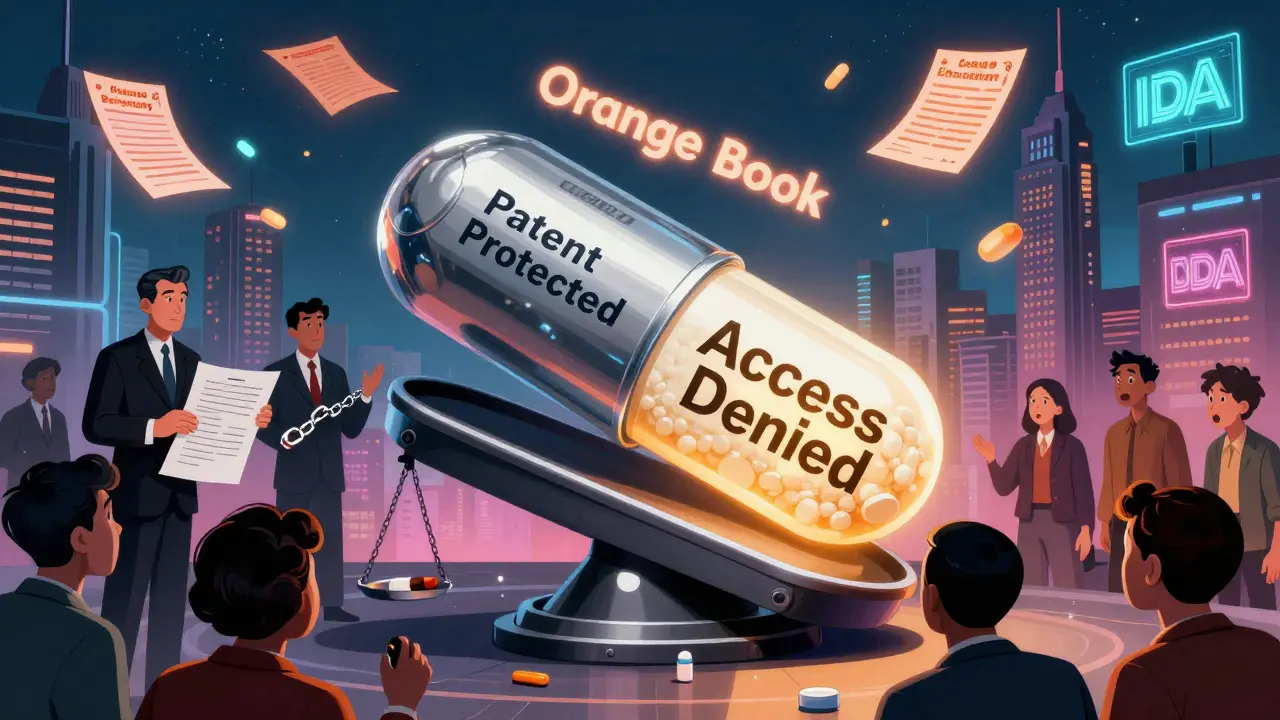
This system worked for years. But as drug prices soared, the tactics got more aggressive. Brand companies started listing dozens of patents in the Orange Book-the FDA’s official list of patented drugs-even if they had nothing to do with the drug’s active ingredient. Some patents covered packaging, dosing schedules, or even manufacturing methods. The goal? Stretch monopolies beyond the original patent term. By 2023, over 85% of U.S. prescriptions were filled with generics. But the path to get there was getting longer, not shorter.
Amgen v. Sanofi: The End of Overly Broad Biologic Patents
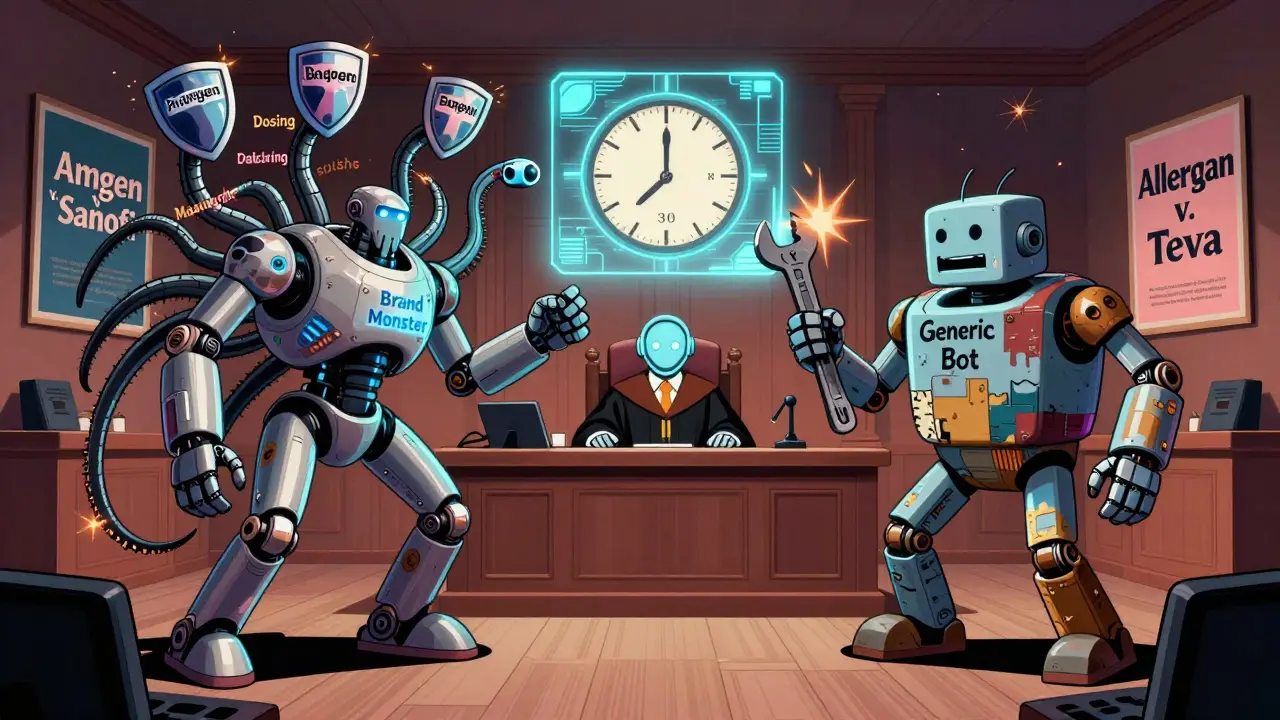
In 2023, the Supreme Court handed down a decision that sent shockwaves through the biotech world. Amgen v. Sanofi involved a cholesterol drug called Repatha. Amgen held a patent claiming millions of possible antibodies, but had only actually made and tested 26. The court ruled that’s not enough. A patent can’t cover everything you *might* invent-it has to enable others to make and use the invention without endless experimentation.
This wasn’t just about one drug. It changed how all biologic patents are written. Before this, companies could file broad patents covering entire classes of molecules, blocking competitors even if they didn’t know exactly what those molecules were. After Amgen, generic makers could challenge those patents more easily. The result? A 22% drop in biologic patent filings with vague claims in 2024, according to USPTO data. For patients, that means faster access to biosimilars-generic versions of complex biologic drugs like Humira or Enbrel.
Allergan v. Teva: The ‘First-File’ Patent Shield
But not all rulings favored generics. In 2024, the Federal Circuit ruled in Allergan v. Teva that a brand company’s first-filed patent can’t be invalidated just because another patent on the same drug expired earlier. This sounds technical, but it’s huge. It means a company can file multiple patents over time-some narrow, some broad-and use the earliest one to block generics, even if later patents are weaker.
Think of it like a fence. The first patent is the main gate. Even if the side gates (later patents) are broken, the main gate stays locked. Teva tried to argue that because a later patent expired, the whole protection should end. The court said no. This decision has made it harder for generics to challenge patents based on timing alone. As a result, 68% of brand companies now file at least three patents per drug, according to a 2025 Rock Ridge Law analysis. The cost? More delays. More lawsuits. More money out of patients’ pockets.
Amarin v. Hikma: When Marketing Becomes Infringement
Here’s a twist: sometimes, generics don’t even need to copy the drug to get sued. In Amarin v. Hikma, Amarin’s drug Vascepa was approved for one use: lowering triglycerides in high-risk patients. Hikma’s generic version had the same active ingredient but was labeled only for that approved use. Still, Amarin sued-because Hikma’s marketing materials suggested doctors could prescribe it for other conditions, like high cholesterol.
The court agreed with Amarin. Even though Hikma didn’t claim an unapproved use on its label, the marketing materials induced doctors to prescribe it off-label. That counted as patent infringement. This case opened the door for brand companies to sue generics not just for making the drug, but for how they talk about it. In 2023, 63% of induced infringement claims by brand companies succeeded in court. It’s a new kind of legal trap: if your generic’s website, sales reps, or patient brochures even hint at a use not on the label, you could be sued.
Why Patent Litigation Costs $6.8 Million Per Case
These aren’t abstract legal debates. They cost real money. The average Hatch-Waxman lawsuit through summary judgment now runs $6.8 million per case, according to Rock Ridge Law’s 2024 report. Why so high? Because these cases mix patent law, regulatory rules, chemistry, and pharmacology. Attorneys need to understand not just the law, but how the drug works in the body. Did the generic company change the salt form? The particle size? The release mechanism? Each tweak can trigger a new patent claim.
Generic manufacturers now spend an extra $1.2 million per product just on pre-filing patent analysis, according to Teva’s legal team. That’s before they even file the ANDA. Small generic companies can’t afford this. As a result, the market is consolidating. The top 10 generic makers now have dedicated litigation teams. Smaller players are getting squeezed out-or forced to wait years before challenging patents.
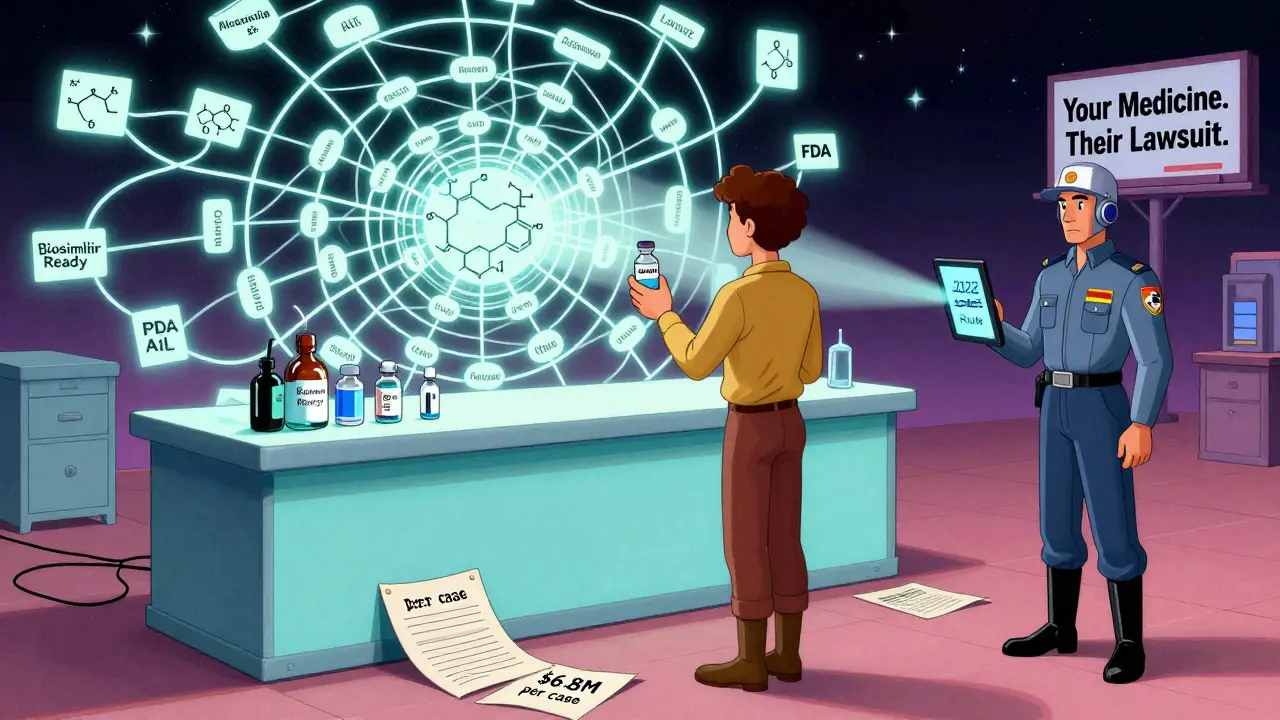
What’s Next? Biosimilars, Transparency, and the FDA’s New Rules
The next big wave is biosimilars-generic versions of biologic drugs like insulin, rheumatoid arthritis treatments, and cancer therapies. These are harder to copy than pills. They’re made from living cells. That means more patents, more complexity, and more lawsuits. By 2027, biosimilar patent cases are expected to make up 31% of all generic challenges, up from 14% today.
The FDA is trying to push back. In 2025, it proposed new rules requiring stricter proof that patents listed in the Orange Book actually relate to the drug’s use. No more listing patents for packaging or manufacturing methods that don’t affect the drug’s effect. If this rule passes, it could cut patent litigation by 15-20% over the next two years.
Meanwhile, the Supreme Court is watching. The Amgen decision already changed how patents are written. The next big case could decide whether companies can use foreign patent offices to delay U.S. generic entry. If the court sides with brand companies, it could mean even longer waits for affordable drugs.
What This Means for You
Behind every generic drug you buy is a legal maze. The courts are supposed to protect innovation-but they’re also supposed to keep drugs affordable. Right now, the balance is tipping. Patent thickets, marketing lawsuits, and delayed approvals are costing patients billions. One user on Reddit summed it up: "My insulin alternative was delayed 22 months due to patent litigation. Cost me $8,400 out-of-pocket."
That’s not an outlier. Evaluate Pharma projects $127 billion in generic sales will be delayed through 2026 because of unresolved patent disputes. Cardiovascular and cancer drugs are the hardest hit. If you’re paying for a chronic condition, you’re not just paying for medicine-you’re paying for legal battles you didn’t ask for.
The system isn’t broken. It’s being exploited. And until the courts, Congress, and the FDA reset the rules, the cheapest pills will still be the hardest to get.
What is the Hatch-Waxman Act and why does it matter for generic drugs?
The Hatch-Waxman Act of 1984 created a legal framework that lets generic drug makers bring cheaper versions to market faster, while giving brand companies extra patent time to recover R&D costs. It established the Paragraph IV certification process, which allows generics to challenge patents before launching. This system is the backbone of today’s generic drug market-over 85% of U.S. prescriptions are filled with generics because of it.
What is the Orange Book and how does it affect generic drug approval?
The Orange Book is the FDA’s official list of approved drug products with their patent and exclusivity information. Generic companies must check this list before filing an ANDA. If a patent is listed, the generic maker must either certify it’s invalid or wait until it expires. Brand companies sometimes list weak or irrelevant patents to delay generics. The FDA’s 2025 proposed rules aim to stop this by requiring stricter proof that listed patents actually relate to the drug’s approved use.
What is a Paragraph IV certification and why is it controversial?
A Paragraph IV certification is when a generic drug maker declares that a brand-name drug’s patent is invalid, unenforceable, or won’t be infringed. This triggers a lawsuit from the brand company and a 30-month delay in generic approval. It’s controversial because it’s the main tool generics use to challenge patents early-but it also gives brand companies a legal tool to block competition. Over 92% of ANDA filers now include a Paragraph IV certification, making it standard practice in the industry.
How do inter partes reviews (IPRs) affect generic patent litigation?
Inter partes reviews (IPRs) are proceedings at the Patent Trial and Appeal Board (PTAB) where generics can challenge the validity of a patent without going to federal court. Since the America Invents Act of 2011, 78.3% of generic patent challenges have used IPRs because they’re faster and cheaper than litigation. In 2023, IPRs led to the invalidation of over 60% of challenged patents. This has become a core part of the generic strategy-many companies now file IPRs alongside traditional lawsuits to weaken brand patents before trial.
Why are biosimilars causing more patent lawsuits than traditional generics?
Biosimilars are copies of complex biologic drugs made from living cells-like insulin or monoclonal antibodies. Unlike small-molecule generics, they can’t be exact copies. This means manufacturers must prove similarity through extensive testing, and brand companies file dozens of patents covering manufacturing methods, delivery systems, and protein structures. The legal disputes are more technical, more expensive, and take longer. By 2027, biosimilar patent cases are projected to make up 31% of all generic litigation, up from 14% today.

Ambrose Curtis
Man, I got hit with a $1,200 insulin bill last year because the generic got held up by some stupid patent trick. Nobody talks about this stuff until it’s your life on the line. The system’s rigged, and the lawyers are laughing all the way to the bank.

Linda O'neil
This is exactly why we need real patent reform. The Hatch-Waxman Act was brilliant in theory, but now it’s just a loophole factory. Brand companies are gaming the system by listing every possible patent under the sun-even for packaging colors. The FDA’s new rules are a start, but they need teeth.

James Dwyer
I used to think patent law was boring. Now I see it’s the reason my dad can’t afford his blood pressure meds. We’re not just talking about corporate profits here-we’re talking about people skipping doses because they can’t pay. This isn’t innovation. It’s extortion.

Chris Urdilas
So let me get this straight-companies can sue you for *suggesting* a drug can be used for something not on the label? And that’s legal? Wow. Next they’ll sue you for thinking about it. Congrats, America: we’ve turned healthcare into a courtroom drama where the audience pays the ticket price.

Rose Palmer
The structural inequities embedded in the current patent litigation framework disproportionately impact low-income and elderly populations. The financial burden of $6.8 million per case effectively excludes smaller manufacturers, resulting in market consolidation and reduced competition. Regulatory intervention is not merely advisable-it is a moral imperative.

Rhiannon Bosse
Oh, so the FDA’s ‘new rules’ are going to fix this? Lol. Tell me, how many times have we heard that before? Big Pharma owns half the Congress and the other half is too scared to touch them. The real story? The same five law firms handle 90% of these cases. They’re the ones making millions. The rest of us? Just collateral damage.

Bryan Fracchia
It’s funny how we celebrate innovation until it becomes a weapon. Patents were meant to protect the inventor, not to create a decades-long monopoly on a molecule that’s been studied since the 70s. We’ve lost sight of the original bargain: reward innovation, but don’t lock up the cure. Maybe we need to ask: who’s really being protected here?

Lance Long
I worked in a pharmacy for 12 years. I watched people cry because they had to choose between insulin and groceries. I saw prescriptions sit unfulfilled because the generic was stuck in litigation limbo. This isn’t just about law-it’s about humanity. And we’re failing. Badly.

fiona vaz
Amgen v. Sanofi was a rare win for common sense. If you can’t even show you made the thing you’re patenting, you shouldn’t get a monopoly. Let’s hope this sets a precedent. Biosimilars are the future-we need to make sure they don’t get buried under the same garbage.
Write a comment