Recent POST





When you have asthma, it’s not always clear why your symptoms flare up. You might be using your inhaler regularly, avoiding triggers, and still waking up wheezing or coughing at night. That’s where FeNO testing comes in. It’s not a replacement for your usual lung tests, but it gives your doctor a clear, objective look at what’s happening inside your airways-specifically, how much inflammation is there. And that makes all the difference in how your treatment is adjusted.
What Exactly Is FeNO Testing?
FeNO stands for Fractional Exhaled Nitric Oxide. It’s a simple, non-invasive test that measures how much nitric oxide is in your breath. Sounds weird? Here’s why it matters: when your airways are inflamed-especially from allergies or eosinophilic asthma-your body produces extra nitric oxide. The more inflammation, the higher the level in your exhaled breath. This isn’t something you can feel. You can’t see it on an X-ray. But FeNO testing picks it up instantly.
The test takes less than a minute. You breathe in deeply through a filter that removes outside air pollution, then slowly exhale into a handheld device for about 10 seconds. It’s like blowing out a candle gently, not hard. No needles. No blood draw. No discomfort. Kids as young as five can do it. That’s why it’s so useful in pediatric asthma care.
What Do the Numbers Mean?
Results are measured in parts per billion (ppb). There’s no single number that says "asthma," but there are clear ranges:
- Below 20 ppb in children (ages 5-12) or below 25 ppb in adults: Low inflammation. Your asthma may be well-controlled, or you might not have allergic-type asthma.
- 20-50 ppb: Moderate inflammation. This often means your current treatment isn’t fully controlling the underlying inflammation, even if your breathing feels okay.
- Over 50 ppb: High inflammation. This strongly suggests you have type 2 (allergic/eosinophilic) asthma and are likely to respond well to inhaled corticosteroids-or even biologic drugs like dupilumab.
These aren’t just guesses. They’re based on guidelines from the American Thoracic Society and NICE (UK’s health authority). A level above 25 ppb in adults makes an asthma diagnosis up to seven times more likely than relying on symptoms or spirometry alone. But here’s the catch: FeNO doesn’t rule asthma out. If your level is low, you could still have asthma-just not the type driven by eosinophils.
How It Changes Treatment
Most asthma treatments focus on reducing inflammation. But without knowing if inflammation is even present, you might be taking more medication than you need-or not enough.
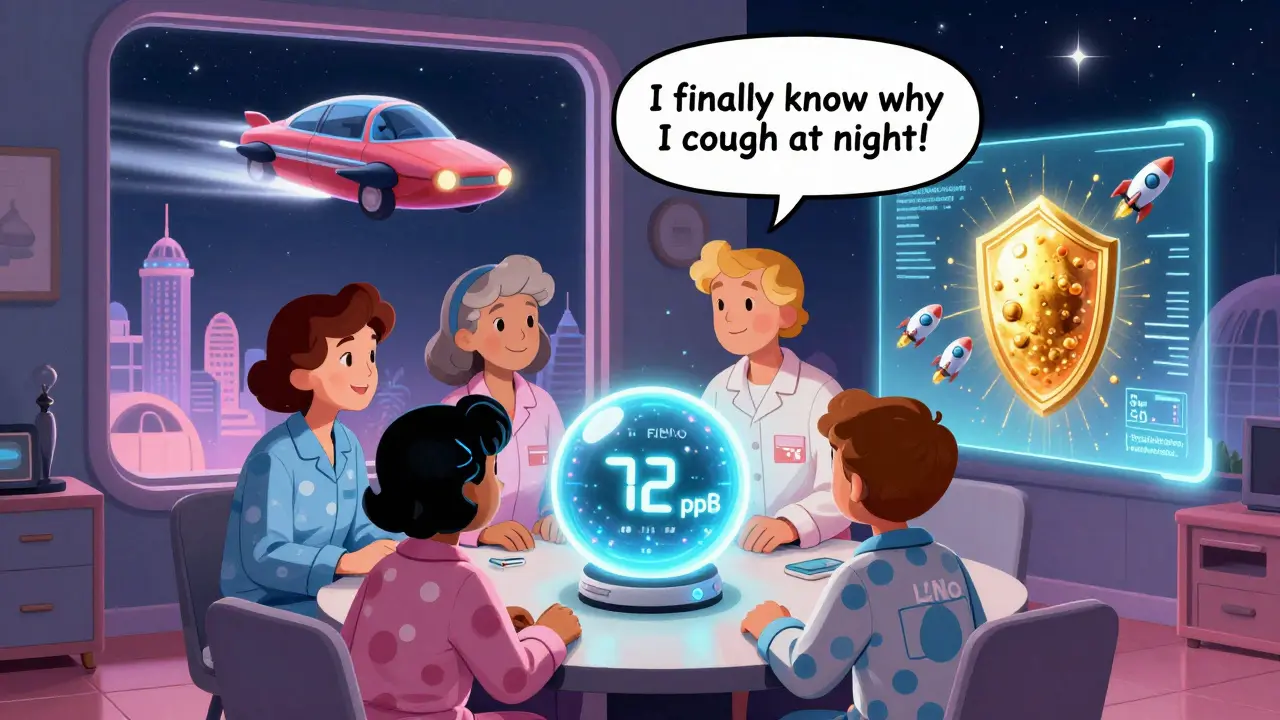
Here’s a real example: A 34-year-old patient in Perth was told for seven years she had chronic bronchitis. She used rescue inhalers constantly. Her spirometry was normal. Then she had a FeNO test: 48 ppb. That’s high. Her doctor switched her to a daily inhaled steroid. Within six weeks, her nighttime cough disappeared. She stopped using her rescue inhaler more than once a week. The FeNO test didn’t just confirm asthma-it changed her life.
FeNO also helps decide if you’re a candidate for expensive biologic therapies. These drugs cost thousands per year. If your FeNO is low, they’re unlikely to help. If it’s high, they can reduce flare-ups by up to 50%. That’s why specialists use FeNO to pick who gets these treatments.
One study showed that when doctors used FeNO to guide treatment changes, patients had half as many asthma attacks. That’s not a small win. It means fewer ER visits, fewer missed workdays, and less reliance on emergency steroids.

How It Compares to Other Tests
You’ve probably had spirometry-breathing hard into a tube to measure lung volume. That tells you how well your lungs are working right now. But it doesn’t tell you why they’re not working well.
FeNO is different:
- Spirometry: Measures airflow. Good for severity, bad for cause.
- FeNO: Measures inflammation. Great for cause, not for airflow.
- Blood eosinophils: Shows inflammation in your blood. Correlates with FeNO, but not as directly.
- Sputum test: Requires coughing up mucus. More accurate than FeNO, but invasive, messy, and not practical for routine use.
FeNO wins on convenience and speed. You get results while you’re still sitting in the chair. No lab wait. No special prep beyond avoiding food, smoke, or exercise for an hour before.
But FeNO has limits. Smoking lowers your FeNO levels by 30-50%, so it can hide inflammation. Recent steroid use can make levels drop, even if inflammation is still there. And if you have non-allergic asthma-like exercise-induced or obesity-related-your FeNO might be normal, even if your symptoms are bad. That’s why doctors never use it alone. It’s always paired with symptoms, lung function, and history.
Who Benefits Most?
Not everyone with asthma needs FeNO testing. It’s most useful for:
- People with unclear asthma diagnosis (e.g., wheezing but normal spirometry)
- Those who keep having flare-ups despite using inhalers
- Patients being considered for biologic therapy
- Children who can’t reliably do spirometry
- People with allergic rhinitis or eczema-signs of type 2 inflammation
For others-like someone with well-controlled asthma and no recent flare-ups-it’s often unnecessary. It’s not a screening tool. It’s a targeted tool.
What Patients Say
Surveys show most people who’ve had the test find it helpful. In one UK survey, 87% said it was "very easy" or "easy." One Reddit user wrote: "Finally, objective proof my inhaler wasn’t working." Another said: "It helped my doctor realize I needed biologics. I hadn’t realized how bad it was until I saw the number: 72 ppb."
But there are frustrations. Some patients report:
- Insurance denying coverage-even when their doctor says it’s needed
- Only being offered the test in big hospitals, not local clinics
- Inconsistent results from one visit to the next (often due to poor technique)
Proper technique matters. If you exhale too fast, too slow, or cough during the test, the device flags it as invalid. That’s why newer devices like the NIOX VERO® give real-time feedback on screen-showing you exactly how steady your exhale should be. Training providers takes just 15-30 minutes. Most clinics now get it right.
What’s New in 2026?
FeNO tech is getting smarter. In early 2023, the FDA cleared the first smartphone-connected FeNO device. You can now buy a portable unit for $299 and track your levels at home. Your doctor can see trends over weeks, not just one snapshot. This is huge for people with unpredictable flare-ups.
Guidelines have also expanded. The European Respiratory Society now recommends FeNO to predict who will respond to biologics like benralizumab. That’s not experimental-it’s standard practice in leading clinics.
Still, access isn’t equal. In the U.S., only 58% of private insurance plans cover FeNO without restrictions. Rural clinics are far less likely to offer it than urban ones. In Australia, Medicare covers it under specific conditions, but not all GPs have the equipment. If your doctor hasn’t mentioned it, ask. It’s not a luxury-it’s precision medicine.
Bottom Line
FeNO testing doesn’t replace your inhaler. It doesn’t replace spirometry. But it adds something neither can: a direct, measurable look at airway inflammation. For people with hard-to-control asthma, it’s often the missing piece. It can prevent unnecessary medication, avoid costly flare-ups, and guide the use of powerful new treatments.
If you’ve been told your asthma is "mild" but you’re still struggling, or if your doctor keeps changing your meds without clear reason, ask about FeNO. It’s quick, painless, and backed by solid science. And in 2026, with better devices and clearer guidelines, it’s more useful than ever.
Is FeNO testing painful?
No. FeNO testing is completely non-invasive. You simply breathe in through a filter, then exhale slowly into a handheld device for about 10 seconds. There are no needles, no throat swabs, and no discomfort. Most people say it feels like blowing up a balloon gently.
How often should I get FeNO testing?
For people on maintenance asthma treatment, testing every 3-4 months is common. If your treatment is being adjusted-like starting a new inhaler or adding a biologic-your doctor may test you every 4-6 weeks until your levels stabilize. Once your asthma is well-controlled, testing may be reduced to once or twice a year.
Can FeNO testing diagnose asthma on its own?
No. FeNO alone cannot diagnose asthma. It’s best used alongside other tools like symptom history, lung function tests (spirometry), and physical exam. A high FeNO level supports an asthma diagnosis, especially if you have allergies. But a low level doesn’t rule it out-some types of asthma don’t cause elevated nitric oxide.
Why is my FeNO level high even though I feel fine?
FeNO detects inflammation, not symptoms. You can have ongoing airway inflammation without feeling wheezy or short of breath. This is why some people have "silent inflammation"-their lungs are still at risk even if they feel okay. A high FeNO level in this case tells your doctor that your current treatment isn’t fully controlling the underlying problem, and it’s time to adjust.
Do I need to prepare for a FeNO test?
Yes. To get accurate results, avoid eating, drinking (except water), smoking, or doing vigorous exercise for at least one hour before the test. Also, don’t use your rescue inhaler within 4 hours unless instructed otherwise. These things can temporarily lower or raise your FeNO level and give a false reading.
Is FeNO testing covered by insurance?
Coverage varies. In Australia, Medicare covers FeNO testing under specific conditions when ordered by a specialist for asthma management. In the U.S., Medicare covers it under NCD 20.21, but many private insurers require prior authorization. Some plans still classify it as "investigational," so check with your provider before scheduling.

Lou Suito
FeNO? More like FeNO-thing. My pulmonologist tried to push this on me last year. Said it was 'precision medicine.' Meanwhile, my spirometry was fine, my symptoms were mild, and I was already on a low-dose steroid. Guess what? My FeNO was 22. So they upped my dose. Now I'm on a nightly inhaler I don't need. Precision? More like overmedication disguised as science.

Emily Wolff
This post reads like a pharmaceutical ad. FeNO is not a diagnostic tool. It's a marketing tool. If you're not allergic, it's meaningless. If you're a smoker? Irrelevant. If you're on steroids? Useless. The real problem? Doctors treat numbers, not patients.

Lisandra Lautert
I had a 72 ppb reading. My doctor said, 'You have type 2 inflammation.' I asked what that meant. She said, 'It means you're not just wheezing-you're actively damaging your airways.' I cried. Not because I was scared. Because I finally had proof my asthma wasn't 'in my head.'

Joseph Cantu
Let me guess-the FDA cleared a smartphone FeNO device. And now we’re supposed to believe Big Pharma didn’t fund this whole thing? The same companies that make the biologics that cost $30k a year? The same ones who lobbied to get FeNO covered? This isn’t medicine. It’s a cash grab wrapped in a white coat.

Jacob Carthy
America needs to stop overtesting everything. I had asthma as a kid. Never had FeNO. Never needed it. Just used my inhaler. Now everyone’s got a gadget, a number, a chart. We’re turning healthy people into patients. Just breathe. Don’t overthink it.

Bhaskar Anand
In India, we don't have this luxury. FeNO machines cost more than a car. We use symptoms. We use history. We use experience. You Americans think you're so advanced. But sometimes, simplicity works better than gadgets. Stop fetishizing technology.

Joanna Reyes
I’ve been on biologics for two years. My FeNO was 89 before I started. Now it’s 18. I haven’t had an ER visit in 18 months. I used to miss work every month. Now I’m running marathons. But here’s the thing-my doctor didn’t just look at the number. She looked at my sleep logs, my peak flow trends, my allergy triggers. FeNO was one piece. Not the whole puzzle. The real win? When your doctor listens. Not just reads a screen.

David McKie
The system is broken. My insurance denied FeNO three times. I had to pay $400 out of pocket. Then they said, 'Oh, we’ll cover it next year.' Next year? I had two asthma attacks in three months. This isn’t healthcare. It’s a bureaucratic obstacle course designed to keep people sick so they keep paying. The real villain? Not asthma. The insurance industry.

Anil bhardwaj
I read this article and felt calm. My son is 8. He hates spirometry. He cries. He runs. We tried FeNO. He blew into the machine like it was a toy. No tears. No fear. We got a number. The doctor said, 'He needs a different inhaler.' We changed it. Three weeks later, he slept through the night. For the first time ever. I didn’t need a PhD to understand that. I just needed a test that didn’t make him cry.

Cory L
I work in a rural clinic. We got a FeNO device last year. It’s been a game-changer. One guy came in saying he had 'chronic bronchitis.' FeNO was 61. We put him on a steroid. Two months later, he showed up with a six-pack of beer and said, 'I haven’t coughed since.' He didn’t even know he had asthma. Now he’s teaching his buddies about it. This isn’t fancy tech. It’s just good medicine that finally works.

William James
I think we’re missing the bigger picture. FeNO isn’t about numbers. It’s about dignity. For years, I was told my asthma was 'mild' because I didn’t wheeze. But I was exhausted. I couldn’t climb stairs. I felt like I was drowning in air. FeNO showed inflammation. My doctor said, 'You’re not lazy. You’re inflamed.' That changed everything. Sometimes, the most powerful thing medicine can do is say: I see you.

Southern Indiana Paleontology Institute
I dont know why you guys are so into this. My cousin in Indiana had asthma. Never got tested. Just used his inhaler. Now he’s fine. You think you need a machine to tell you if you’re breathing? Just listen to your body. Stop overcomplicating life. You dont need a number to know if you’re sick. You just need to breathe.
Write a comment