Recent POST



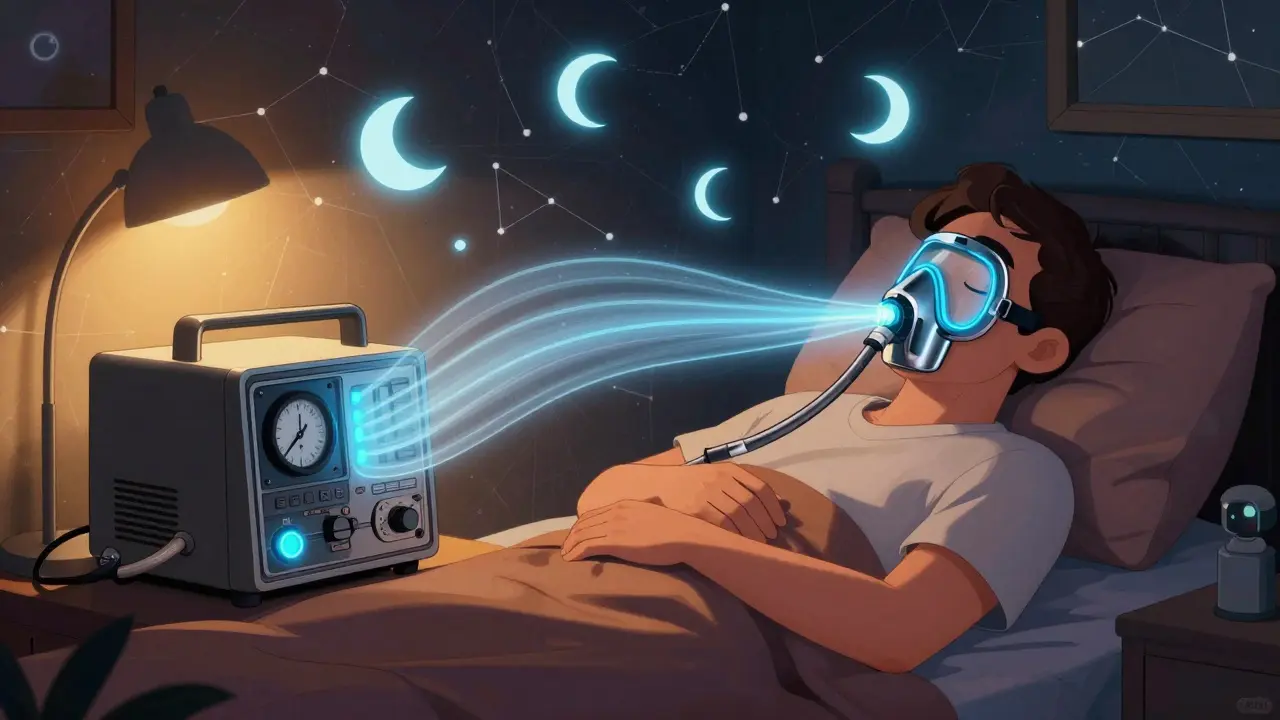
CPAP and BiPAP both help you breathe better while you sleep-but they’re not the same thing.
If you’ve been told you need a breathing machine for sleep apnea, you’ve probably heard about CPAP and BiPAP. They look similar-mask, hose, quiet machine-but they work in very different ways. Choosing the wrong one can mean discomfort, poor sleep, or even giving up on treatment altogether. The truth? Most people with sleep apnea do fine with CPAP. But if you’re struggling to breathe out against the pressure, or you have other health issues like COPD or heart failure, BiPAP might be the answer.
Let’s cut through the noise. No jargon. No fluff. Just what you need to know to understand which device might actually work for you.
How CPAP Works: Simple, Constant Pressure
CPAP stands for Continuous Positive Airway Pressure. It’s been the gold standard for treating obstructive sleep apnea since the early 1980s. The machine delivers one steady pressure all night long-whether you’re inhaling or exhaling. Think of it like a gentle air splint keeping your airway open so it doesn’t collapse when you sleep.
Typical pressure settings range from 4 to 20 cm H₂O. Most people need between 8 and 12 cm H₂O, but that’s determined by a sleep study. The machine doesn’t change its pressure based on your breathing. It just pushes air in at the same rate, every time.
That simplicity is why CPAP is used in 85-90% of sleep apnea cases. It’s reliable, affordable, and well-tested. Devices like the ResMed AirSense 11 or Philips DreamStation 2 are common today. They’re smaller, quieter, and smarter than older models, with built-in humidifiers and automatic pressure adjustments based on your breathing patterns.
But here’s the catch: exhaling against constant pressure can feel like breathing through a straw. If your prescribed pressure is high-say, 14 cm H₂O or more-that resistance can make it hard to breathe out. That’s where many people struggle. And if you can’t breathe out comfortably, you’re less likely to use the machine consistently.
How BiPAP Works: Two Pressures, Less Effort
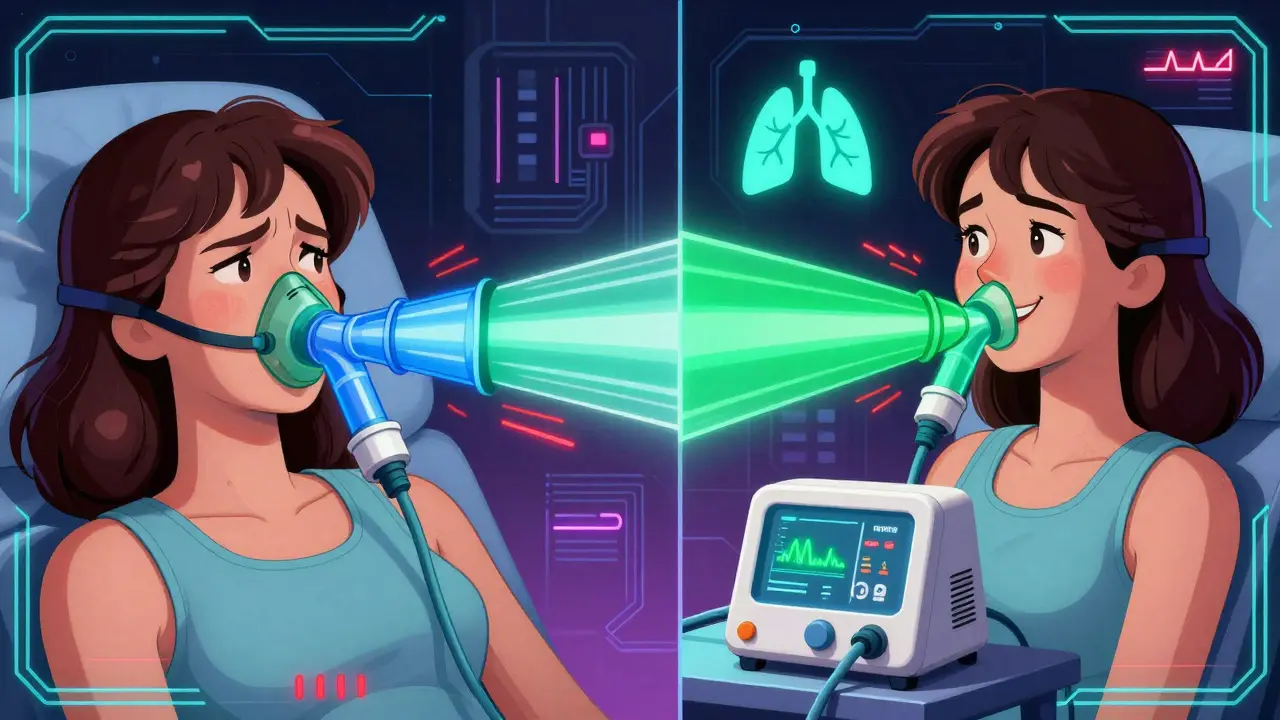
BiPAP, or Bilevel Positive Airway Pressure, gives you two different pressures: one for inhaling (IPAP), and a lower one for exhaling (EPAP). For example, your machine might be set to 14 cm H₂O when you breathe in, and drop to 8 cm H₂O when you breathe out. That 6 cm difference makes exhaling feel much easier.
This isn’t just about comfort. Reducing the pressure on exhalation lowers the work of breathing by 30-40% compared to CPAP at the same high pressure. That’s huge for people with weak respiratory muscles, COPD, or obesity hypoventilation syndrome.
BiPAP machines also have extra features CPAP doesn’t. Many include a backup rate-meaning if you stop breathing for a few seconds, the machine will force a breath. That’s critical for central sleep apnea, where your brain forgets to tell your lungs to breathe. It’s also why BiPAP is often used for heart failure patients or those with neuromuscular diseases like ALS or muscular dystrophy.
Modern BiPAP devices, like the ResMed AirCurve 10 VAuto or Philips DreamStation 2 BiPAP, can even adjust pressure automatically based on your breathing. But that complexity comes with a trade-off: more settings mean more things that can go wrong.
Who Gets CPAP? Who Gets BiPAP?
Not everyone needs a sleep study to figure this out-but you should. Still, here’s a quick guide based on real-world clinical use:
- CPAP is first-line for: Obstructive sleep apnea (OSA) without other lung or heart conditions. If your main problem is your airway collapsing, CPAP fixes it.
- BiPAP is recommended for: People who can’t tolerate CPAP pressure above 12-14 cm H₂O; those with COPD and high carbon dioxide levels (hypercapnia); central sleep apnea; obesity hypoventilation syndrome; or neuromuscular disorders.
According to the American Thoracic Society, BiPAP should not be used as a first try for simple OSA. But if you’ve tried CPAP and quit because you felt like you were suffocating, BiPAP might be your next step.
Here’s a real example: A 62-year-old man with severe OSA (AHI of 45) and a BMI of 38 was prescribed CPAP at 16 cm H₂O. He could only tolerate 2 hours a night. Switched to BiPAP at 18/8, he slept 7 hours and felt like he could breathe again. That’s not rare-it’s common among high-pressure CPAP users.
On the flip side, a 50-year-old woman with mild OSA (AHI of 12) and a CPAP pressure of 9 cm H₂O had no trouble with CPAP. She didn’t need BiPAP. Her machine worked perfectly. And she saved $600.
Cost, Insurance, and What You’ll Pay
CPAP machines cost between $500 and $1,200. BiPAP machines? Usually $800 to $1,800. That’s a big difference. And insurance doesn’t treat them the same.
In the U.S., Medicare covers 80% of CPAP costs. But for BiPAP, you have to prove CPAP failed. That means using CPAP for 30 days, at least 4 hours a night, and still being unable to tolerate the pressure. Only then will they approve BiPAP. Many people don’t make it past this step because they give up too soon.
Private insurance varies. Some require a letter from your sleep doctor explaining why BiPAP is medically necessary. Others won’t cover it unless you have a diagnosis of COPD, central apnea, or hypoventilation.
Don’t assume BiPAP is “better.” It’s not. It’s just different-and more expensive. If you don’t need it, you’re paying extra for features you won’t use.
Adherence: Who Actually Uses Their Machine?
Here’s the hard truth: about half of people with sleep apnea stop using their machine within a year. That’s true for both CPAP and BiPAP.
But here’s what the data shows:
- CPAP users average 5.1 hours of use per night.
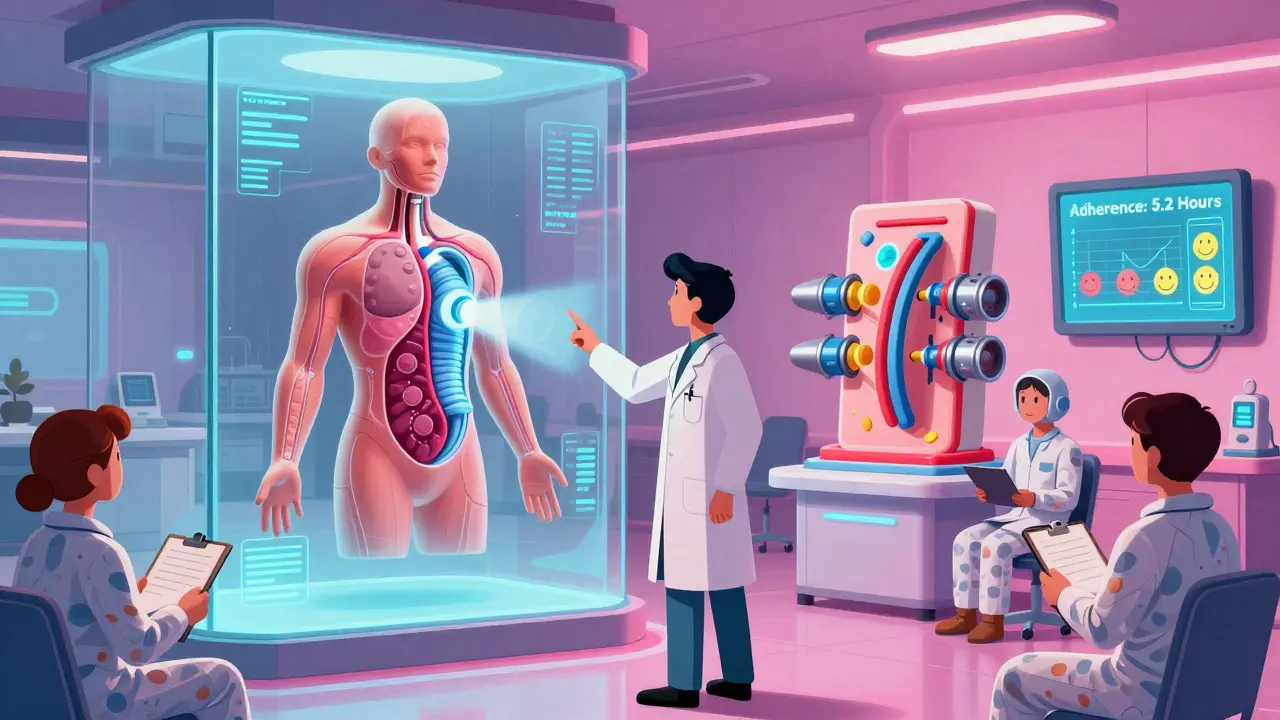
- BiPAP users average 5.2 hours.
That’s not a meaningful difference. A 2021 Cochrane review of nearly 2,000 people found no significant improvement in sleep quality, daytime alertness, or long-term health outcomes with BiPAP over CPAP-for simple OSA.
So why do some people swear by BiPAP? Because for them, it’s the only thing that lets them breathe. If you’re one of the 10-15% who can’t tolerate high CPAP pressure, BiPAP isn’t an upgrade-it’s a necessity.
But if you’re just starting out, try CPAP first. Give it a real shot. Use it for at least 30 days. Adjust the ramp feature, try a different mask, add humidification. Many people who quit CPAP did so because they didn’t get the right support-not because the machine didn’t work.
What You Need to Know Before You Start
Both machines require a sleep study. You can’t just buy one off the shelf and expect it to work. The pressure settings must be personalized. A CPAP pressure that’s too low won’t stop your apneas. A BiPAP pressure that’s too high on exhalation defeats the purpose.
Mask fit matters more than you think. About 70% of discomfort comes from a bad seal. If your mask leaks, you’ll wake up with dry mouth, red marks, or air in your stomach. Try nasal pillows, full face masks, or hybrid designs. Don’t settle for the first one your clinic gives you.
Humidification is non-negotiable. Dry air causes nasal congestion and makes you want to quit. Most modern machines have heated humidifiers. Use them.
And don’t ignore the learning curve. CPAP usually takes 2-4 weeks to get used to. BiPAP? 3-6 weeks. The extra settings-ramp, backup rate, pressure relief-can be confusing. Ask for a respiratory therapist. Don’t just rely on the manual.
What’s New in 2025?
Devices today are smarter. ResMed’s AirSense 11 and Philips’ DreamStation 3 now track your breathing in real time and adjust pressure automatically. Some even include built-in pulse oximeters to check your blood oxygen levels overnight.
Artificial intelligence is starting to predict apneas before they happen. But reimbursement hasn’t caught up. Insurance still wants proof of failure before approving advanced machines.
The biggest shift? More people are being diagnosed with complex sleep apnea-OSA combined with central apnea or COPD. That’s driving BiPAP adoption. But for most, CPAP remains the right choice.
Final Thoughts: Don’t Overthink It
CPAP is the workhorse. It’s simple, effective, and affordable. If you have obstructive sleep apnea and no other lung or heart conditions, start here.
BiPAP is the specialist. It’s for when CPAP doesn’t cut it-when you need help breathing out, or your brain forgets to breathe. It’s not better. It’s just the right tool for a different job.
Don’t let marketing or a friend’s story push you toward BiPAP. Don’t let fear of pressure make you skip CPAP entirely. Talk to your sleep doctor. Get the right study. Give CPAP a real try. And if it doesn’t work? Then BiPAP is waiting.
Because the goal isn’t to use the fanciest machine. It’s to sleep well-and breathe easy-every night.
Can I use a BiPAP machine instead of a CPAP if I have simple sleep apnea?
Technically, yes-but it’s not recommended. For simple obstructive sleep apnea without other health issues, CPAP is just as effective and much cheaper. BiPAP adds complexity and cost without improving outcomes for most people. Insurance often won’t cover it unless you’ve tried and failed CPAP first.
Why do some people say BiPAP feels easier to breathe with?
Because BiPAP lowers the pressure when you exhale. If your CPAP pressure is set high-say, 14 cm H₂O-exhaling against that constant force can feel like breathing through a narrow tube. BiPAP drops to a lower pressure (like 8 cm H₂O) on exhalation, which reduces the effort and makes breathing feel more natural. This is especially helpful for people who need high pressures or have weak respiratory muscles.
Is BiPAP only for people with COPD?
No. While BiPAP is commonly used for COPD with high carbon dioxide levels, it’s also used for central sleep apnea, obesity hypoventilation syndrome, and neuromuscular diseases. The key is whether you need two different pressure levels or backup breaths. If you have pure obstructive sleep apnea without these conditions, BiPAP isn’t usually needed.
How do I know if I need a sleep study before getting a machine?
You absolutely need one. CPAP and BiPAP settings must be personalized. Too little pressure won’t stop your apneas. Too much can cause discomfort or even harm. A sleep study measures your breathing patterns, oxygen levels, and apnea events to determine the right pressure and machine type. Never buy a machine without a doctor’s prescription based on a sleep study.
What if I can’t tolerate CPAP? Should I just switch to BiPAP?
Try adjusting CPAP first. Change your mask, use a ramp feature, add humidification, or try a different pressure setting. Many people who think they can’t tolerate CPAP just need better support. If you’ve tried for 30 days and still can’t breathe out comfortably, then BiPAP is the next logical step. But don’t give up on CPAP too soon.
Do BiPAP machines require more maintenance than CPAP?
The cleaning and care are the same-daily mask washing, weekly filter changes, monthly tubing checks. But BiPAP machines have more settings and modes, which means more things can go wrong. If your machine starts cycling unpredictably or doesn’t respond to your breathing, it might need a technician. CPAP is simpler to troubleshoot on your own.
Will insurance cover a BiPAP machine if I just want it?
No. Insurance companies require documented medical necessity. That usually means you’ve tried CPAP, failed to tolerate it (based on usage data), and have a specific condition like COPD, central apnea, or hypoventilation. Simply wanting a “better” machine isn’t enough. Be prepared to provide sleep study results and a letter from your doctor.

Jessica Salgado
I tried CPAP for 3 weeks and felt like I was suffocating. My mask kept leaking, I woke up with a dry throat, and I hated the noise. Then I switched to BiPAP at 16/8 and it was like someone unlocked my lungs. I sleep 7 hours now. No more headaches. No more brain fog. This isn't a luxury-it's a lifeline.

amanda s
CPAP is for wimps. If you can't handle a little pressure, maybe you shouldn't be sleeping at all. My grandpa used a cardboard box and a fan in '78 and lived to 92. Stop coddling yourself and get tough.

Peter Ronai
Actually, you're all wrong. BiPAP isn't even the real solution. The real issue is upper airway resistance syndrome, which 70% of 'OSA' patients actually have. Most docs don't even know how to test for it. You need a MANDIBULAR ADVANCEMENT DEVICE with a sleep endoscopy, not some $1500 machine that just pushes air. CPAP is a band-aid. BiPAP? A bigger band-aid with more buttons.

Michael Whitaker
While I appreciate the empirical data presented regarding the comparative efficacy of continuous versus bilevel positive airway pressure modalities, I must respectfully assert that the underlying assumption-that patient adherence is primarily a function of physiological comfort-is fundamentally flawed. The psychosocial determinants of compliance, including perceived autonomy, therapeutic alliance, and cognitive dissonance regarding chronic illness, are significantly underrepresented in this discourse.

Sachin Bhorde
Bro, CPAP is fine if u set it right. I had same prob-felt like choking. Then i found out my mask was too tight n my humidifier was off. After fixin that, i went from 2hrs to 7hrs. Also, try ResMed AirMini if u travel. Cheap n lite. BiPAP? Only if u got COPD or central apnea. Dont waste money. Sleep doc should guide u, not amazon reviews.

Joe Bartlett
CPAP works. I’ve used mine for 8 years. Simple. No drama. My wife doesn’t even notice I’m wearing it anymore. If you can’t handle it, it’s not the machine-it’s you.

Marie Mee
I think the FDA is hiding something. Why do all these machines have that weird blue light? I swear mine flashes when I dream. My neighbor says the same thing. They’re tracking us. And the humidifier? It’s not for moisture-it’s for vaporizing something else. I stopped using mine. I sleep on my side now. Better than any machine.

Naomi Lopez
The notion that CPAP is 'sufficient' for all obstructive sleep apnea cases is a reductive fallacy rooted in cost-driven healthcare paradigms. The physiological heterogeneity of upper airway collapse dynamics demands individualized pressure titration-something BiPAP inherently accommodates through its dual-pressure architecture. To dismiss BiPAP as 'unnecessary' is to confuse affordability with appropriateness.

Salome Perez
In my community in Mexico City, we have a saying: 'The best medicine is the one you use.' I've seen people with sleep apnea in rural villages use bamboo tubes and cotton masks-anything to breathe. The real tragedy isn't the cost of the machine. It's the silence people keep because they think they don't deserve help. If CPAP gives you one good night of sleep, it's worth it. If BiPAP gives you ten, then honor that. Your breath is sacred. Don't let bureaucracy steal it.

Evelyn Vélez Mejía
The existential dilemma of sleep technology is not mechanical-it is ontological. We outsource the most intimate act of self-regulation to a machine that demands compliance, silence, and surrender. Is CPAP a cure, or merely a ritual of control? BiPAP, with its asymmetrical pressure, mirrors the duality of human existence: inhale the world, exhale the burden. We don’t just treat apnea-we negotiate our relationship with vulnerability. The machine doesn’t fix the body. It teaches us to listen to it.

Victoria Rogers
lol everyone acts like biPAP is some magic wand. i used both. biPAP was worse. the machine kept making this weird clicking noise like a dying robot. and the settings? total mess. i had to call tech support 3 times. cpap was silent, reliable, and i didn't need a degree to use it. also, my insurance denied biPAP because i 'didn't prove failure'-which is bs because i didn't even try for 30 days. i gave up. now i just sleep on my stomach. works fine.

Meghan O'Shaughnessy
My dad used CPAP for 12 years. Then got COPD. Switched to BiPAP. Still uses it. He says the difference isn’t the machine-it’s the fact that someone finally listened. He had a respiratory therapist come to his house every month. Showed him how to clean it. Made him feel like a person, not a patient. That’s what matters. Not the pressure settings. The human touch.
Write a comment