Recent POST



Complementary Treatment Interaction Checker
Check for Potential Interactions
Enter your prescription medication and complementary treatment to see if there's a potential interaction risk. This tool is not a substitute for professional medical advice.
Many people taking prescription medications face side effects that don’t go away - nausea, fatigue, dry mouth, neuropathy, or constipation. Sometimes, the medicine works, but the cost feels too high. That’s where complementary treatments come in. These aren’t replacements for your doctor’s prescription. They’re tools used alongside it to help you feel better while staying safe.
What Counts as a Complementary Treatment?
Complementary treatments are practices or products used with conventional medicine to ease side effects. They include things like acupuncture, herbal supplements, meditation, massage, and dietary changes. The key word here is complementary - not alternative. You don’t stop your medication. You add something to help your body cope.The National Center for Complementary and Integrative Health (NCCIH) reports that about 38% of U.S. adults use some form of complementary therapy. The most common reasons? Managing side effects from cancer drugs, heart medications, and painkillers. In Australia, up to two-thirds of people use these approaches, often without telling their doctor.
Acupuncture: Proven for Nausea, Constipation, and Pain
If you’re on chemotherapy, opioids, or certain blood pressure meds, acupuncture might be one of the most reliable options. A 2017 meta-analysis in JAMA Oncology found that acupuncture reduced chemotherapy-induced nausea by 36% compared to fake (sham) treatments. Another Cochrane review of 41 trials showed a 32% greater improvement in opioid-induced constipation than standard care alone.How does it work? It’s not magic. Needles placed at specific points stimulate nerves that send signals to the brain, helping regulate nausea centers and gut motility. Sessions usually last 20-30 minutes. Most people feel relaxed afterward. Side effects are rare - minor bruising or soreness at needle sites are the most common.
For neuropathy from taxol or other chemo drugs, patients report up to a 50% reduction in tingling and burning after 6-8 weekly sessions. This isn’t anecdotal. Multiple randomized trials back it up.
Ginger: A Kitchen Staple That Actually Works
You don’t need a clinic for this one. Ginger - fresh, dried, or in capsule form - has strong evidence for easing nausea. A 2013 study in the Journal of Pain and Symptom Management found that 0.5 to 1.0 grams of ginger daily cut chemotherapy-related nausea by 40%. That’s better than some anti-nausea pills for some people.It’s also helpful for motion sickness and morning sickness. Capsules are easiest to dose accurately. You can also sip ginger tea or chew crystallized ginger. Avoid high doses (over 4 grams per day) if you’re on blood thinners like warfarin - ginger can thin blood too.
One Reddit user, u/ChemoSurvivor2022, wrote: “Ginger capsules reduced my nausea by 70% compared to ondansetron alone.” That’s not unusual. But another user, u/CancerWarrior87, shared a warning: “I took milk thistle with my chemo and had to be hospitalized for liver toxicity.” That’s the danger of assuming everything natural is safe.
Herbs and Supplements: High Risk, Mixed Rewards
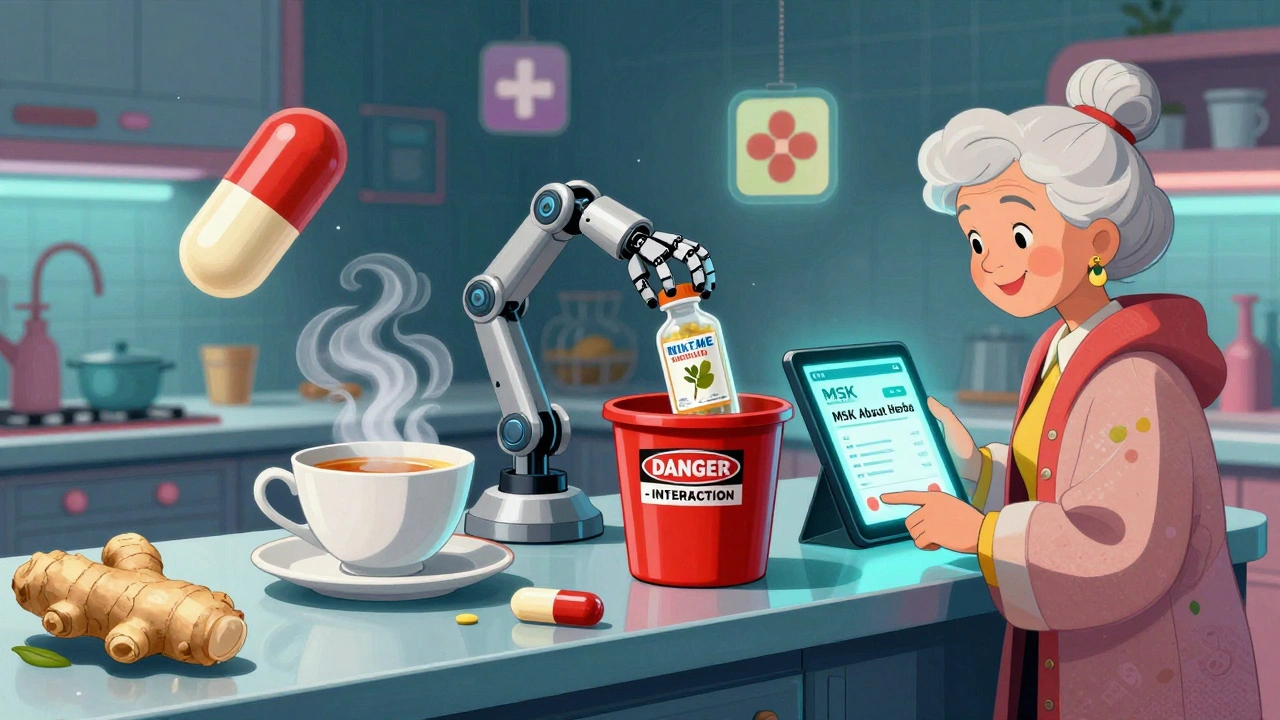
This is where things get tricky. Many people turn to herbs like milk thistle, echinacea, or garlic because they’ve heard they “help the liver” or “boost immunity.” But here’s the truth: some of these can interfere with your meds - sometimes dangerously.Garlic, for example, can increase bleeding risk when taken with aspirin or lisinopril. Ginseng may raise blood pressure or interfere with antidepressants. Milk thistle, often used for liver support, has been linked to liver toxicity in patients on certain chemo drugs. A 2018 study of 318 cancer patients found that 133 different herbal combinations were in use - and 20 patients needed urgent warnings because of interaction risks.
Even “safe” supplements like fish oil or evening primrose oil can thin blood. Beta-carotene and antioxidants like vitamins C and E may protect cancer cells during radiation or chemo, according to Cancer Research UK. That’s not what you want.
The American Heart Association warns that blue cohosh can cause rapid heartbeat and high blood pressure. Lily of the valley - sometimes sold as a heart tonic - can dangerously lower potassium when taken with digoxin, a common heart failure drug.
There’s no universal safety list. What’s fine for one person could be dangerous for another. Always check with your pharmacist or doctor before starting any herb or supplement.
Mind-Body Practices: Calm the Nervous System
Fatigue, anxiety, and insomnia are common side effects of many medications. These aren’t just “in your head.” They’re real physical responses. Mind-body practices help reset your nervous system.Meditation and deep breathing have been shown to reduce stress hormones like cortisol. One study found cancer patients who practiced mindfulness for 8 weeks reported better sleep and less fatigue. Yoga, tai chi, and guided imagery work similarly. They don’t cure side effects, but they make them easier to live with.
Massage therapy is another low-risk option. For people on long-term pain meds, it can reduce muscle tension and improve circulation. A 2020 study in Palliative Medicine showed massage reduced pain scores by 30% in patients with chronic opioid use.
Why So Many People Don’t Tell Their Doctors
Here’s the biggest problem: most people don’t tell their doctors they’re using these treatments. In one UK hospital study, only 20.9% of patients using complementary therapies mentioned them to their healthcare team. That’s dangerous.Doctors can’t protect you from interactions if they don’t know what you’re taking. A 2021 study found that most physicians have less than 20 hours of training in herb-drug interactions. But you can bridge that gap.
Start by making a list: write down every supplement, herb, tea, or therapy you use. Include doses and how often. Bring it to your next appointment. Say: “I’m using this to help with my side effects. Can we check if it’s safe with my meds?”
Tools like the Memorial Sloan Kettering About Herbs app (used by over 11,000 people monthly) can help you check interactions before you talk to your doctor. The NCCIH also has a free online interaction checker updated monthly.
What’s Safe? What’s Not?
Here’s a quick guide based on current evidence:| Treatment | Best For | Effectiveness | Risk Level | Key Warning |
|---|---|---|---|---|
| Acupuncture | Nausea, constipation, neuropathy | High | Low | Use licensed practitioners only |
| Ginger (0.5-1g/day) | Chemotherapy nausea | High | Low to moderate | Avoid high doses with blood thinners |
| Meditation/Yoga | Fatigue, anxiety, sleep | Moderate | Very low | None |
| Massage Therapy | Muscle tension, pain | Moderate | Very low | Avoid deep tissue if on blood thinners |
| Milk Thistle | Liver support | Unclear | High | Can cause liver toxicity with chemo |
| Garlic Supplements | Heart health | Moderate | High | Interacts with lisinopril, aspirin, warfarin |
| Blue Cohosh | Menstrual issues | Low | Very high | Can cause heart attack or stroke |

How to Use These Safely
1. Never stop or change your prescription - talk to your doctor first. 2. Disclose everything - supplements, teas, oils, acupuncture, even yoga if you’re doing it for health reasons. 3. Start low, go slow - try one new thing at a time. Give it 2-4 weeks before deciding if it helps. 4. Check for interactions - use the MSK About Herbs app or NCCIH’s online tool. 5. Buy from trusted sources - look for third-party testing (USP, NSF, or ConsumerLab seals). Avoid products with vague labels like “proprietary blend.” 6. Watch for red flags - if you feel dizzy, have chest pain, or your skin turns yellow, stop and call your doctor.What’s Changing Right Now
In 2023, the NIH spent $142 million on research into complementary therapies - nearly 40% of that focused on managing medication side effects. Major cancer centers now offer integrative medicine services, and hospitals are starting to track CAM use in electronic records.The future is personalized. Researchers are looking for biomarkers that predict who will respond to acupuncture or ginger - not just based on diagnosis, but on genetics, gut health, and metabolism. This isn’t sci-fi. It’s happening now.
But the biggest barrier isn’t science - it’s silence. Patients don’t talk. Doctors don’t ask. And that’s where the risk lives.
Can I use ginger instead of my anti-nausea pill?
No. Ginger is a helpful addition, not a replacement. Anti-nausea medications like ondansetron work by blocking specific brain signals. Ginger works differently - by calming the gut and reducing inflammation. Using both together often gives better results than either alone. Never stop your prescribed medicine without talking to your doctor.
Are herbal supplements regulated like prescription drugs?
No. In the U.S., supplements are regulated as food, not medicine. That means manufacturers don’t have to prove they work or are safe before selling them. Contamination with heavy metals, pesticides, or even prescription drugs has been found in some products. Look for seals from USP, NSF, or ConsumerLab - they test for purity and potency.
Is acupuncture painful?
Most people feel little to no pain. The needles are very thin - thinner than a human hair. You might feel a slight pinch or tingling when they’re inserted, but it should not hurt. Many patients fall asleep during sessions. Always choose a licensed acupuncturist with clean, single-use needles.
Can I take turmeric with my blood pressure medicine?
Turmeric (curcumin) may lower blood pressure slightly and thin the blood. If you’re on lisinopril, beta-blockers, or warfarin, it could increase the risk of low blood pressure or bleeding. Talk to your doctor before using turmeric supplements. Eating it in food (like curry) is generally safe.
Why do some people say complementary treatments don’t work?
Because not all of them do. Some are backed by strong science - like acupuncture and ginger. Others have no proof at all. People who try unproven, expensive supplements and see no change often say they “don’t work.” But that’s not the whole story. The ones that do work are often underused because patients don’t know about them or are afraid to ask their doctor.
Should I tell my pharmacist about my supplements?
Yes - even more than your doctor, your pharmacist is trained to spot drug interactions. They see your full medication list and can flag dangerous combinations. Bring your supplement bottles with you when you pick up your prescriptions. It takes two minutes and could prevent a hospital visit.
Next Steps
If you’re struggling with side effects, start here: - Write down your top 3 side effects. - Pick one complementary treatment with strong evidence (like ginger for nausea or acupuncture for pain). - Talk to your doctor or pharmacist - bring your list. - Try it for 4 weeks. Track how you feel. - Don’t add more until you know how the first one works.The goal isn’t to fix everything overnight. It’s to take back some control. Medications save lives. Complementary treatments can help you live better while taking them.

Andrea Petrov
So let me get this straight - we’re now encouraging people to stick needles in themselves and chew ginger like it’s a magic potion while ignoring the real issue: Big Pharma is poisoning us on purpose. The FDA doesn’t want you to know this, but acupuncture is just a distraction tactic so you don’t ask why your meds cost $2000 a month. And don’t get me started on ‘licensed practitioners’ - most of them are just reiki-certified yoga instructors who went to a weekend seminar in Boulder. 🤡

Andrea DeWinter
Hey I just wanted to say this post is so helpful. I’ve been on chemo for 2 years and ginger capsules saved my life. I didn’t tell my oncologist at first because I thought they’d laugh but they didn’t. Now I bring my supplement list to every appointment. Seriously if you’re taking anything herbal - write it down. Even if it’s just chamomile tea. Your pharmacist will thank you. And if you’re scared to ask - just say ‘I want to make sure I’m not hurting myself’ - they’ll get it. You’re not being weird. You’re being smart. 💪

Evelyn Pastrana
OMG yes ginger is the real MVP 🙌 I used to puke every time I took my pills until I started chewing those little ginger candies. Like I didn’t even need the fancy meds anymore. My dog even started licking my plate when I ate ginger cookies. Not a joke. He’s a 12-year-old pug who’s never cared about food. Now he’s basically my ginger enforcer. Also acupuncture? I cried during my first session. Not from pain. From relief. Like my body finally went ‘ohhhhhh you’re not trying to kill me’.

Nikhil Pattni
Actually I have to correct this entire article. In India we’ve been using turmeric and ashwagandha for 5000 years and no one ever needed a ‘licensed practitioner’ or a ‘third-party seal’. The FDA doesn’t regulate Ayurveda because it can’t compete with Western pharma profits. You think ginger works? Try neem leaf tea for nausea - it’s 10x stronger and costs 50 cents. Also, milk thistle is not dangerous - it’s the pharmaceutical companies that are dangerous. They don’t want you to know that liver detox is just a $20 bottle of seeds from the local market. And why are you using ‘NCCIH’ as a source? That’s just NIH’s PR arm for Big Pharma. I’ve seen studies where placebo acupuncture outperformed real acupuncture because the patients believed in the system. The real treatment is trust. Not needles.

Arun Kumar Raut
Man I really appreciate this post. I’m from India and my mom takes blood pressure meds and she started taking turmeric with black pepper because she heard it helps. She didn’t tell anyone. Then she got dizzy and almost fell. We went to the doctor and they said ‘oh you’re on lisinopril? Turmeric can drop your BP too much’. She was scared but now she brings all her herbs to the pharmacy. We even got a little notebook. It’s not about being ‘alternative’ - it’s about being safe. Just talk to someone who knows. No shame.

precious amzy
One must interrogate the epistemological foundations of ‘evidence-based’ complementary medicine. The very notion that ‘effectiveness’ can be quantified via randomized controlled trials - a paradigm rooted in Cartesian reductionism - is inherently colonial, ignoring embodied, contextual, and indigenous knowledges. To label milk thistle as ‘high risk’ is to privilege pharmacological hegemony over ontological pluralism. One does not ‘use’ ginger to ‘manage’ nausea; one participates in a relational cosmology wherein the plant is not an object but a co-agent in healing. The NCCIH, as a state-funded apparatus, merely reproduces biopower. Your ‘MSK app’ is a digital panopticon.

Carina M
It is profoundly irresponsible to present ginger and acupuncture as ‘evidence-based’ while omitting the fact that the majority of studies are underpowered, industry-funded, or conducted on small, non-representative cohorts. The term ‘complementary’ is a linguistic sleight-of-hand designed to legitimize quackery under the veneer of scientific legitimacy. One does not ‘add’ a substance to a pharmaceutical regimen and expect neutrality. The pharmacokinetic interactions are neither trivial nor fully mapped. This article is a dangerous misrepresentation of risk. If you are taking warfarin, do not consume ginger, garlic, or fish oil - period. And if your doctor doesn’t know this, they are not qualified to be your doctor.

Elliot Barrett
Ugh. This is just a long ad for acupuncture clinics and ginger capsule companies. I’ve tried all this stuff. None of it worked. I just took my nausea pill and went to bed. If you want to waste money on needles and herbal teas, go ahead. But don’t act like you’re doing something revolutionary. You’re not. You’re just buying into wellness capitalism.

Katherine Chan
Y’all I just want to say - if you’re reading this and you’re scared to talk to your doctor - you’re not alone. I used to hide my magnesium supplements because I thought they’d think I was crazy. Then I said ‘hey I’m trying this to help with my cramps’ and they said ‘cool, let’s check your levels’. That’s all it took. You don’t need to be perfect. You just need to be honest. And if your doc rolls their eyes? Find a new one. You deserve someone who sees you as a person, not a chart. 💛

Tim Tinh
so i tried the ginger thing after my chemo and it was a game changer. like i could actually eat food again. my wife made me tea with fresh ginger and honey and i swear i cried. also acupuncture? i was skeptical but the lady was super chill and i fell asleep. i didn’t tell my doc at first but then i brought my list and he was like ‘oh good you’re not taking that milk thistle stuff’ - turns out he knew all about it. just talk to them. they’re not monsters. also typoed ‘acupunture’ in my notes once and they still understood. lol.

Iris Carmen
my aunt took milk thistle with her chemo and ended up in the er. she thought it was ‘natural so it’s safe’. yeah no. don’t be her. just ask your pharmacist. they’re the real heroes.

Ruth Witte
GINGER IS LIFE 🌿💛 I used to throw up every time I took my meds. Now I chew a ginger chew and I’m good. Also yoga for fatigue? 10/10. I do 10 mins in my pajamas before bed. No one’s watching. I’m not ‘healing’. I’m just surviving. And that’s enough.

Lauren Dare
While I appreciate the attempt at synthesizing empirical data, the article’s conflation of ‘effectiveness’ with ‘anecdotal satisfaction’ undermines its purported rigor. The NCCIH’s metrics are not peer-reviewed gold standards but rather patient-reported outcome measures susceptible to placebo bias. Furthermore, the inclusion of ‘massage therapy’ as a ‘moderate’ intervention lacks stratification by tissue depth, pressure modulation, or practitioner credentialing - rendering the recommendation clinically meaningless. One cannot generalize ‘low risk’ across heterogeneous modalities without ontological precision.

Taya Rtichsheva
so i read this whole thing and then i went and told my dr about my turmeric capsules. she said ‘oh yeah that’s fine but maybe cut it to half’ and i was like… wait she knew? i thought i was the only weirdo doing this. turns out half the people in her clinic do it. we just don’t talk about it. so yeah. just talk. it’s not that scary.
Write a comment