Recent POST






Imagine spending hundreds of dollars on prescription medication, only to have most of it hit the back of your throat instead of your lungs. It sounds like a waste, but for millions of people with asthma or chronic obstructive pulmonary disease (COPD), this is the daily reality. Studies show that between 70% and 90% of patients use their inhalers incorrectly. When you get the technique wrong, you might be getting as little as 8% of the medicine into your airways. Getting it right can double or triple that number. The device itself isn't the problem; how you use it is.
We are going to break down exactly how these devices work, why so many people struggle with them, and the specific steps you need to take to ensure every puff counts. Whether you are managing acute asthma attacks or living with long-term COPD, understanding your tool is just as important as the medicine inside it.
The Three Main Types of Inhalers
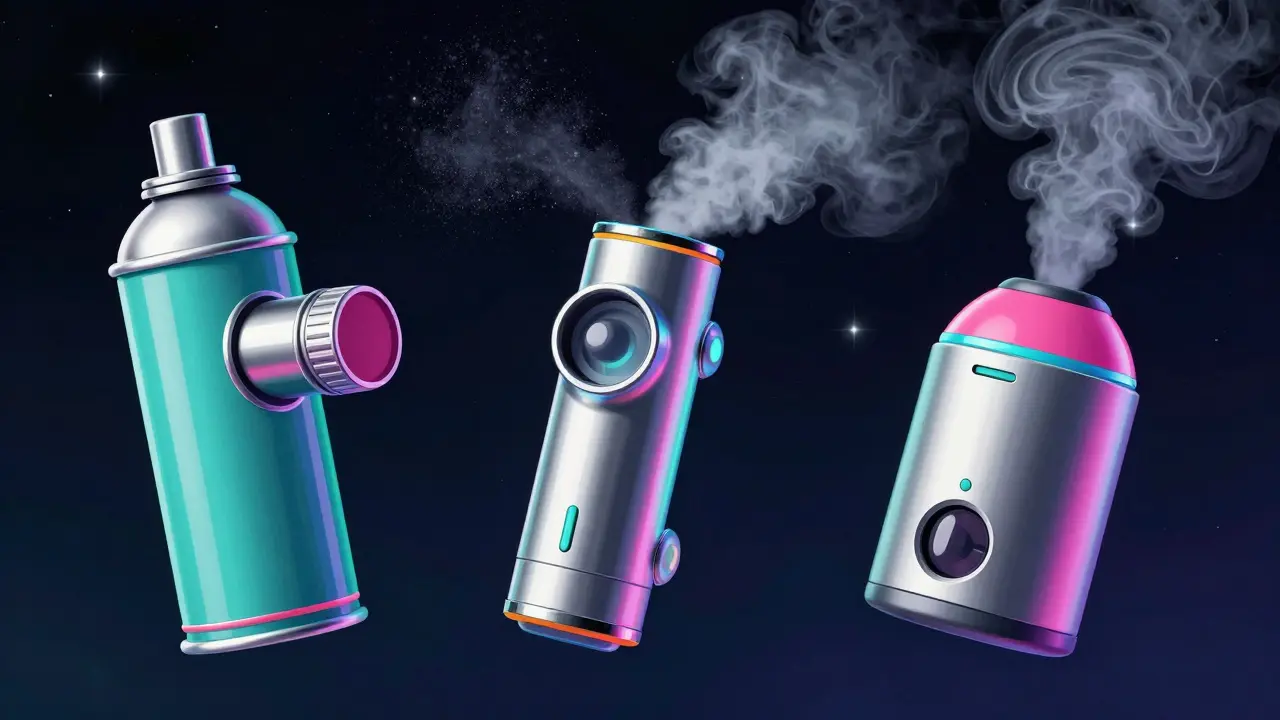
Not all inhalers are created equal. In fact, they are quite different machines designed to deliver medicine in distinct ways. Knowing which type you have is the first step to using it correctly. There are three primary categories dominating the market today.
First, there is the Metered-Dose Inhaler (MDI). This is the classic "puffer" you see in movies. It contains medication suspended in a pressurized canister. When you press the top, a valve releases a precise dose-usually between 90 and 200 micrograms-into the air. Examples include ProAir HFA. The challenge here is coordination. You have to press the canister at the exact same moment you start inhaling. A 2022 study found that only 23% of patients could do this naturally without training.
Second, we have the Dry Powder Inhaler (DPI). Devices like the Diskus, Ellipta, or Turbuhaler fall into this category. These don't use propellants. Instead, they hold medication in a fine powder. To get the medicine out, you have to breathe in hard and fast. The force of your breath breaks up the powder and carries it into your lungs. This eliminates the hand-breath coordination issue, but it introduces a new requirement: you need enough lung strength to generate an inspiratory flow of at least 60 liters per minute. If you have severe COPD, you might not be able to breathe in forcefully enough to make a DPI work.
Third, there is the Soft Mist Inhaler, such as the Respimat. This device generates a slow-moving mist over about 1.5 seconds. It sits somewhere in the middle. It doesn't require the frantic coordination of an MDI, nor does it demand the powerful lung blast of a DPI. It’s often easier for older adults or those with weaker lung capacity to manage.
| Type | How It Works | Key Requirement | Best For |
|---|---|---|---|
| Metered-Dose (MDI) | Pressurized spray | Hand-breath coordination | Acute attacks, all ages (with spacer) |
| Dry Powder (DPI) | Breath-activated powder | Fast, forceful inhalation | Patients with good lung strength |
| Soft Mist | Slow-moving mist | Moderate inhalation speed | Elderly or those with weak lungs |
Why Technique Matters More Than Brand
You might think switching brands will solve your breathing problems, but experts say otherwise. Dr. Robert Openbush from the American Lung Association puts it bluntly: proper technique is the single most important factor in effectiveness. It matters more than the specific device you choose.
When you use an MDI without a spacer, only 8% to 30% of the medication reaches your lungs. The rest hits your mouth and throat. But if you add a spacer-that plastic tube attachment-the delivery jumps by 70% to 100%. Spacers act as a holding chamber, allowing the fast-moving spray to slow down before you inhale it. They also remove the need for perfect timing. You press the inhaler into the spacer, then breathe in normally. It’s a game-changer for accuracy.
However, spacers are not universal. Do not use a spacer with a Dry Powder Inhaler. Doing so reduces efficacy by 50% to 70% because the powder clumps together in the extra space. The European Respiratory Society warns against mixing techniques or devices without training, as confusion can drop effectiveness by nearly half.
Step-by-Step Guide to Using Your Inhaler
Let’s look at the mechanics. The National Heart, Lung, and Blood Institute (NHLBI) outlines specific steps that maximize drug deposition. Here is how to do it right for the two most common types.
For Metered-Dose Inhalers (MDIs)
- Shake it: Shake the inhaler well for 5 seconds. About 45% of patients skip this, leading to uneven doses.
- Prepare: Remove the cap and exhale fully away from the device. Never blow into the inhaler.
- Position: Place the mouthpiece between your teeth and seal your lips around it. Tilt your head slightly forward if using a spacer.
- Inhale and Press: Start breathing in slowly and steadily through your mouth. At the same time, press down on the canister. Aim for a slow inhale lasting 3 to 5 seconds.
- Hold: This is the critical part. Hold your breath for 10 seconds. Research shows this increases lung deposition by 20% to 30%. If 10 seconds feels impossible, count as high as you comfortably can.
- Wait: If you need a second puff, wait exactly 60 seconds. This allows the first dose to settle and prevents overwhelming your airways.
For Dry Powder Inhalers (DPIs)
- Load: Follow the device instructions to load the capsule or rotate the lever. Never remove a capsule manually unless instructed.
- Exhale: Breathe out gently, away from the mouthpiece. Make sure you don’t blow into the device, as moisture can ruin the powder.
- Inhale Hard: Seal your lips tightly around the mouthpiece. Breathe in quickly and deeply. You should feel a tickle in your throat-that’s the sign the powder is breaking up.
- Hold: Remove the device and hold your breath for 10 seconds.
- Rinse: Always rinse your mouth with water after using inhaled corticosteroids. This reduces the risk of oral thrush by 75%.
Common Mistakes That Sabotage Treatment
Even experienced users slip up. A review of user experiences on platforms like Reddit and Drugs.com highlights recurring errors. One major complaint was simply "not knowing if I'm using it correctly."
Here are the biggest pitfalls to avoid:
- Incorrect Head Position: Tilting your head back too far when using an MDI causes the spray to hit the back of your tongue. Keep your head neutral or slightly forward.
- Weak Inhalation for DPIs: If you breathe in too slowly with a dry powder inhaler, the powder won’t aerosolize. It stays stuck in the device or lands in your mouth.
- Skipping the Breath Hold: Exhaling immediately after inhaling blows the medication out before it settles. Those 10 seconds matter.
- Poor Storage: Store inhalers at room temperature (20-25°C). Heat above 30°C can reduce medication efficacy by 15% to 20%. Don’t leave your inhaler in a hot car.

Who Struggles Most?
Technique issues aren't evenly distributed. Age and disease severity play huge roles. A 2022 study by the National Asthma Council Australia found that 62% of patients over age 65 struggled with DPIs due to insufficient inspiratory strength. If you are elderly or have advanced COPD, a DPI might not be the right choice for you. An MDI with a spacer or a Soft Mist inhaler is often safer and more effective.
Children face similar challenges. The UK Inhaler Group recommends "tidal breathing" for kids and the elderly when using spacers. Instead of taking one deep breath and holding it, they breathe normally into the spacer for 30 to 60 seconds. This captures the medication without requiring complex maneuvers.
The Future of Inhaler Technology
We are moving toward smarter solutions. The FDA approved smart sensors like Propeller Health in 2021, which attach to inhalers to track usage and technique with 92% accuracy. By 2025, analysts predict 40% of inhalers will include digital adherence monitoring. These tools help doctors see if you are actually using your medication correctly, bridging the gap between prescription and practice.
Looking ahead, "closed-loop" inhalers are in development. These would adjust the dose based on real-time lung function measurements. While we wait for that tech, mastering the current devices remains your best defense against respiratory distress.
Should I use a spacer with my inhaler?
If you use a Metered-Dose Inhaler (MDI), yes. Spacers increase medication delivery to the lungs by 70-100% and remove the need for perfect hand-breath coordination. However, never use a spacer with a Dry Powder Inhaler (DPI), as it significantly reduces effectiveness.
How long should I hold my breath after using an inhaler?
You should aim to hold your breath for 10 seconds. This allows the medication particles to settle in your lungs rather than being exhaled immediately. If 10 seconds is difficult, hold it as long as you comfortably can.
Why isn't my inhaler working even though I use it regularly?
Improper technique is the most likely cause. Up to 90% of patients use inhalers incorrectly, meaning very little medicine reaches your lungs. Common issues include poor coordination with MDIs or insufficient inhalation force with DPIs. Ask your doctor to watch you use it.
Can I use a Dry Powder Inhaler during an asthma attack?
It depends on your ability to breathe in forcefully. During a severe attack, you may not have the lung strength required to activate a DPI. MDIs are generally preferred for acute attacks because they deliver medication regardless of inhalation speed, especially when used with a spacer.
Do I need to rinse my mouth after using an inhaler?
Yes, especially if your inhaler contains corticosteroids. Rinsing your mouth with water and spitting it out reduces the risk of oral thrush (a fungal infection) by 75%. It also prevents hoarseness.