Recent POST





You’re on Warfarin, the blood thinner that’s been keeping people alive since 1954. You love a good salad. Then your doctor says, "Watch out for spinach." Suddenly, dinner feels like a minefield. Do you skip the greens? Do you eat them only on Tuesdays? The old advice was simple but restrictive: avoid vitamin K entirely. But modern medicine has flipped the script. It’s not about avoiding green leafy vegetables; it’s about consistency.
This shift isn’t just a suggestion; it’s backed by decades of clinical evidence. A landmark study published in the *Journal of the American Medical Association* way back in 1956 laid the groundwork, showing that stable intake matters more than zero intake. Today, major health authorities like the Mayo Clinic and the National Institutes of Health (NIH) agree: you can eat your kale, collard greens, and broccoli. You just need to keep the amounts steady. Here is why consistency over avoidance is the smarter strategy for your heart and your taste buds.
The Science Behind the Clotting Dance
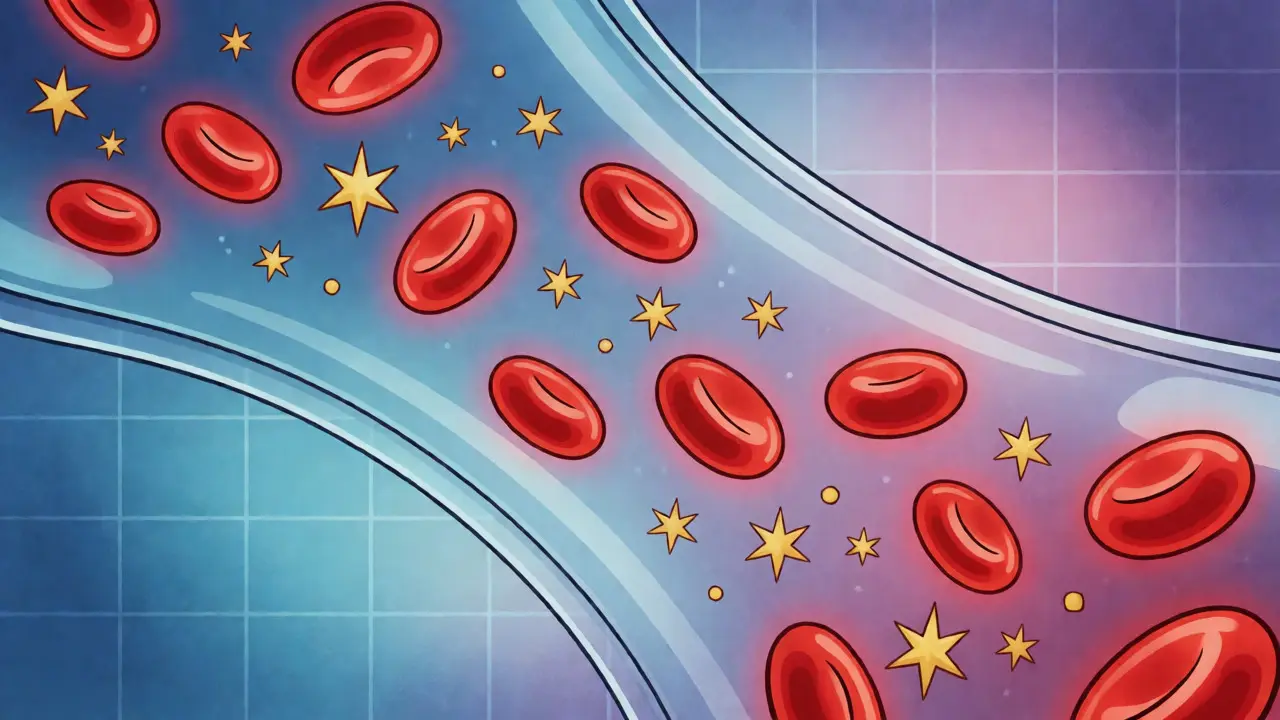
To understand why this matters, you have to look at what’s happening inside your blood vessels. Warfarin works by blocking an enzyme called VKORC1, which your body needs to activate Vitamin K. Without active Vitamin K, your liver can’t produce enough clotting factors II, VII, IX, and X. This slows down blood clotting, which is exactly what we want if you’re at risk for dangerous clots from conditions like atrial fibrillation or mechanical heart valves.
But here’s the catch: Vitamin K is found abundantly in nature, especially in dark green leaves. If you suddenly eat a massive bowl of spinach after weeks of eating iceberg lettuce, you flood your system with Vitamin K. This counteracts the Warfarin, making your blood clot faster than intended. Your International Normalized Ratio (INR)-the number doctors use to measure how thin your blood is-drops. A lower INR means higher risk of a stroke or clot. Conversely, if you stop eating greens abruptly, your INR spikes, increasing bleeding risk. The goal isn't to eliminate Vitamin K; it's to keep your supply line steady so the medication dosage remains effective.
Why "Avoidance" Is Outdated Advice
For years, patients were told to steer clear of high-vitamin K foods. This led to poor nutrition and miserable diets. Think about it: leafy greens are packed with fiber, antioxidants, and essential minerals. Cutting them out doesn't just remove Vitamin K; it removes health benefits. Research confirms that strict avoidance often leads to worse outcomes because patients struggle to maintain such a restrictive diet long-term.
A 2024 NIH study specifically looked at spinach consumption among Warfarin patients. The conclusion? Patients could safely include spinach in their daily meals, provided they didn't exceed 100 grams per day and kept that portion consistent. This validates what many dietitians have argued for years: rigid prohibition is unnecessary and potentially harmful. Joan Salge Blake, a registered dietitian at Boston University, emphasizes that the key to preventing fluctuations is maintaining a consistent intake, not eliminating the food group.
Vitamin K Content: Know Your Greens
Not all greens are created equal. Some are vitamin bombs, while others are relatively safe. Understanding these differences helps you plan meals without fear. For context, the recommended daily allowance (RDA) for Vitamin K is 120 micrograms for men and 90 micrograms for women. However, when you're on Warfarin, your target isn't just the RDA; it's consistency around a specific baseline set by your doctor.
| Vegetable | Approximate Vitamin K (mcg) | Serving Size | Impact Level |
|---|---|---|---|
| Spinach | 889 mcg | 1 cup cooked | Very High |
| Collard Greens | 772 mcg | 1 cup cooked | Very High |
| Kale | 547 mcg | 1 cup cooked | High |
| Broccoli | 220 mcg | 1 cup cooked | Moderate |
| Lettuce (Iceberg) | <10 mcg | 1 cup raw | Low |
Notice the huge gap between spinach and iceberg lettuce. One cup of cooked spinach provides nearly ten times the daily requirement for women. That’s why a sudden switch from a low-K diet to a spinach-heavy one can wreck your INR levels within 3-5 days. But if you eat that same cup of spinach every single day, your body adapts, and your Warfarin dose can be adjusted to match that steady input.
Practical Tips for Keeping Your INR Stable
So, how do you actually implement "consistency" in real life? It doesn't mean eating the exact same meal every day. It means keeping your weekly average of Vitamin K stable. Here are some actionable strategies:
- Pick a Baseline: Decide on a reasonable amount of high-Vitamin K veggies you enjoy. Maybe it's half a cup of broccoli with dinner four times a week. Stick to that pattern.
- Swap Smartly: If you want variety, swap high-K veggies for other high-K veggies rather than mixing high and low randomly. For example, rotate between kale and collard greens instead of switching from kale to carrots.
- Watch Hidden Sources: Vitamin K isn't just in salads. It's in vegetable oils (soybean, canola), certain supplements, and even some multivitamins. Check labels carefully.
- Be Careful with Supplements: Avoid St. John's Wort, Ginkgo Biloba, and high-dose fish oil unless cleared by your doctor, as these can interact with Warfarin independently of Vitamin K.
If you travel or have a holiday feast where your diet changes drastically, let your healthcare provider know. They might temporarily adjust your dose or ask for an extra INR check. Remember, minor variations are okay. The goal is to avoid big swings.
Warfarin vs. Newer Blood Thinners
You might wonder why you're still dealing with this dietary hassle when newer drugs exist. Direct Oral Anticoagulants (DOACs) like Eliquis (apixaban) or Xarelto (rivaroxaban) don't require INR monitoring or strict Vitamin K limits. So why stick with Warfarin?
Cost and specific medical conditions are the main reasons. Warfarin costs roughly $4-$10 a month, whereas branded DOACs can run $500-$600. For many patients, this price difference is decisive. Additionally, Warfarin remains the gold standard for patients with mechanical heart valves, particularly in the mitral position, where DOACs are contraindicated. It is also preferred for those with severe kidney impairment. If you fall into these categories, mastering the Vitamin K balance is part of the deal.
What Happens If You Slip Up?
Life happens. You go to a barbecue and eat a giant plate of coleslaw. Panic sets in. Don't worry. One off-day rarely causes catastrophic failure. The danger lies in sustained inconsistency. If you notice your urine looks different or you feel unusually bruised, contact your clinic. More importantly, tell your pharmacist or doctor about significant dietary changes before your next INR test. Context helps them interpret your numbers accurately.
Some patients find digital tracking tools helpful. A recent study from the University of Iowa suggested that using apps to log Vitamin K intake reduced INR variability by 27% compared to standard counseling alone. If you struggle with estimation, try weighing your greens for a few weeks until you get a feel for portion sizes.
Frequently Asked Questions
Can I eat spinach if I take Warfarin?
Yes, you can. Recent studies confirm that consuming up to 100g of spinach daily is safe for Warfarin patients, provided the portion size remains consistent day-to-day. The key is regularity, not elimination.
Does cooking affect Vitamin K content in vegetables?
Cooking concentrates Vitamin K per cup because water evaporates and volume decreases. For example, one cup of raw spinach has much less Vitamin K than one cup of cooked spinach. Always track the form (raw vs. cooked) you usually consume to maintain accuracy.
What should I do if my diet changes unexpectedly?
If you anticipate a significant change in Vitamin K intake, such as during a holiday or vacation, inform your healthcare provider. They may recommend an interim INR test or a temporary dose adjustment to prevent your levels from drifting outside the therapeutic range.
Are there any vegetables I should completely avoid?
No vegetable needs to be completely avoided solely due to Vitamin K content. Even high-K foods like kale and Brussels sprouts are acceptable if eaten consistently. Focus on managing portion sizes rather than banning specific foods.
How quickly does Vitamin K affect my INR?
Changes in Vitamin K intake can impact your INR within 3 to 5 days. A sudden increase in Vitamin K typically lowers INR (increasing clot risk), while a decrease raises INR (increasing bleeding risk). This delay is why consistent monitoring is crucial.

fred eden
Oh man, this hit home for me! 🥗 I used to be so scared of my salad bowl that I basically lived on icebergs and chicken. It’s such a relief to know that consistency is the real key instead of total avoidance. My INR was all over the place because I’d go weeks without greens then binge on kale smoothies. 😭 Now I just try to keep it steady and honestly? I feel way better and less anxious about dinner. Thank you for sharing this! ❤️

Pearl Richardson
The narrative presented here is suspiciously convenient for pharmaceutical conglomerates pushing Warfarin despite its archaic nature.
While the JAMA study from 1956 is cited, one must question who funded the modern 'consistency' guidelines promoted by the NIH. Are we truly being told what is medically optimal, or are we being managed into cheaper, older treatments to save insurance costs while ignoring the superior safety profiles of DOACs? The emphasis on 'tracking apps' feels like surveillance capitalism creeping into our biological rhythms. We are not just patients; we are data points in a larger experiment of cost containment. 🕵️♀️📉

larry williams
I want to gently encourage anyone reading this who might feel overwhelmed by the idea of tracking their vitamin intake. It is completely understandable to feel a bit lost when your relationship with food suddenly becomes a medical calculation. Please remember that you are doing a wonderful job simply by showing up to learn more about your health. You do not need to be perfect every single day; you just need to be consistent enough to help your body find its rhythm. If you slip up, as life inevitably happens, give yourself grace and know that your healthcare team is there to support you through the adjustments. Your effort matters, and you are capable of mastering this balance at your own pace. 💪🌱

Stephen Horn
It is frankly disappointing to see such simplistic advice circulated among the general populace. The notion that 'consistency beats avoidance' ignores the complex pharmacokinetics involved in VKORC1 polymorphisms which vary drastically across ethnic groups. To suggest that a simple dietary baseline can account for genetic variability is intellectually lazy. Furthermore, the comparison to DOACs fails to acknowledge the nuanced bleeding risks associated with renal clearance issues which are often poorly managed in primary care settings. One must possess a certain level of scientific literacy to understand why Warfarin remains relevant beyond mere cost considerations, yet this article panders to the lowest common denominator of patient understanding. 🧐📚

Gurjit Singh
This is moral clarity in medicine. We have been misled by convenience culture into thinking we can ignore the natural order of nutrients. Vitamin K is essential for life, not an enemy to be avoided. The error lies in the modern habit of erratic eating patterns, not in the vegetables themselves. We must return to discipline. Consistency is not just a medical tip; it is a virtue. Those who fail to maintain regularity in their diet deserve the fluctuations they experience. There is no excuse for laziness in managing one's health. Discipline brings stability. Stability brings health. This is basic truth.

hareesh kumar
Wait hold on are we sure the studies aren't biased?? Like seriously think about it. Who profits if we eat more spinach?? The agribusiness lobby!! They want us eating those dark leafy greens to keep demand high. And the doctors?? They probably get kickbacks from the supplement companies selling 'Warfarin-safe' multivitamins that have hidden Vit K in them. I read somewhere that iceberg lettuce is actually a conspiracy to keep people deficient so they buy pills. It’s all rigged. The system is designed to keep us confused and buying products. Don’t believe everything you read even if it says JAMA. Follow the money. Always follow the money. 🤯💸🥬

Venkatesan V.K.
Lazy analysis. The article glosses over the critical distinction between phylloquinone (K1) and menaquinone (K2). Focusing solely on green vegetables ignores the significant contribution of fermented foods and gut bacteria to Vitamin K status. A patient eating consistent spinach but varying their yogurt intake will still see INR swings. The author fails to address this complexity, offering a shallow solution to a deep problem. It is exhausting to read such superficial content.

Marc-David Mayer
Hey everyone! Just wanted to add that finding a routine that works for YOU is the most important part. 🌟 Some people find meal prepping helps a ton with consistency. Start small, maybe just track one vegetable type for a week and see how it goes. You've got this! Don't let the fear stop you from enjoying healthy food. Stay positive and keep communicating with your doctor. You're doing great! 👍🥦

Stuart Lorne
this is obvious stuff really. everyone knows you cant just eat random amounts of kale. its not rocket science. i mean did we really need a whole article for this? feels like padding. also why does no one talk about the taste of collard greens being awful unless you drown them in grease. anyway good luck with your blood tests i guess. 🙄

Anderson Miller
Ah, yes, the eternal dance between the liver, the enzyme, and the leafy green. How poetic. It is almost philosophical, isn't it? We seek control over our internal chemistry, yet we are beholden to the whims of a salad. The irony is palpable. We count micrograms like misers counting coins, hoping the bank doesn't close. But hey, if it keeps the heart beating and the brain unclotted, perhaps the absurdity is worth the price. Or perhaps we are just spinning wheels in a hamster wheel made of broccoli. 🎭🔄

Kimberly Thomas
Your entire premise is flawed. You assume patients have the cognitive capacity or financial means to weigh every gram of spinach. Most people are barely surviving financially. Telling them to 'track' their intake is elitist nonsense. Also, you ignored the interaction with antibiotics which messes up gut flora and thus Vitamin K production regardless of diet. This article is useless for the average person. Stop pretending this is easy.
Write a comment