Recent POST


When you fill a prescription, you might not think about whether you’re getting the brand-name drug or the generic version. But behind the scenes, state governments are actively pushing pharmacists and doctors to choose generics - not because they’re less effective, but because they’re cheaper. And it’s working. In 2025, nearly every state has some kind of policy in place to make generic drugs the default choice. These aren’t random rules. They’re carefully designed financial and legal incentives meant to save billions in public and private healthcare spending.
How States Push for Generic Drugs
States don’t force doctors to write only generic prescriptions. Instead, they make it easier - and cheaper - for patients and providers to choose them. The most common tool? Preferred Drug Lists (PDLs). These are lists of medications that Medicaid and other state-run programs prefer because they’re cost-effective. If a doctor prescribes a drug that’s not on the list, the patient often pays more out of pocket, or the prescriber has to jump through hoops to get approval. As of 2019, 46 out of 50 states had PDLs for their Medicaid programs. Twenty states review these lists every year. Ten do it quarterly. That means the lists aren’t static. They’re updated based on new data, price changes, and whether a generic version just hit the market. If a brand-name drug drops its price dramatically, it might get added to the list. If a generic becomes available and costs 80% less, the brand-name version gets bumped off.Why Copayments Matter More Than You Think
One of the most powerful levers states use is the difference in patient copayments. Let’s say you need a blood pressure medication. The brand-name version costs $40 with a $20 copay. The generic? Same effectiveness, same side effects, but a $5 copay. Which one are you more likely to pick? The answer is obvious - unless you’re told otherwise. States have been increasing this gap for years. In the late 1990s, the difference between brand and generic copays was small. Now, it’s common to see $15-$30 differences. That’s not an accident. Research from the National Institutes of Health found that when patients pay more for brand-name drugs, they switch to generics - and they do it fast. In fact, the effect of a $3 higher copay for a brand drug is about the same as a presumed consent substitution law. That means changing what patients pay at the counter can be just as powerful as changing how pharmacists operate.Pharmacist Substitution: Presumed Consent vs. Explicit Consent
Here’s where things get interesting. In most states, when a doctor writes a prescription for a brand-name drug, the pharmacist can legally swap it for the generic - unless the doctor says “do not substitute.” That’s called presumed consent. In 11 states, the pharmacist has to ask you first. That’s explicit consent. The difference? Huge. A 2018 NIH study showed that states with presumed consent laws saw a 3.2 percentage point increase in generic dispensing compared to states requiring patient permission. That might sound small, but it adds up. If all 39 explicit consent states switched to presumed consent, they could save $51 billion a year in drug spending. That’s not theoretical. It’s a real number based on actual prescription data. Why does this work? Because pharmacists are already incentivized to dispense generics - they make more profit on them. But when they have to ask you, you might say no. You might think, “My doctor prescribed this brand. It must be better.” You don’t know that generics are required by the FDA to be just as safe and effective. Presumed consent removes that barrier.The Medicaid Rebate System: The Hidden Engine
None of this would work without the Medicaid Drug Rebate Program. Created in 1990, this federal program forces drugmakers to give states a discount on every prescription filled through Medicaid. For generics, the minimum rebate is 13% of the average manufacturer price. But here’s the kicker: most states negotiate even bigger discounts. As of 2019, 46 states had supplemental rebate agreements with generic manufacturers - meaning they paid even less than the federal minimum. These deals are secret, but they’re critical. Without them, the cost savings from generics wouldn’t be enough to justify the administrative work of managing PDLs or copay differentials. States also use Maximum Allowable Cost (MAC) lists. These set the highest price a pharmacy can be reimbursed for a generic drug. If a pharmacy tries to bill $15 for a generic that the MAC says is worth $8, they only get $8. This keeps prices down and prevents pharmacies from charging more than the market allows.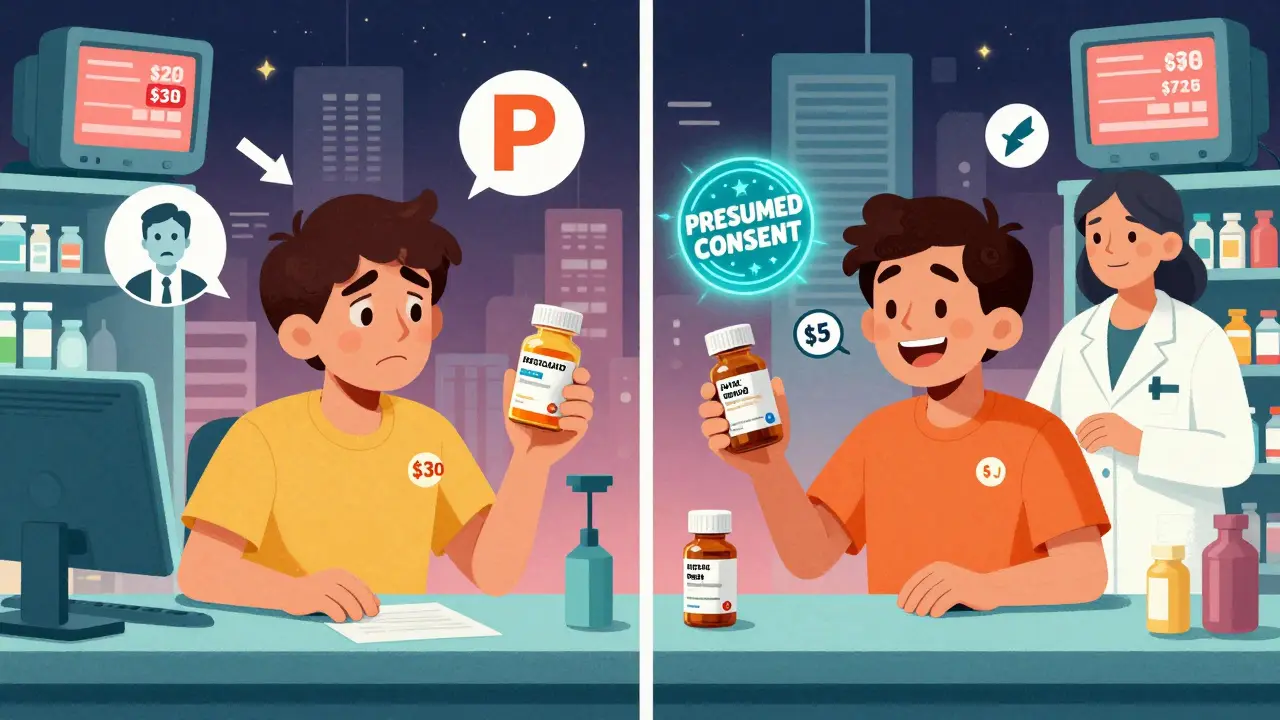
What Doesn’t Work: Mandatory Substitution Laws
You might think that forcing pharmacists to substitute generics every time would be the most effective strategy. But it’s not. A 2018 study found that mandatory substitution laws - where pharmacists must swap generics regardless of patient or doctor preference - had no measurable impact on dispensing rates. Why? Because pharmacists were already substituting anyway. They made more money on generics. They had less paperwork. They didn’t need a law to tell them what to do. The real problem wasn’t pharmacist behavior - it was patient perception and doctor habits. That’s why policies that target patients (copays) or remove friction (presumed consent) work better than rules that target pharmacists.The 340B Program: A Double-Edged Sword
The 340B Drug Pricing Program lets safety-net hospitals and clinics buy drugs at steep discounts - often 20% to 50% off. These savings help serve low-income patients. But here’s the catch: when these clinics use Medicaid to pay for 340B drugs, states have to reimburse them based on the 340B ceiling price, not the usual reimbursement rate. That created a mess. Some states were paying more than the actual cost of the drug. Others were paying less. In 2016, CMS stepped in and said: “No more. Reimbursement can’t exceed the 340B ceiling price.” That change forced states to rework their payment systems. It also made it harder for clinics to use expensive brand-name drugs, pushing them toward cheaper generics - even if they weren’t on the PDL.Why Generic Use Is Rising - But Spending Isn’t Falling
You’d think more generic use means lower drug spending. And it should. But it doesn’t always. From 1993 to 1998, generic prescriptions jumped from 33% to 45%. That’s a big win. But total spending on drugs kept rising - because new brand-name drugs were coming out at $10,000, $20,000, even $50,000 a year. One expensive new drug can wipe out the savings from thousands of cheap generics. That’s why states can’t just rely on promoting generics. They also need to control the prices of new drugs. Some are starting to. A few states now use “value-based” pricing, where they pay more for drugs that deliver better outcomes. But most still focus on the low-hanging fruit: generics.
The Future: The Medicare Drug List
The federal government is watching. In 2023, CMS started developing the Medicare $2 Drug List - a plan to make certain low-cost generics available for just $2 a month to Medicare Part D enrollees. It’s voluntary, but if it works, it could become a national model. States are already using similar ideas. If a generic drug costs less than $10, some states cap the copay at $5. Others have “$0 copay for generics” programs for chronic conditions like diabetes or high blood pressure. The Medicare $2 model could push more states to adopt even simpler rules: if it’s a generic, and it’s cheap, the patient pays almost nothing.What’s at Risk: Generic Manufacturers Leaving Medicaid
There’s a dark side. Generic drugmakers aren’t always happy with how Medicaid works. The program requires them to pay inflation rebates - meaning if a drug’s price goes up even slightly, they owe the state more money. But here’s the problem: sometimes, the price doesn’t go up. The cost of ingredients does. Or there’s a shortage. Or the drug is old and no one’s buying much of it anymore. Avalere Health found five scenarios where generic manufacturers end up paying rebates even though they didn’t raise prices. In those cases, they lose money. And when they lose money, they stop making the drug. Or they quit selling it to Medicaid altogether. That’s a real threat. If a state saves $10 million by pushing a generic, but the manufacturer stops making it, the state ends up with no supply - and no savings. That’s why some experts warn that pushing too hard on rebates could backfire. The goal isn’t just to cut costs today. It’s to keep generics available tomorrow.What Works Best - And What Doesn’t
Let’s cut through the noise. Based on data from 2019 to 2025, here’s what actually moves the needle:- Works great: Presumed consent laws, copay differentials ($15+ gap), Preferred Drug Lists with annual reviews, MAC lists, supplemental Medicaid rebates.
- Doesn’t work: Mandatory substitution laws, provider-only education campaigns, penalties on pharmacists for dispensing brands.
- Emerging: $2 or $5 generic copay programs, value-based pricing for new drugs, federal models like the Medicare $2 Drug List.
What You Can Do
If you’re on Medicaid, Medicare Part D, or even a private plan with a formulary, ask your pharmacist: “Is there a generic version?” Don’t assume the brand is better. It’s not. Ask your doctor: “Can we try the generic?” Most will say yes. If you’re paying $30 for a brand-name drug that has a $5 generic, you’re not saving money - you’re paying extra. You’re also helping your state’s program work better. More generic use means lower premiums for everyone. Generic drugs aren’t a loophole. They’re the law of economics. And when states design smart incentives, they save billions - without sacrificing care.Are generic drugs really as good as brand-name drugs?
Yes. The FDA requires generic drugs to have the same active ingredient, strength, dosage form, and route of administration as the brand-name version. They must also meet the same strict standards for purity, stability, and performance. The only differences are in inactive ingredients - like fillers or dyes - which don’t affect how the drug works. Studies consistently show generics perform just as well as brands in real-world use.
Why do some doctors still prescribe brand-name drugs?
Sometimes it’s habit. Other times, they believe - incorrectly - that a brand is more reliable. In rare cases, a patient may have had a reaction to a specific generic manufacturer’s version, and the doctor notes “dispense as written” to avoid recurrence. But for over 90% of medications, there’s no medical reason to avoid the generic. Most doctors will switch if asked.
Can I be forced to take a generic drug?
No - but you might pay more if you don’t. Most states allow you to request the brand-name drug, even if it’s not on the preferred list. But you’ll likely pay the full difference between the brand and generic price. For example, if the brand costs $80 and the generic $10, you might pay $70 out of pocket. That’s not a ban - it’s a financial nudge.
Why do some generic drugs cost more than others?
Generic drugs aren’t all the same price. Multiple companies can make the same drug, and competition drives prices down. But if only one company makes it, or if there’s a shortage, the price can spike. That’s why states use Maximum Allowable Cost (MAC) lists - to cap what they’ll pay and prevent price gouging.
Do generic prescribing incentives reduce overall healthcare costs?
Yes - but only if the savings aren’t eaten up by new, expensive drugs. Generic use has saved states over $200 billion since 2000. But total drug spending keeps rising because new specialty drugs cost $100,000+ per year. Generic incentives work best when paired with policies that control the prices of those high-cost drugs. Alone, they slow the growth of spending - not reverse it.

Dave Alponvyr
Generic drugs work just fine. I’ve been taking them for years. Saved me hundreds.

Joanna Ebizie
Oh please. You think the FDA really checks these generics? My cousin got a bad batch that made her dizzy for weeks. They’re all made in China now anyway. Who even knows what’s in them?

Arun ana
This is actually super interesting! 🙌 I work in pharma in India and we make a ton of generics. The quality control is strict, and it’s amazing how much this saves people. More states should do this! 🌍💙

Ron Williams
Been on Medicaid for 8 years. The copay difference is the real game-changer. I used to get the brand, then switched when my copay jumped from $10 to $30. Didn’t even notice a difference in how I felt. Smart policy.

Randolph Rickman
People are scared of generics because they don’t understand them. It’s not about trust in science - it’s about trust in the system. When you explain that the FDA requires the same active ingredient, same absorption rate, same everything - people relax. Education matters.

Dylan Smith
Wait so if I’m in a state with explicit consent and I don’t know any better, I’m paying more for nothing? That’s not fair. They’re literally the same pill. Why do we need to ask permission to save money? This feels like corporate manipulation

Mike Smith
It’s important to recognize that these policies are not about restricting choice - they’re about aligning incentives. Patients aren’t being forced; they’re being guided toward the most cost-effective option. And when that option is equally effective, why wouldn’t we? This is public health engineering at its finest.

Colleen Bigelow
Let’s be real - this is all part of the government’s plan to control us. First they push generics, then they’ll push mandatory vaccines, then they’ll track your meds through your phone. Big Pharma and the FDA are in bed together. You think they care about your health? They care about control. And the rebates? That’s just money laundering disguised as policy.

Billy Poling
The empirical evidence is unequivocal. The implementation of preferred drug lists, coupled with differential copayment structures and presumed consent substitution statutes, has demonstrably increased the rate of generic dispensing without compromising clinical outcomes. The economic impact is substantial, with state Medicaid programs realizing savings in the billions annually, while simultaneously maintaining therapeutic equivalence. Furthermore, the Maximum Allowable Cost mechanisms serve as a critical bulwark against price inflation by generic manufacturers, ensuring fiscal sustainability. It is therefore both fiscally prudent and clinically responsible to expand these models, particularly in light of the demonstrable inefficacy of mandatory substitution mandates, which fail to account for patient autonomy and provider discretion.

Kayleigh Campbell
So we’re spending billions to convince people to take the same pill with a different label? And the real villain is the patient who thinks brand = better? Wow. We’ve turned healthcare into a behavioral economics experiment. Someone get me a snack and a reality check.

Kitty Price
My grandma takes 7 generics. She says they work better than the brands because they don’t make her feel weird. She’s 82 and still walks 3 miles a day. 🌿

Elizabeth Bauman
China and India are making our meds now? That’s not just a trade issue - it’s a national security threat. If they cut off supply, we’re all screwed. Why aren’t we building our own generic factories? This is how countries lose their sovereignty. We need to bring this back to America - now.

SHAMSHEER SHAIKH
As someone who has worked in the pharmaceutical supply chain across multiple continents, I can confirm that the quality of generic drugs manufactured under regulated conditions - whether in the U.S., India, or Germany - is rigorously maintained. The notion that generics are inferior is a myth perpetuated by marketing, not science. States that implement these policies are not just saving money - they are upholding the ethical obligation to provide equitable access to essential medicines. Let us not confuse affordability with inferiority.

Hadi Santoso
my doc gave me a brand name bc i asked and i paid $45. then i went to the pharmacy and they said ‘hey this generic is $5’ so i switched. no one told me i could’ve done that. so dumb. why don’t pharmacists just tell people this stuff?

sue spark
my sister has diabetes and her insulin generic saved her from choosing between meds and rent. i wish more people knew this stuff. it’s not magic. it’s just math and compassion
Write a comment